By Dave McCracken General Manager

Dave Mack


There were 11 of us involved with this particular Week-long Dredging Project. Our team included Craig Colt, Jason and Andrew Inks as individual dredge supervisors, and Otto Gaither as the Project’s shore boss. Over time, we have found that our dredging projects go a lot better when we have an experienced operator supervising each dredge, along with a shore boss that looks after all of the ongoing support needs on the river and in the camp. This leaves me free to work with beginners, coordinate the sampling program, and then push production forward as soon as we locate some high-grade gold.

Craig Colt and I had invested some time the week before, working out where we would launch this Project. New strikes are being made by active members of The New 49’ers all the time along the Club’s extensive mining properties. We pay very close attention to this; because once someone establishes the existence of high-grade in a section of river, it opens up a whole new perspective on where we are likely to discover more high-grade within the immediate area.

We have worked out a sampling program in these Projects that always works. So, how much gold we are going to recover basically comes back to how good the area is where we decide to launch the project in the first place. There is always some risk, though. This is because we never really know how much gold is present until the work is done.

There is not enough time in a week to change our minds and start all over again in a whole new area. So we must choose our area with care. In choosing an area, Craig and I must balance the desire for uncovering rich high-grade gold, with the risk of maybe not finding any high-grade at all. Finding nothing is the nightmare that we have managed to avoid on every project so far. We want to keep it that way!

After weighing all the options, Craig and I decided we were going to launch this Project into the lower-end of K-14. This is an area on the Klamath River just upstream from Portuguese Creek. That is about 20 miles upriver from Happy Camp. There were 2 very serious high-grade discoveries in there a few years ago. Several members were recovering ounces and ounces of nuggets along a bedrock shelf on the edge of the Highway-96 side of the river. They were using 5-inch dredges, although the work could have easily been done with 3-inch dredges, because the water and material were very shallow. Several other members were dredging a rich fine and flake-gold pay-streak using an 8-inch dredge from the far side of the river. But we never saw anyone work the river in the middle, between the two pay-streaks. Craig and I swam that section of the river with mask & snorkel, doing a thorough survey of the bottom. It looked good!

We work hard to prepare in advance for each of these Group Mining Projects. To get a head start, we launched the 8-inch dredge well in advance. This is the piece of equipment which takes the most time to set up. Our dredge supervisors and shore boss went through all our gear several days in advance. We bought all the supplies and fuel necessary to get us through the week. Everything was ready to go!

Then, the day before we were to begin, an oil tanker truck was involved in an accident about 25 miles upstream of our intended project site, and spilled some unknown amount of chemical substance into the river. This prompted the local authorities to issue a heath advisory, telling swimmers and rafters that they should avoid going into the river downstream of the spill.

So there went another perfectly good (great) mining plan! Although we will probably resurrect it during his next season, if nobody else beats us into that location.
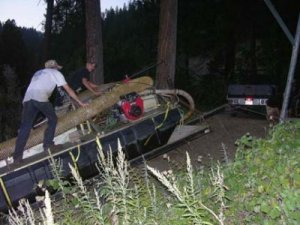
All of this created somewhat of an emergency situation where our dredge supervisors and I found ourselves down on the river after dark on the night before the project, using two winches to pull our 8-inch dredge out of the river, up the side of a rather steep embankment, and onto the road. We needed to do this to keep from losing the first full day of the project!

Saturday morning found us back in Happy Camp, doing orientation and planning with all of our team partners in this Project. Everybody adjusted quickly to the news that we were going to go back up to UK-3. We coordinated a plan to get all the gear and camping outfits moved up to the Club’s camping location near the UK-Claims. Most of us drove up there in a long parade of trailered dredges and RV’s. That was really something to see!

After allowing everyone a while to set up camp on Saturday afternoon, we all drove down to look over our options along the UK-claims. We had to figure out where we were going to launch this project. Since we were starting this process over again right from the beginning, I took the time to explain everything important that I already knew about these claims along the upper Klamath River; where other members had already made high-grade discoveries, and where I believed the best opportunities were located.

It didn’t take us long to decide that we would drop back behind where we had done a very successful dredging project last year. Lee Kracher and his family had also operated several dredges in the same area the year before, and they had recovered a lot of gold. Our plan was to drop back just behind where they had been dredging. As good as they had done, it seemed reasonable that we would find something good just downriver.

So we devoted the remaining part of the first day launching a 5-inch, 6-inch and an 8-inch dredge into the river. Getting the 8-incher in required us to winch the dredge (using a trailer) down an embankment. This was a bit of a challenge, but we worked it all out pretty fast. Years ago, we mounted an electric winch in the back of a truck that we rigged up to support these mining programs. That winching system helps us gain access (with dredges and boats) to some of the more remote areas of the river. Being able to get your gear in and out of difficult areas without much trouble increases your sampling options!
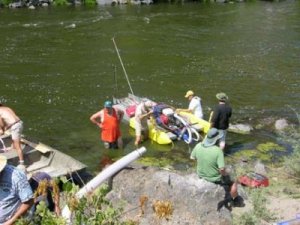
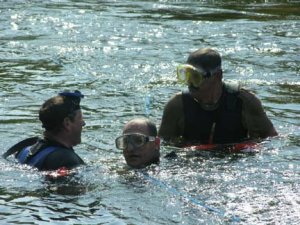
  

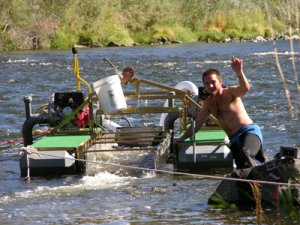
The second day found our entire team getting started down on the river. We split the crew into three teams. The most experienced guys joined Craig on the 8-inch dredge. Those with some previous experience teamed up with Jason on the 6-inch dredge. Andrew and I planned to work with beginners on the 5-inch dredge for the first few days over in the shallow part of the river.

While these Dredging Projects are not classes or training events, it still remains necessary for us to show participants how to do the things that they need to do to contribute to the forward motion of the mining program. Some participants do not want to go underwater. Although, I will say that many change their minds about this when they see how fast other beginners take to it. For those who will support the program from the surface, we take the necessary time to show them how to do that part of the job. In this way, it does not take very long for helpers on the surface to become a strong and important part of the program

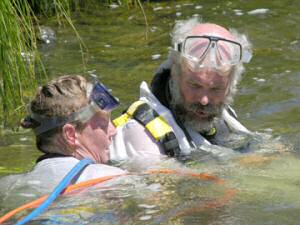
We also take the necessary time to help beginners through the early stages of getting themselves underwater. Doing this requires shallow water where we can help participants to get accustomed to the underwater environment in a location which is shallow enough that a person can lift his or her head out of the water anytime it feels necessary. This removes most of the immediate fear of drowning, so that the person can better-focus on the skills involved.
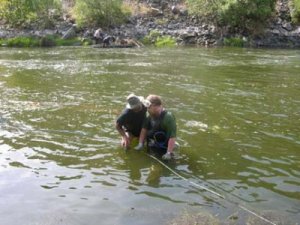
Every human being has a basic fear of the water. Some of us don’t feel that fear until some panic situation arises. For others, intense fear can be energized at just the thought of putting your head underwater. This is actually pretty normal. Through long experience, we have discovered that the key to helping someone through this is by beginning with some activity that the person is comfortable with. This might start with just sitting down along the edge of the river and getting comfortable breathing through the hookah regulator. Then, in a step-by-step process, just allowing the person some personal time to become comfortable with each step along the way, we will soon have the person breathing from the hookah regulator in shallow water. The rest is easy.

The main purpose for helping beginners to get comfortably through these first stages is that they will soon become very productive partners on the dredging program. By mid-way through the week on these projects, most beginners are already playing an important roll in the team effort to locate and recover high-grade gold.

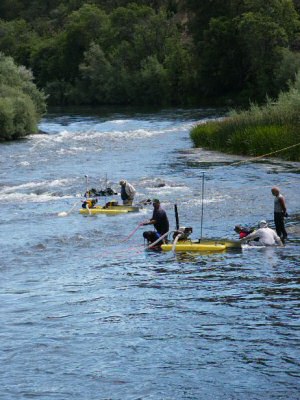
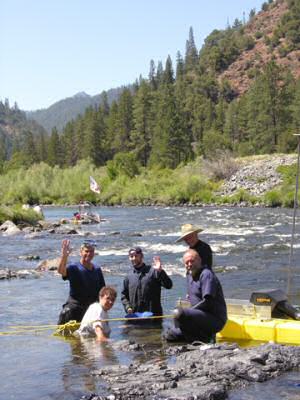
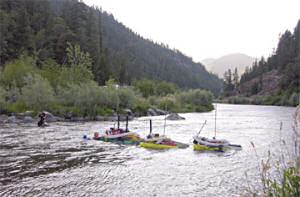
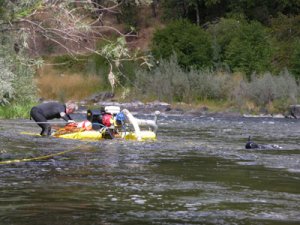
We used a small boat and outboard motor to move dredges around during this project. This saves us time in swimming ropes across the river and pulling gear and supplies across. With the boat, we just hook onto the dredge and pull it anywhere we want to go. Sometimes, we put the dredge’s suction nozzle in the boat and just drag the dredge around backwards by the suction hose. This allows us to quickly reposition the dredges in an ongoing sampling plan without having to waste valuable time and energy in disconnecting and reconnecting the suction hoses every time the dredges are moved. All of this adds up to more productive activity.
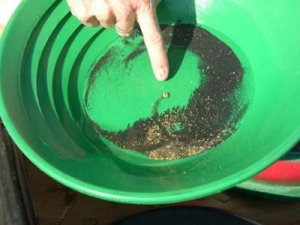
Otto captured the following video sequences as we were using the boat to move our dredges around:

Craig’s crew wasted no time in setting up the 8-inch dredge on the far side of the river. Their first test hole was put down into high-grade gold not far off the stream bank. The streambed material over there was less than 3 feet on top of some rough bedrock. Those

guys came up hooping & hollering after the very first dive! I remember thinking, “Wow, this is going to be an easy week!”When I went over to take a look, they already had a good showing of gold in their pan for just the little work they had done! So I encouraged Craig’s team to drop the 8-inch dredge further downstream to see if they could pick up an extension of the high-grade.
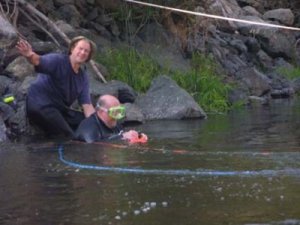
Jason and his team set up the 6-inch dredge on the Klamathon Road-side of the river. Jason then went out into the river on an extended airline to do an underwater survey. This is a drill where we attach 2 airlines together so the person can get out as much as 90 or 100 feet into the river away from the dredge. While the dredge is operating at idle (to provide air to the diver), with his lead weights on, Jason crawled out to take a good look at the river-bottom in the area where we wanted to get a good sample. Normally when we do this, we are looking for places where the bedrock is exposed along the bottom of the river. This allows us to target sample locations where we know that streambed depth will not extend beyond our reach. While crabbing around out there on the bottom, Jason found a place where someone else had already dredged a sample hole to the bedrock in about 5 feet of hard-packed streambed material. He and his team were lucky. They would have an opportunity to get a sample out there without having to dredge an entire sample hole from scratch. This saved them about a full day of work!
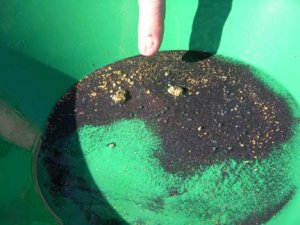
Like Craig’s crew on the other side of the river, Jason’s team was cheering their results by the end of our first day on the river. Except that Jason’s crew was finding nice gold nuggets! The following video sequence was captured as Jason’s team was just pulling the first nuggets from their sluice box:

Andrew and I were not recovering very much gold on the 5-inch dredge over near the edge of the river; but by the end of the first day, all of our beginners had progressed to spending some time dredging underwater. This was a good beginning!

It took another day before all of our beginners had graduated to the 6-inch dredge. This required us to move a few of Jason’s guys over to the 8-inch dredge. Consequently, both dredges could be operated in shifts all day long. After that, we just used the 5-inch dredge to provide extra air for the divers.
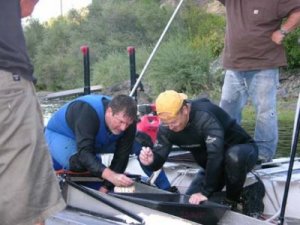
As often happens, the two dredging teams quickly evolved into some friendly competition. While it is nearly impossible for a 6-inch dredge to match the production (nearly double) of an 8-inch dredge, Jason’s team gave Craig’s team a good run for their money all week long. This was because the stronger line of beautiful nuggets was running down Jason’s side of the river. The following video sequence captured how much excitement was going around while we recovered all that beautiful gold:

There was a little frustration during the first few days on Craig’s dredge, because the pay-streak was not as rich when they dropped back and dredged another sample hole. It is always hard to drop back on a high-grade pay-streak. We do it to block-out a whole section of high-grade material in front of us. This is kind of like having money in a bank account! Otherwise, you can dredge forward and drop tailings all over the best gold!

Since several of the participants in this Project were planning to stay around for another week or two after we finished (using their own dredges to work the pay-streak), it seemed worth the effort to drop back and provide them with some good high-grade to dredge when our week together was over. It took about 3 sample holes for Craig’s team to work it all out. After that was accomplished, they were hooping & hollering on Craig’s dredge for the rest of the week.

Because the streambed material was deeper where Jason got started, we did not bother to drop the 6-inch dredge back on the pay-streak. That would have taken too much of our limited time. So there will be plenty more high-grade to go back to during the upcoming season. We will do another Project in there unless someone else beats us to it!!

This was kind of an unusual dredging Project, in that we were recovering nice gold from our first day of operating dredges on the river. More often, it takes us several days of progressive, coordinated sampling to walk our way into a rich pay-streak. Still, we had some interesting challenges to overcome in developing this gold deposit. The richest portion clearly was located in the middle of the river where the water-flow was stronger. There were some big rocks out there that we needed to roll back. All of this took a serious, coordinated effort. The following video sequences will give you the reality that these are serious mining projects where everyone on the team is usually tested:

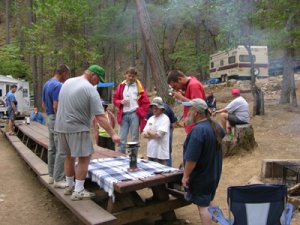
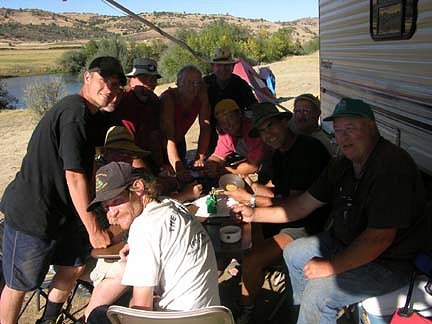
With all of the beginners integrated into the two production teams, and the friendly competition between the two dredges to find the most and best gold each day, this group evolved into a tight-knit team by mid-week. Nearly everyone was camped in the Club camping area located just up the road from where we were dredging. Evenings found us enjoying meals together over at Otto’s camp. We set up chairs near his barbeque, so we could enjoy the beautiful sunsets. There was a lot of excited conversation about the gold we were recovering – and the additional gold which must also be in that section of K-3. Otto is one of the best BBQ cooks I have ever met! He is always there with a friendly smile and helpful hand. So shared some nice, relaxing evenings after working hard on the river each day.
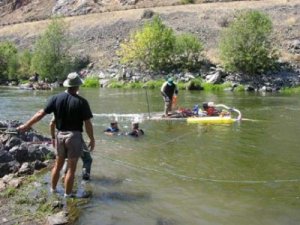
Our team was so grooved-in and organized by Thursday, that I found myself with nearly nothing to do. In fact, I was so bored, that I drank my whole thermos of coffee before noon, and had to go back to camp and brew up another pot! I am never comfortable just sitting around with nothing to do when there is productive activity going on all around me. Usually, on these Projects, there is an opportunity for me to take a short dive or two every day. I like to jump in and help with the sampling process. I like to jump in and operate the production dredge alongside a good support team that knows what to do. I get a big charge watching gold uncovered from a rich pay-streak!

But I found myself a spectator up in the boat on Thursday afternoon. There was no place for me on the dredges. This team had taken completely over. They knew exactly what to do to prevent any momentum from being lost. They had it together so well, that I couldn’t even make any suggestions how to improve things. So I resigned myself to work on my sun tan up in the boat, while sitting back proudly watching my team. These partners were so good, that if we went another day, we would have had to split-off a third team onto the 5-inch dredge just to make the most out of them.
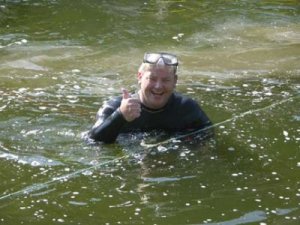
Just to give them all a good run for their money, on Thursday afternoon, I challenged anyone to dive in on a breath of air, swim out to the middle of the river, and walk the 6-inch suction hose to the bank against the strong pull of the river. This is quite a challenging task. Not having done much that day, I was hoping to demonstrate for everybody how it is done. But Andrew succeeded on his first try.

At camp that night, we all agreed that we would use the final day to remove our gear from the river and do a final gold clean-up. As our project site was far from any road access points where we could back a trailer down to the river, we would normally break down the dredges and pack individual components up the hill. But this crew was so geared-up by now, that we packed the entire dredges up to the road without breaking them down! It only took us a few hours to remove all of our gear from the river.

We also helped several of the participants to move their personal dredges down the hill, so they could pick up in the pay-streak right from where we left off on the project. Other members were also moving in to take up positions not far up and downstream from where we were working. Smart moves! There was a lot of excitement going around!
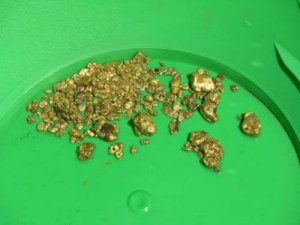
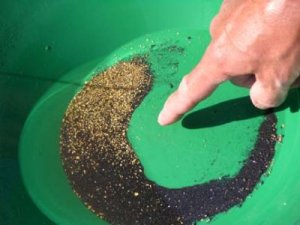
  

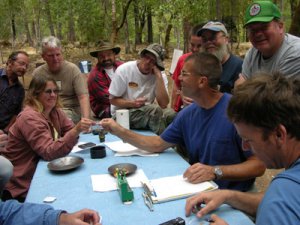
We accumulate our clean-ups all week inside of a 5-gallon bucket and save it all for the final day. It would subtract too much productive-time during the week if we were to perform a final clean-up every day. So we always allow the afternoon on Friday to do the final clean-up and split-off the gold evenly amongst all the participants. The following video sequences demonstrate that the final separation and gold-split are a fantastic way to end off on one of these projects. Receiving a split of the gold is a very satisfying acknowledgement for all of the hard work:

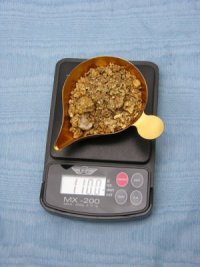
Friday afternoon found our entire crew doing the final clean-up process together up at camp. In all, we recovered 99.2 pennyweights (4.96 ounces) in beautiful gold, of which there were 27.9 pennyweights of nice nugget material. Each person received some of the nuggets. Everyone was happy with their individual shares. But I believe everyone was even more excited about the team experience and lasting friendships that we created on this project.
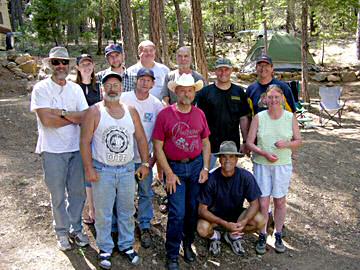
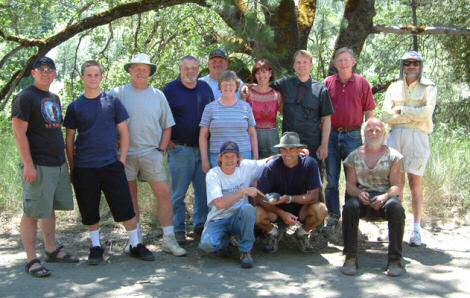
After doing a group photo, those of us that had to leave said our goodbyes and broke camp. The others stayed around to work the gold deposit. Other members were arriving just in time to take up our camping spots as we were pulling out.


By Dave McCracken

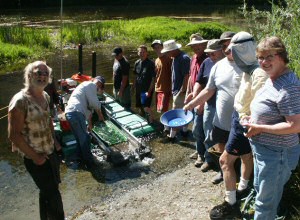
Week-long Group Dredging participants
Week-long Group Dredging participants join together for a group
picture at the Brown Bear Claim (K-6) after their final clean-up.

This Group Project took place on the Brown Bear claim along the Klamath River at K-6, around two miles upstream from Horse Creek, about 50 miles upriver from Happy Camp. There were thirteen participants (11 men and 2 woman), including myself and two helpers. Two of the participants were dredging for the first time ever, one who was uncomfortable going under water when we began the week.

Most of us put up in the campground at Brown Bear for the week. There is a USFS river access there, where non-fee camping areas have been developed. This made it nice and convenient after the long workdays during the project.

We chose Brown Bear for this project because it is a rather long claim that includes a lot of river diversity; slow, shallow areas, rapids, directional changes in the river, etc. New 49er members made a strike on this claim in the mid-90’s, so we already knew high-grade gold was traveling through this section of river. Having both new and advanced dredgers on a project allows us a lot of sampling options. I hoped that if we hit the area hard with enough sampling, we would find some rich new deposits.

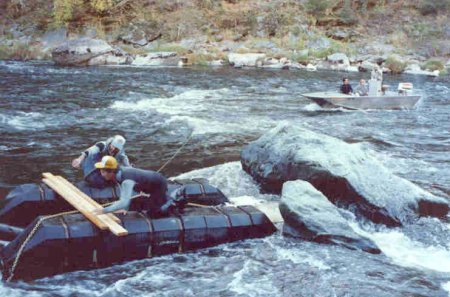
As we already knew where an earlier deposit had been located below a set of rapids, I directed our more experienced participants to position a 5-inch dredge out in the middle of the rapids and do a sample there. I know this sounds difficult, but there were big boulders out there blocking the river’s flow, creating big pools behind, where the dredge and divers were protected. The Klamath had dropped down to summer-low flow levels, so it was not that difficult. They dredged the hole down through about 4 feet of original grey Klamath River hard-pack (never been mined before by anyone) on the first day, and were recovering some nice sized flakes of gold.

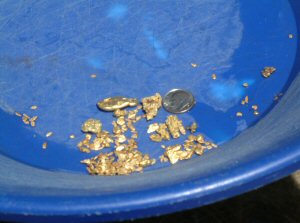
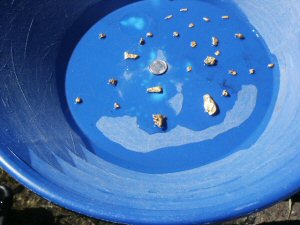
Nuggets found at Brown Bear
Everyone was really happy about the assortment of nuggets that were found.

Although it was nothing to get excited about yet, the big flakes were an encouraging sign that we were on the right track.

Sampling at Brown Bear
Sampling on the top of the Brown Bear claim in about two feet of water.

We used two 4-inch dredges during the first two days of the project to complete two other sample holes to bedrock on the far side of the river (away from the highway) across from our campground. These holes needed to be dredged, as we were looking for the common path that the high-grade gold is following in that section of the river. The pay-streak located downstream from there in the mid-90’s was also on the far side of the river. So it seemed like a reasonable bet that we might find some high-grade where we were sampling further upstream. Because the water was slow and shallow there, this was a good place to help our less-experienced and beginning participants get more comfortable underwater and guide them in the basics about how to operate a dredge, how to do things underwater and what to look for when prospecting. We were finding some beautiful hard-pack over there, and the bedrock had plenty of irregularities to trap gold. But by the end of the second day, we had determined the general path of high-grade gold was not traveling along the far side of the river.

The more-experienced guys had reached bedrock out in the middle of the river on the second day, and established that was where the high-grade is traveling through that section of river. They were recovering lots of nice flakes and some nuggets out there in about 4 1/2 feet of hard-packed grey material with some pretty large boulders. We were getting pretty excited about that.

We all worked as a team on the third day to clear a platform on the near bank, just under our campground, and set up the 12-ton winch. That took about half the day. The second half of the third day was invested into grooving-in participants how to operate the winch and coordinate as a team to pull big rocks out of the dredge hole. After a bit of trial and error, we had it down pretty well.

I always start feeling real proud when I can stand back and watch participants pull together to get the important work done which results in high-grade gold and nuggets being recovered from the river. In short order, they pulled enough boulders out of the hole to get a work area opened up.

Into the fourth day, over half the participants were venturing out to take shifts on the 5-inch dredge in the middle of the river. We were tightening up the winch cable from the bank to create a handhold so they could walk out there. It was working out pretty well, and the gold was adding up.

Flakes of Gold
Large and small flakes of gold started showing up in the 4-inch sluice boxes right away!

However, that was only one dredge producing gold for us. Not good enough! And, even though they were getting better at dredging, a number of the participants were still not comfortable going out into the middle of the Klamath River to dredge in a set of rapids.

Since the high-grade gold path is in the middle of the river in that section of the Klamath, we decided to move the two 4-inch dredges to the upper end of the claim where several directional changes (bends in the river) were likely

to place the gold deposits on one side or the other of the river. This was all taking place while a small team continued the dredging and winching program downriver, so the gold would be building up in our bucket.

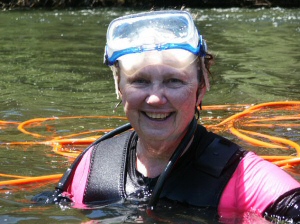
Peggy Derrick
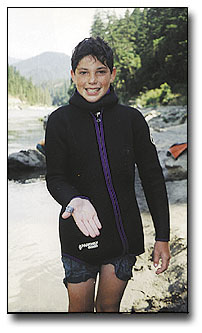
Peggy Derrick smiles after coming up from a dive.

By the end of the fourth day, we were sampling upriver using the two 4-inch dredges. Two of our more experienced teammates sampled the highway-side of the river, just downstream on the inside bend under a set of rapids. This was a textbook location to find a rich pay-streak, but they were finding loose streambed material that had apparently washed in there from winter storms. At the end of the day, they finally had to give up that sample hole, because the loose material was too much for the 4-inch dredge to make any meaningful headway through.

While those guys were doing that, my primary focus was in helping our two least-experienced participants to do their first sample hole on their own, from start to finish. We were on the opposite side of the river where the water was shallow and slow, with bedrock sticking out of the water in places. Frankly, because the area was so easy to dredge, I did not expect to find much gold there, believing that other members must have dredged this place during the past.

When it was time to start this test hole, with just a little help, one of the new-dredgers went right under and started to get some work done. The other still had some anxiety to overcome about going out in the river underwater. This is not unusual. It is common to have a few people in each project that need a little extra help to get though the underwater basics. This person had been dredging in the days before, but was still pretty nervous about going underwater. I always use some gentle encouragement and spend the necessary time as a personal lifeguard to help first timers get through the stressful early stages. It seldom takes very long. Once a beginner gets busy underwater (especially when gold is being recovered), he or she usually overcomes the trepidation in a matter of hours. Getting all the participants through this stage is one of the several things I must accomplish in every one of these projects. This, so that we can get them productive as soon as possible.

Finding enough gold to split off at the end of the week, with the participants actually doing most of the work, is another one of my missions!

After about an hour of dredging, our two beginners came up for a rest, pretty excited that they were seeing flakes of gold on the bedrock. There was no longer any fear. That part was already long-forgotten. We looked in the sluice box, and it was speckled with small and large flakes of gold. This was the first time in all our projects that beginning-dredgers actually went out and located a pay-streak on their own. I’ll never forget the feelings of enthusiastic accomplishment.

It is also the first time we have located two high-grade pay-streaks in a single project! Everyone was feeling pretty good around camp that night!

The fifth and sixth days of the project are now just a blur to me. In fact, I probably could have taken those days off and it would not have mattered much to the final outcome. All of the participants worked together to pull themselves into a production team. Everyone had already graduated from the basics. The 5-inch dredge no longer required any winching, because the hole had been opened up enough to allow bigger rocks to be rolled back as progress was made. All but just a few of the team members invested a shift or two on that dredge, mainly to get a first-hand look at what the original (virgin) Klamath River streambed material looks like.

Sluice full of Gold
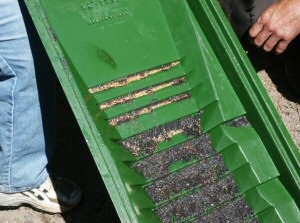
The top of the finishing-sluice was filled with gold during final clean-up on the last day.

And everyone also spent some time working the 4-inch dredges in the pay-streak upriver. That deposit consists of a foot of hard-packed streambed on top of shallow bedrock in one-to-six feet of water. The dredging in this pay-streak is so easy, I almost felt guilty putting in my own shifts. However, the overwhelming amount of enthusiasm from all the other team-mates helped me get though my guilt. Miners helping miners! We spent the seventh day floating gear out, doing the final clean-up and splitting off the gold. In all, we recovered around 2 ¼ ounces of gold, mostly nice flakes. About a third consisted of nice nuggets, the largest which was 4 pennyweights (almost ¼-ounce).

 Everyone got a shareSharing the Gold

My best guess is that there should be a strong high-grade line of gold going right down the middle of the river on K-6 from just below the USFS river-access to well below the rapids.

Just as our project was coming to an end, several members were already converging upon the upper pay-streak we had located; the easy one. Smart move!!

I floated a dredge though about ¼-mile of river down to the USFS river access from the upper pay-streak when the project was over. There is lots of bedrock showing in that area, too. And it is located between the two pay-streaks we located last week. It is silly to think there is not some high-grade to also be recovered out of that stretch. Check it out!


By Dave McCracken

Nearly 3 ounces of gold  Lilly Fuller
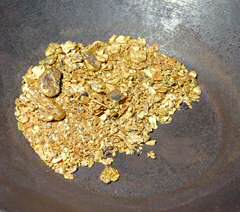
Pictured are the nearly 3 ounces of gold for the week, of which 11.8 pennyweights
were nuggets. Lilly Fuller smiles as she cleans up the final concentrates for the week.

 
This Group Project took place on the Schutts Gulch claim along the Klamath River at K-11, several miles upstream from Seiad Valley, about 20 miles upriver from Happy Camp. There were 14 participants (11 men and 3 woman), including myself and my 3 experienced helpers, Craig Colt, Ernie Kroo and Dale Carnagy. Several of the participants were dredging for the first time ever, two who were pretty nervous about going underwater water when we began the week.

Most of us camped in the USFS campground at O’Neil Creek for duration of the project. That is a nice, shaded, developed area with toilet facilities and picnic tables, located only a half-mile from where we were doing the project. We decided on the first day to stay in the central group-site together as a community. This made it convenient after the long workdays during the project. Plus it allowed all of us to visit and enjoy the after-hours together.

We chose the Schutts Gulch claim for this project because it is a very long claim that includes a lot of river diversity; slow, shallow areas, rapids, and directional changes in the river. New 49’er members have been making rich gold-strikes along this claim both in and out of the water since the early-90’s. I also made a very high-grade strike (6 ounces of gold out of a single pocket) in the mid-90’s, so I already knew high-grade gold was traveling through this section of river.

Having some less-experienced dredgers on a project requires a place where there is some easily-accessible, slower, shallow-water areas and there is still hope of finding high-grade gold. K-11 has many such locations on both sides of the river.

4-inch sample team
Four-inch sample team pauses to consider the next move,
as six-inch team is recovering gold just downriver.

K-11 also has some deeper, faster areas where potential for high-grade is really good. From past experience in this area, I felt pretty comfortable that if we hit the area hard with enough sampling, we would find some good gold deposits waiting for us.

As K-11 is such a long claim, We broke it down into three separate sampling areas: the top third of the claim; the center section; and the lower third of the claim. For practical purposes during these projects, I like to try and keep the several dredges we use within a reasonable distance of each other. Because once things really get going, I spend long days running up and down the bank, or swimming back and forth, going from dredge to dredge, while directing the sampling effort and coordinating the participants.

If we did not find what we were looking for in the upper section of the claim, my plan was to float all the gear down to the lower sections and continue the sampling effort there. I feel the potential for high-grade gold is just as good in the lower sections as it is in the top. As it was, we remained in the top section for the entire project, and several participants are still dredging high-grade in there as I write this newsletter.

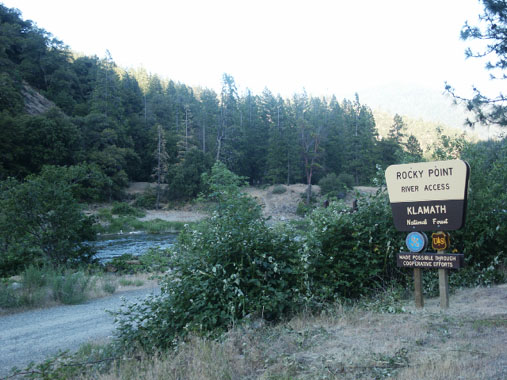
Some members have been working good gold deposits on the far side of the river during earlier seasons. The problem is in transporting the people and gear from a Group Project over there from the road-side. There is a Forest Service road that goes around to the other side, but I did not want to lose the time driving all the way around every day. Another option was to use a boat at the USFS Rocky Point river access which is located about half-way down the claim. But we finally decided to start our project on the road-side. We needed to sample there anyway.

We spent the first day of the project doing orientation, moving several dredges with support gear down the hill, and getting all participants into the water for their first dives. We were using two 4-inch dredges to sample the slow, shallow areas nearer to the edge of the river. These dredges are set up for two divers each. While more experienced participants were getting a little sampling-work done further out in the river, I spent some quality time working with the less-experienced dredgers nearer to the shore.

From long experience at this, I find that beginners make very fast progress, even those who have a healthy fear of the water, as long as we begin their experience from a place where they are comfortable. Sometimes this means having the person hang out along the river’s edge for a while just looking underwater with a face mask. Once comfortable with that, I get the person looking from the edge using the mask, but breathing with the HOOKA regulator. Then I get the person to swim around the edge of the river on their own with mask and regulator, sticking his or her head down and getting used to the idea of breathing underwater. This usually progresses along just fine if the person is given some time on his or her own to work through the initial discomforts.

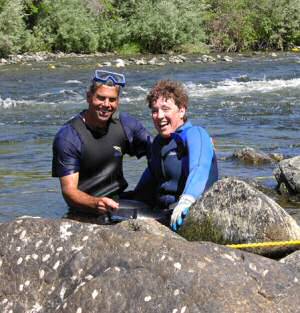
Herb Miller and Doti BuruursemaHerb Miller and Doti Buruursema prepare to start a sample hole on the far side of the river.
Before long, I am usually pressing down comfortably to hold the person just under the water’s surface while he or she is breathing through the regulator and looking around. It is a safe process, because I am right there being sensitive to how the person is doing. The key is to not push it too fast. The next step is to strap on the weights so the person can spend some time on the bottom in water shallow enough to get his or her head out of the water if he or she feels the need. From that point, it is seldom very long before the person is out helping on the designated beginner-dredge; the one that is operating in a very safe area.

One of my primary objectives in every project is to get all the less-experienced dredgers through these early stages and to the point where they feel comfortable working out in the river. All of the beginners in this project were competent dredgers by the time the project was over.

Years ago, I located a high-grade pay-streak out in the middle of the deeper, faster part of the river along the upper-portion of K-11. It was so long ago, I cannot even remember why we stopped dredging there, although I am sure it was not because the gold played out. The streambed is rather shallow out there; average maybe 2 feet to bedrock. The bedrock pays in the cracks and pockets when they are right. Sometimes the pay is very rich. So on the first day of the project, I directed Ernie Kroo and one of our more-experienced participants to do a sample right out in the middle, directly in line with where I had established high-grade gold in the past. They were operating a 6-inch dredge. And while they immediately started getting into some gold, it turned out that even our most experienced participant was not able to deal with the fast-water conditions out there.

Dave with Sandy CrawfordSandy Crawford always ready to light up the day with a big smile.
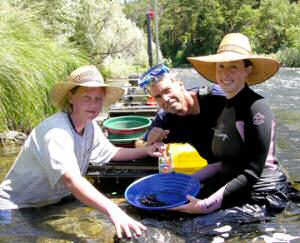
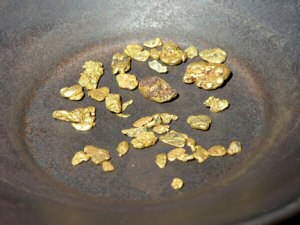
Meanwhile, Craig Colt and Dale Carnagy had drifted further downriver to do another sample in the middle using a 5-inch dredge. They were running into deep streambed material there. By the end of the second day, we decided to withdraw from the 5-inch sample hole in the middle of the river, because it was going to require a winch to be set up to move the boulders, the hole was going too deep to do on a 7-day project, and we knew there were other good gold prospects to sample on the far side of the river.

By the end of the second day, all participants, were out in the river pursuing the sampling effort using the two 4-inch dredges. Surprisingly, they located a pretty rich gold deposit in a hard-packed gray layer on the road-side of the river. We were already accumulating an interesting amount of gold from those two dredges. The excitement level was starting to build, and all participants wanted to spend more time in the water.

Because no-one was up to going out in the middle of the river with Ernie on the 6-inch dredge (where the rich pockets of gold are located), we decided to organize a production team to work with Ernie on the 6-inch dredge where the two 4-inch dredges had located a gold deposit closer to the edge of the river. On the third day, the two 4-inch dredges were moved further upriver on the road-side to continue the sampling process, while the 6-inch dredge was accumulating gold for the group project.

We also swung the 5-inch dredge across to the other side of the river to do a new sample. A long-time member from Sweden named Morgan had already been dredging on the other side for about a week, and he was

showing us a lot of beautiful gold, along with some nice nuggets that he was finding over there. The 5-inch dredge was put in line with Morgan several hundred feet downstream. Craig and Dale immediately got into some really nice gold over there, but there were big rocks that were going to require a winch. So they drifted back further downstream on the morning of the 4th day to begin another test hole.

While Ernie and his crew were in production with the 6-inch dredge, building up our accumulation of gold for the week, other crew members were performing sampling operations further upstream though the 4th day. They were finding gold up there in some shallow hard-pack, but it was not the high-grade deposits I was hoping to find. So we made a tactical decision to swing one 4-inch dredge across to the far side of the river to do some sampling upstream and in line with where Morgan was getting all his gold.

There is a system to getting a dredge safely across fast water. If you do it wrong, you are almost certain to dump the dredge over and lose a bunch of gear. If you do it right, it all happens so easily that everyone is left wondering what all the worry was about. That’s the way we always do it (the easy way!). So this was all good experience for those who had not seen it done before.

We asked for volunteers; and those who were the strongest swimmers were assigned to perform the samples on the other side of the river. There is also a proven-method for safely crossing a fast-moving river. Participants were getting a lot of exposure on this project in how to deal with more challenging conditions.

Once on the other side, participants used the 4-inch dredge to perform three good samples on the 5th day. Without any assistance from me, they discovered a rich gold deposit on their 3rd hole. I was so proud! This deposit is in the top layer of hard-pack. As the gold is fine in size, and they could not see it in the gravel, they did some small production-runs at different depths to discover where the gold was coming from. Right out of the text book! At the end of the day, the concentrates from their sluice box were so saturated with fine gold, that even I could not pan them out. The excitement-level was really building!

Dave with two students  Nuggets

Enough nuggets were recovered that each participant got to choose 3 pieces as a part-share.

Further downstream, Craig and Dale located a rich gold deposit in about 4 feet of old original streambed on top of bedrock. They were getting lots of fine and flake-gold out of a gray layer, and also picking up some nuggets off the bedrock. Those guys were really excited!

The second 4-inch dredge was dropped down to spend most of the 5th day production-dredging along-side the 6-inch dredge. Between those 2 dredges, we were accumulating some nice gold. They were also getting some nuggets off the bedrock. Imagine; gold nuggets being recovered from both sides of the river! Interestingly, the 4-inch dredge was recovering more gold than the 6-inch dredge. We speculated this was because the gold line was stronger as they dredged closer to the edge of the river.

So we began the 6th day with 4 separate high-grade gold deposits being mined on the upper end of K-11. Morgan was mining one, and we had located three more. Because Craig and Dale had found so much gold the day before, we made the decision to swing the 6-inch dredge across and move it downriver to work alongside the 5-inch dredge. By now, we had been through this drill enough times that our crew probably could have done it without me around. But to be on the safe side, I always keep a personal hand in the most challenging exercises during any project. Getting the dredge across and set up in the new hole was done in very short order.

Because not everyone on the project was comfortable swimming the river, we launched a boat in the morning and used it to get people, gear and supplies over to the other side. All these logistics caused us to get somewhat of a late start under the water. We made up for that by working later. In fact, I was still trying to get everyone to shut down the dredges at 7 PM at the end of the 6th day. I wrote that off to gold fever. The deposits were pretty rich. Everyone was excited.

Managing these week-long projects is a personal challenge for me in many ways. Every project is entirely different, depending upon who the participants are, and where we choose to go on the river. I always balance the need to do things safely (primary concern), while providing participants exposure to the real thing; the way high-grade gold deposits are found and developed in the river. We always find some gold. But when the participants are the ones who discover high-grade, and pull themselves into a dedicated team-effort to recover as much gold as possible in the remaining time, I am certain the adventure-experience for them is something they will never forget. This is not television or a theme park. It is the real thing!

And I am personally rewarded with very meaningful experiences on every project. Watching a person struggle early in the week with deep-seated fears of the water and having to overcome them by reaching down inside to find the powerful substance of their most inner strength is a demonstration of true bravery. I get to be part of that each time we do a project. While I cannot put it into words, being alongside a person who is overcoming personal limits is a very meaningful and honorable experience. I feel very close to my crew members in this way.

Listening to the prospecting-chatter of participants at camp during the evening is a another special bonus to me; talking about the color and hardness of the different hard-packed streambed-material they had encountered during the day’s activities, and projecting hope for how those clues might lead us into the next pay-streak… This is a whole reality that is only understood by prospectors who have actually done it. Listening to the discussions and hope for the next discovery creates an inner reward for me, allowing me to believe that I am doing something meaningful by managing these Group Projects.

Dave with two students  Dredges

I suppose the highlight of this particular project for me was on the 7th day when we decided to connect 3 suction dredges together and float them down through a long stretch of fast water like a train. This equipment needed to be extracted off the river and stored away safely for the next project. The average person anywhere would be fully challenged to just float a single dredge downstream in fast water and across the Klamath River. But we hooked three of them up like a convoy of fully-loaded tractor-trailers! Everyone involved with this exercise did their part like we had been working years together as a mining-team.

Naturally, I took the most upstream position on the rope to guide the chain of dredges, so I could keep a close eye on the whole operation. And I cannot remember ever feeling so proud, watching the teamwork and listening to the enthusiastic coordination of my partners in this adventure. For me, this feeling always seems to go along with the sad realization that the team will soon break up, with most everyone needing to go back to their normal lives.

We spent the 7th day pulling the dredging gear out of the river and cleaning all the concentrates we accumulated for the week. Doing a final clean-up is too time consuming to do every day on one of these projects. So we save it all up for the last day. Cleaning up a substantial accumulation of concentrates that contain a lot of fine gold, and accomplishing a full separation so that the gold can be split off evenly amongst the participants, is a fair amount of work. We never use mercury or any chemicals in the process. It is important for every prospector to know how to do the final gold separation. On our projects, under my careful guidance, the participants do almost all of the work. But I always get the personal pleasure of weighing out all the final shares.
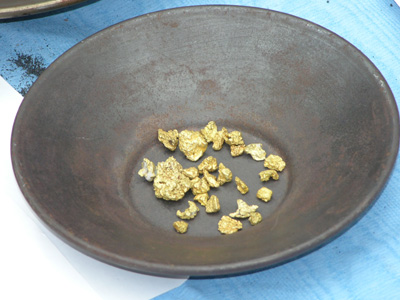
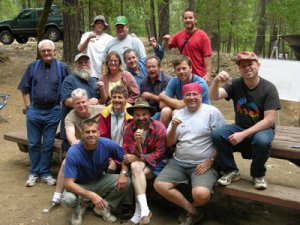
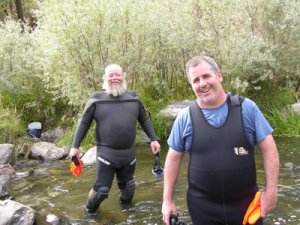
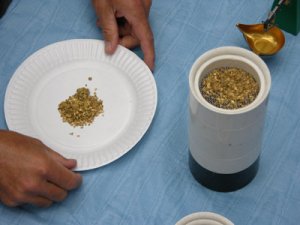
In all, we recovered nearly 3 ounces of gold for the week, of which 11.8 pennyweights (a little more than half-ounce) were nuggets. Two pretty important pay-streaks were located; both which are being worked by numerous members as I write this newsletter. The richest part of the upper claim remains relatively untapped, because it lies under a section of deeper, faster water which we could not access using the team involved with this project.


By Dave McCracken


This Group Dredging Project took place towards the lower end of the Club’s K-11 claim (Hwy-96 mile marker 63.58) along the Klamath River, not far upriver from Schutt’s Gulch. This is located about 3 miles upriver from where Highway 96 crosses Seiad Creek, near the small town of Seiad.

We conducted another Group Dredging Project towards the upper-end of this claim earlier in the season and did pretty well. K-11 is a very productive section of river, both for dredging and surface-sluicing activity on the far side of the river. The claim is quite long; and despite lots of successful activity, I don’t believe that most of the area has even been adequately sampled yet.

I have had my eye on the lower-end of K-11 since all the way back to 1997, when founding Club member, Tony Steury, was dredging there with a 5-inch dredge, consistently recovering an ounce of gold per day. I was buying his gold, so I knew he was getting it. And because of that, I made a special visit to Tony’s dredging site one day, and even swam down into his excavation to get a first-hand look. Tony was dredging towards the road-side edge of the river, pretty near to the lower-end of K-11.

To my knowledge, no-one ever returned to the area where Tony was dredging to pick up what he might have missed. Tony’s gold was all flakes and fines. It was a lot of gold for the amount of material he was processing through his 5-inch dredge.

Over the years, I have swam down through the lower-end of K-11 with lots of different members who were participating in various group events, and I have always encouraged members to go back there and search for the gold Tony left behind. Tony only dredged in there for a few weeks, so he could not have cleaned the area out. But I have never seen anyone go back there.

That’s the thing about the The New 49’ers; we have so many available options, it takes a long time to get around to all of them!

Anyway, “Tony’s lost gold” was one of the primary targets we were considering for this Group Project. I figured we could find it with an organized group using 3 dredges to sample around the target area. So, a few days before this Group Project, Craig Colt and I were down standing along the edge of the river at Schutts Gulch, taking a hard look at the speed and depth of the water, access points, parking, camping and other things that are important to these Group Projects.

Group Projects require at least a few slow, shallow areas where we can work with less experienced miners. Projects sometimes require more parking than would normally be needed. They require the access to not be too difficult. These are all things we have to think about in advance. Because we don’t know everyone who will be on a Group Project until everyone shows up on Saturday morning, we have to plan for members that might not be up for difficult situations.
Craig and I spent most of a day comparing the lower-end of K-11 to another very promising-looking area towards the lower-end of K-9. Here is another area where few members have gone, and where the dredging prospects look fantastic! No question that we will do a Group Dredging Project on K-9 in the near future.

Anyway, after spending the better part of a day weighing and balancing the two areas, Craig and I decided we would do this Group Project at K-9. It really looked the best for what we wanted to do.

But on our way back to Happy Camp, we saw a 5-inch dredge floating out on the river towards the lower-end of K-11; perhaps 100-yards upstream of where Tony Steury made his big strike. So we stopped to talk with the member, Bruce Johnson, who was dredging there. He showed us his gold, which consisted of plenty of fines and flakes, with some nice, crystalline nuggets. Wow!

Bruce told us he was getting his gold from around some larger rocks in a hard-packed layer around three feet into the material. The water was only about 6-feet deep out where Bruce was dredging. Bruce told us emphatically that he did not have any problem with the Group Project moving in around him, since he was about to finish his season, anyway. In fact, he said he would welcome the company.

So Craig and I immediately did the smart thing; we asked Bruce if we could operate his dredge for an hour or so, allowing him to keep any gold that we found. With no hesitation, Bruce agreed to allow us the use of his dredge. So Craig and I jumped right into his hole and started dredging without any further delay.

There is an important lesson in this: The New 49’ers is a highly-active mining association, with very expansive property reserves. The choices of where to go are endless. For better success, it is important to narrow the choices to the best-possible prospects any way you can. The most effective way I know to do this, is to get right down inside of an active mining excavation that is recovering high-grade gold. Then you can see for yourself what the streambed layers look like, and where the gold is coming from. It doesn’t get any better than that!

Members often ask me how I am able to readily locate high-grade pay-streaks on New 49’er claims. There is no secret to this. I pay attention to every strike that is made on our claims. Whenever possible, when there is a new strike, I go right down and look at where the gold is coming from, what streambed layers are involved, how wide the pay-streak is, how much volume is being processed, and how the deposit lines out in the waterway. These are things that I never forget!

My memory is poor on some things. But I never forget the details of where someone finds gold! Because I know I can always go back to those same areas with a sampling team and pick up where the earlier miners left off – either at one end of the pay-streak, or a little further up or downstream, where the next pay-streak is located.

The nice thing about a Group Project is that I can direct a dozen or so people, using several dredges, in a very-organized sampling program that is targeted to re-establish a gold-line that has already been found before.

So when Bruce offered to allow Craig and I to use his dredge to have a look at a pay-streak he was actively mining, we wasted no time getting into the water. Bruce told us that most of his gold was coming from the contact zone on top of a really hard-packed grey layer down about three feet into the streambed material. He said he could see the gold sitting right on top of the grey layer. It didn’t take but about 15 minutes for Craig and I to work a top-cut (reaching out and working about 4 or 5-square feet of material off the front of Bruce’s dredge hole) down to the grey layer. Sure enough, we saw the pieces of gold sitting right on top of the grey material. That’s all we needed to see!

The wonderful thing about our mining group is that we have so many really nice people associated with us as active members. Miners helping miners! I cannot tell you how lucky Craig and I felt when Bruce invited us to bring the Group Dredging Project into the area where he was actively dredging up a high-grade gold

deposit!

Here’s my secret to finding gold: When someone offers you a sure thing, take it!

So Craig and I quickly altered our plans to manage this Group Project at the lower-end of K-11 near Schutt’s Gulch. Fortunately, the Forest Service has a very nice developed campground at O’Neil Creek (Hwy 96 mile marker 65.50), about a mile upriver from where we were going to be doing the Project. We made arrangements to rent the group camping site for a week, so participants would have a comfortable, quiet place to camp.

This Group Project involved 12 participants (11 men and 1 woman), plus my two very-experienced helpers, Craig Colt and Ernie Kroo and myself; 15 of us in all.

Several of the participants were dredging for the first time ever, and several others had little previous experience under the water. One of the primary objectives of these projects is to help all participants achieve personal confidence while dredging underwater. We take this responsibility very serious. The nice thing about this Project was that since we already pretty-much knew where the gold was, I was going to be able to put 100% of my own focus into helping others dial in, to what we needed to do.

Most of us camped in the Forest Service O’Neil campground for duration of the project. So, we were also able to spend some very pleasant after-hour time visiting and enjoying our moments together during this adventure. Ernie Kroo is one of the best guys on a BBQ-pit that I have ever seen, and he takes great pleasure in making sure everyone eats well on these Projects. The food was great!

All of the participants in this Project arrived full of motivated-enthusiasm. When Craig and I walked everyone down on the first morning to show them where the gold had already been located, it was everything we could do to slow things down enough to keep track of the activity. I have to say, this was the fastest I have ever seen three dredges put into the water and set up. People were actually running with the loads! Usually, I am happy if we just get camp set up and the dredges in the water on the first day. But this was all done before lunch on the first day of this Project!

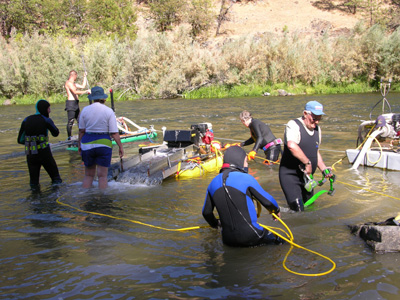
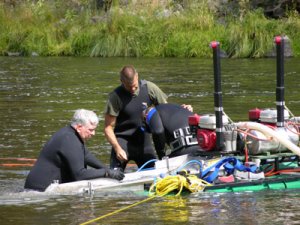
So with just a little discussion, we turned three separate teams loose on Saturday afternoon in an organized sampling plan. One dredge was placed around 60 feet in front of where Bruce was dredging, directly in line with him. Another dredge was placed around 60 feet downstream and directly in line with where Bruce was getting his gold. And the third dredge was sent about 100 yards downstream in an effort to find “Tony Steury’s lost gold.”

This type of gold mining (dredging) is not rocket science. Since Bruce was getting good gold, we were nearly certain that if we got directly in line with him in the river, and dredged down to the very same layer, that we would get gold, too. We proved this theory correct by the end of the first day. While our upstream dredge was already producing fines and nice-sized golden flakes, the downstream dredge started producing nice big corn-flake-sized crystalline gold nuggets.

I just cannot tell you how excited everyone was! I was sitting back thanking my lucky stars for how easy the week was going to be for me. Incredible!

These Group Dredging Projects are usually very challenging for me. While there are many things we have to make happen during the week, they all basically add up to three very important things: (1) we have to help all the participants get dialed in to what we want to accomplish, with no-one getting injured. (2) We have to locate a high-grade gold deposit. (3) We need to develop the gold deposit in such a way as to recover as much gold as we can during the remaining time allowed to us.

While the other things are incredibly important, I can tell you from plenty of experience that it is the recovery of lots of gold that carries the emotional tone of the group during the project. Every gold deposit is different, and therefore causes different types of feelings. This deposit was full of beautiful, crystalline nuggets that were being picked out of the dredges after every dive – and sometimes even while the dives were happening. All week long, people were rejoicing in their excitement about the nuggets we were recovering. What a week!

All of the important choices and decisions are discussed during these Group Projects. This is part of the experience. Because, just like the fork in the road when you only have enough time to go in one direction, every main choice during any gold prospecting expedition will affect how things come out in the end. While we have narrowed the choices down to just a few by the time we begin one of these Projects by choosing the section of river, we still must decide where we will do our sample holes, and how much time we will devote to each sample.

There are never any fixed answers to these choices. There is an emotional and intellectual chemistry involved where the results of samples are compared to each other, measured against the prior information we have about the area, and balanced against how much time we have. Seldom is there a fixed right-or-wrong answer. You just do the best you can and push forward. We always try and get all of the participants directly involved with this chemistry; because this is the risk-taking adventure-side of prospecting that turns to an incredible feeling of wonder and excitement, and a fantastic feeling of team-work accomplishment, when high-grade gold is recovered.

Having seen Tony Steury’s gold back in 1987, I knew without a doubt that his pay-streak was richer than the one we were mining near­­­ Bruce. But the question was: When there is a limited amount of time, and we are already mining a very good pay-streak further up-stream, how much of our available resources should be invested into looking for something we might not find? One of our three dredges (33% of our production-capability) was being spent looking for “Tony’s lost gold” with no luck so far. So, by mid-week, we collectively decided to move the third dredge up to the sure-pay-streak and leave the richer strike for another day.

The main challenge we faced in the established pay-streak, was that the richest gold was being recovered out of the deepest, fastest water out in the middle of the river. Although, luckily, the biggest, nicest nuggets were being recovered closer to the edge of the river, where the water was much slower. So we spent most of the remainder of the week shifting crews off and on, with everyone dredging where they were most comfortable. I think it is safe to say that everyone involved with the project was personally challenged in meaningful ways as the week played out.

In all, we recovered 5.5 ounces of gold for the week, of which 52.7 pennyweights (half the gold) were nuggets. This was, by far, the most nuggets (5 nice nuggets to each participant) we have ever recovered during a Group Project.


Several of the participants, along with other members of the Club, stayed around the immediate area to work out the deposit with Bruce after our project was completed.

But don’t think for a moment that this claim is worked out. We could easily devote 10 more Group Dredging Projects to sample this very long claim! The potential is fantastic!


By Sara Koehler

It has been said that there is a time for everything under the sun. Well, the time for dredging is definitely summertime…And, there is no better place to dredge than Happy Camp, California! “Happy Camp.” The very name makes me smile in disbelief! This place really does exist! The water is cool, but not too cold, and the weather is usually quite mild. Better yet, there are “Gold Nuggets” as big as your thumbnail! We always find enough nuggets to make every day feel like a “surprise” birthday party!

Wherever we settle in for our dredging season, we all work as a team to make our home away from home as comfortable and relaxing as it can be. The children take turns taking care of our trash, making sure we always have a nice, clean camp. Everyone takes turns doing dishes and setting the table for meals…all except for Scott and me! With six children there are plenty of extra hands, eager to be of help.
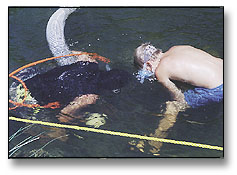
When Scott and the boys get our equipment ready to launch at the spot we have chosen on the Klamath River, we dredge for a couple of hours at the beginning of each day. We can’t contain ourselves, and check our sluice box for gold every time we stop the engine to refuel. If some of the children are on the beach and hear the dredge engine being turned off, they all dive into the river and swim up to the edge of the dredge to get a sneak preview. We lift the flare’s flap, and “Surprise,” there are beautiful gold nuggets staring us in the face!

At the end of the day, we jump in our car and drive back to our camp. We try to take turns talking about everything that had happened to us during the day. Our adventure is not just about finding gold; but, also about the frogs, the insects, the birds, the swimming feats, the great lunch, the interesting people we meet at the river, the weather conditions, and all the “little things” that make us laugh.

How did we find this place? We’ve always had an interest in gold mining and had heard about Dave Mack’s videos from a friend of my brother. We bought Dave’s video at a mining equipment store in Sacramento, and had become spellbound watching Dave’s mining techniques, instructions and demonstrations. This is the first time that we had ever heard of the New 49’ers and Happy Camp! I knew that my husband, Scott, was going to get really excited about “all this new information!” Immediately we called the New 49’er office, that very same day!

We don’t want to sound like expert gold nugget hunters, because we’re not. We don’t own any private claims. When we became members of the New 49’ers Prospecting Club we instantly had over 60 miles of mining claims along the Klamath River and its tributaries in the northwest corner of California. Thus, we began our dredging adventure –we signed up for group dredging projects, and we even ordered a 5-inch dredge!

All winter long we watched all of Dave Mack’s videos, so that when we finally got to meet him face-to-face, our kids thought that they already knew him personally. Dave was very surprised, and taken aback, by all the admiration and affection our kids showered on him. If Dave Mack had a free hand, one of my kids had a hold of it. The other ones just waited until another free hand became available so they could latch on. I have to say that Dave took our children’s affection with good cheer and appreciation.
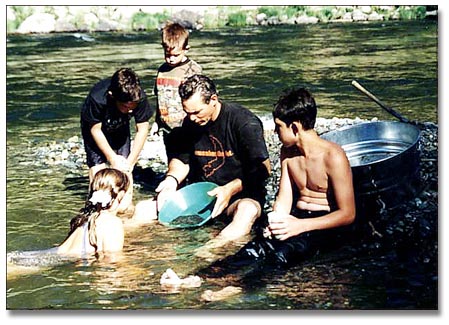
Our six children accompany Scott and me on our gold mining adventures. I do all the cooking and run errands, but there is also plenty of time for me to enjoy reading and sewing on the beach. It is very relaxing, and when Scott comes up for a break or lunch, we enjoy just being together in these great outdoors and fresh air. The children assist in all the various aspects of dredging, but there is plenty of time for swimming, getting sunburned, and eating!

Scott spends as much time as possible under the water, “vacuuming” the bottom of the river. We started out with both Pro-Mack 2-inch and 5-inch dredges. Then the second summer we ordered a 10-inch, customized, “wonder”-dredge. It is a beautiful piece of equipment! Being on it makes one feel like a “King and Queen of the River.”

We made our first trip to Happy Camp in June of 1995. Taking our tents, tent-trailer, and dredges, we camped at the Anderson Campground, on the Klamath River. The weather was chilly and wet, but we sure did have fun anyway! We dredged, panned, and high-banked. We attended group mining projects and attended claim tours. We cooked, washed clothes, read books, talked-over ideas and created many “plans.”

During our first week in Happy Camp the Discovery Channel (Cable TV) paid us a visit at our home on the river. Their crew was producing a show entitled “Easy Does It!” They wanted to film a piece on small-scale gold mining and they spent most all of one day with us. The cameraman filmed Scott dredging and the children panning. They interviewed both Dave Mack and us. The next time we heard from the Discovery Channel was at the end of the summer when they called our home to ask how much gold we had found. A few weeks later they sent us a copy of the 5-minute segment that they had made for television. Then a few months after that we were actually on television! We were thrilled!
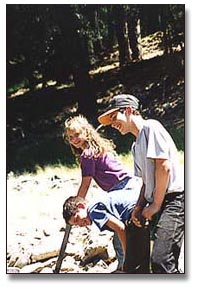
After our time at “Anderson Campground,” we moved to a place down-river from Happy Camp named Independence. During that same first summer we camped on a roadside turnout, 230-feet above the claim. Getting down to the river each morning, which was a difficult access from that location (downhill), made for an exciting beginning and ending of each day. Scott and the kids immediately went to work cutting a trail down to the river. It was a very steep trail, and perilously paved with poison oak! Our children became experts in identifying poison oak! The section of river we were on had small and large boulders that created a nice area for our kids to swim in, away for the rushing flow of the Klamath. It was deep enough and safe enough for Ben, our youngest, to dive off some of the boulders. At the end of the day we would all get filthy-dirty clawing our way back up to our camp. The “best,” or should I say most challenging, part of the day was that we had no running water! But, otherwise we certainly got a lot of great exercise! That particular summer was extremely hot, and there was no break from either the heat or the “jack-braked” semi-trucks. The high point of our experience at Independence was being invited by some very hospitable, new friends to take showers in their home!
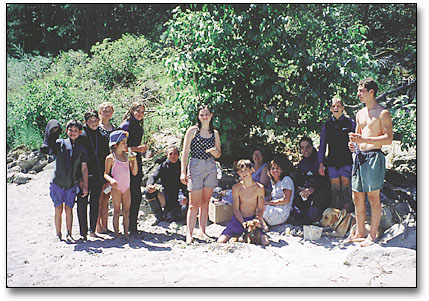
The next summer, 1996, we stayed with friends in their house, and felt free to dredge anywhere that looked appealing. We learned how to work the 10-inch dredge. We couldn’t believe the attention the dredge received, running or not. It has incredible size, volume, power, and beauty! This is when we first met the Andrezejewski family for the first time.

By the beginning of the summer of 1998 our family was no longer working and functioning in isolation. We teamed up with a wonderful couple, Max and Lesley Andrzejewski, and their five children. They had driven to Happy Camp every summer for three years from Pittsburgh, Pennsylvania with their children. We “hit it off” immediately when we met them for the first time at a weekly New 49’er potluck. We have become extremely good friends since then! We have done so many things together; dredging, eating, shopping, making repairs, putting out fires, and even doctoring “ouch-ies.” All these activities have firmly “cemented” our friendship!

Two sets of parents, eleven children, two dogs, a pan full of gold, and a cool river on a hot day all add up to non-stop adventure and fun! We have all learned a lot from each other in many, many ways! Some of the lessons we learned together even included “bloopers,” such as: Don’t fill your dredge’s gas tank while it is still running; keep plenty of duct-tape on hand; don’t forget to wash your ears out with Domeboro after dredging; peanut butter and jam sandwiches taste best when eaten on a beach; any kind of cookies and chips will be devoured; and be sure to take lots of food to the Saturday night potlucks! Happy Camp is a great place to bring a family. There’s no doubt about it! It’s also a good place to invite your friends to come and visit. The area is really beautiful and the New 49’ers are a great group of people. They are helpful, friendly, hardworking, and adventuresome.
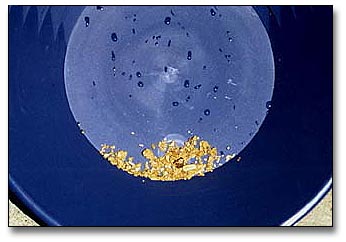
But, did we find many gold nuggets? Yes! We kept our ears open and heard a hot tip from Dave McCracken during one of his river tours with 20 or more people. “Go to this spot! It has nuggets along the far bank,” he said. We checked it out, and sure enough, he was telling the truth!

We’ve been coming to Happy Camp for the last four summers. We’ve camped in campgrounds and on a highway turn-out, stayed in a motel, “borrowed” and rented friends’ houses, and this year we’ll probably buy our own property. I will be glad to have a “permanent” place to call home during the summer when that “dredging itch” needs scratching, and we all climb into our car and head back to Happy Camp!

Really, though, we didn’t start gold mining to become rich. God has truly blessed us with a wonderful family and many, very dear friends—who have become family. We have already found the Motherlode!


By Dave McCracken

Everything was going normal. My partner and I were using an 8-inch dredge, pumping rich gold from underneath about seven feet of hard-packed streambed. It was just another day in god’s country. Then, without any warning, we ran out of air. “Out of gas,” I thought. As I turned around to go back to the dredge, there it was, upside down, with the engine muffler resting on the bottom of the river!

Dave Mack

 
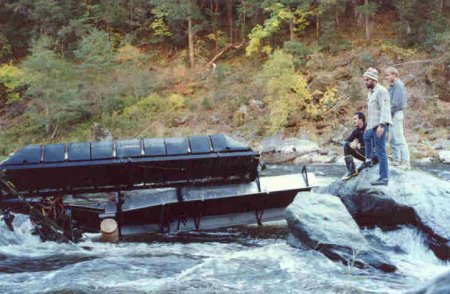
flipped dredgeThere are few things more disheartening in gold dredging than flipping your dredge upside down in the river! But if you spend some time talking with experienced dredgers in river-dredge country, you will find a good percentage of operators have experienced turning one or more dredges over at one time or another.
Dredges get flipped over because of numerous different factors. One common reason is not having enough flotation under the dredge. Another is having a dredge design where the dredge is not wide enough. Another common problem is in dredge designs whereby the forward-most floats are not tapered enough to help deflect the river’s flow.

Design problems aside, there are two common situations which cause dredges to flip over. The first is when something happens to cause the sluice box to start loading up with the material you are pumping. As more and more material piles up in the sluice box, and then perhaps onto one of the pontoons, the increased weight eventually overwhelms the dredge’s floatation capacity, and over she goes! This can happen in minutes if you are feeding the nozzle at production speed!

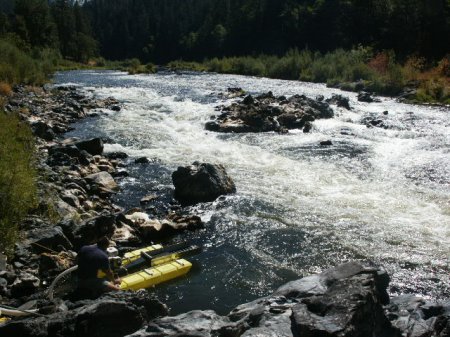
The second common reason for flipping a dredge is floating it out into faster water than the design can manage. Every dredge has its limits! A dredge which might float just fine in shallow, slack water might not last five minutes in the faster flow of a river. fast water

As fast water often poses more risk to the dredge than an experienced operator, sometimes you have to find some slack water along the edge of the river where it is safer to float the dredge!

Gold quite often deposits in the fast water sections of a river. Also, because of the faster water, these areas often have less gravel and overburden covering the pay-streaks. Less streambed makes sampling go faster. Consequently, river dredgers often find ourselves dredging in the faster sections of gold-bearing rivers—including white water rapids.

It is difficult enough to overcome the underwater problems associated with fast water dredging. Knocking out plug-ups in the suction hose is particularly difficult. A dredger should not also have to worry about his or her dredge flipping over at the same time. Therefore, a certain amount of dredge modification might be necessary on any store-bought dredge before it is used under fast water conditions.

Normally, dredges are modified for fast water by adding more flotation—sometimes to the sides, sometimes to the forward-part of the dredge.

Here’s something important: Additional side flotation tends to make the dredge more stable from side to side and generally prevents the flipping problem. However, additional side flotation enormously increases the dredge’s water drag in the fast current. This puts a great deal of pressure on the tie-off lines, and it also makes it more difficult to get on and off the dredge, or work around the dredge (knocking out plug-ups) without getting swept down river. This is because the additional drag directs a larger volume of water around the sides of the pontoons.

It is usually more difficult to mount additional flotation as an extension of the front of your dredge; but we have found in our own operations that this is the better overall modification for several reasons. Reduced water drag is very important in swift water conditions. More floatation up front helps prevent the dredge from doing a submarine dive! Also, the additional platform in front of the dredge provides more space to place support gear on your dredge. And, in the case of larger dredges, if you should ever want to mount a winch on the front of your dredge, the extra flotation and frame will already be in place.

But you do not need to be in fast water to flip a dredge over. As mentioned above, a very common reason for a dredge to flip over during operation is sluice box load-up. This is when rocks and gravel overwhelm the sluice box, start flowing over onto the decks, and eventually cause the dredge to list over to one side and flip. If you have a water-flow problem with your recovery system, the problem must be resolved before you operate your dredge without someone at the surface to keep an eye on it. The key is to get enough water-flow to keep all of the rocks and material moving through and out of the recovery system. We always make sure we have a little more flow than necessary, because we choose not to hire a dredge tender to stay on deck.

Occasionally, even with a dredge which is set up perfectly, just the right rock can lodge in the sluice box and create an obstruction. Then that single rock can be the cause of a sluice box load-up. If not caught in time, the load-up can collect enough weight to flip the dredge over. This is why I say many experienced dredgers have had the fun (not) of flipping a dredge. Helpful hint: It never hurts to look back every once in a while to make sure your dredge is floating alright!

Tying off the dredge properly in swift water is also an important factor in preventing a flip-over. Obviously, you do not want your dredge sitting broadside in a fast current! It is a matter of applying Murphy’s Law: you must observe the water-flow and its effect on the dredge. If it looks chancy, come up with another plan.

When a dredge is flipped over, you usually lose all of the items that float. If the river is swift, these things are usually quite some distance down river before you get back up on the bank and remove your dive gear. I will never forget the time we came up from a dive several years ago just in time to see the five-inch dredge that was operating just downriver from us was underwater and

hanging by just one pontoon. The guy was dredging when we started our dive, so we assumed he was still underwater, pinned by a rock, or perhaps knocked in the head by the dredge when it flipped over, or something. Because the owner of the dredge was nowhere to be seen!

However, it turned out that when the dredge flipped over, the dredger came to the surface and saw his other pontoon going downstream fast. He off-loaded his dive gear and swam through three separate sets of rapids trying to catch the pontoon. These were the very substantial rapids on our Mega Hole claim at K-15A! He never did catch up with the pontoon. He showed back up at the dredge about 45 minutes later, exhausted and demoralized. We already had dragged the remainder of his gear out of the river. Using my jet boat, several hours later, we located his pontoon about eight miles downriver in a back eddy. It only took him several days to get his dredge running again. He installed extra flotation to prevent further such incidents.

When a dredge is flipped over, after it is set right-side-up again, the water needs to be completely removed from inside the engine and hookah air compressor. We usually do about half a dozen oil changes, starting the engine for a few seconds each time, to remove more water. As long as the oil keeps turning milky, it is necessary to keep changing it.

It is not as hard on an engine if it is not running when it goes underwater! Sometimes it is necessary to remove the electrical components and blow them out with air or replace them altogether in order to get spark at the spark plug again.

The air compressor must have all water removed from inside, as well as the intake air filters and air lines. If the compressor was running when it was submerged, it will be necessary to pull out the reed valves and make them straight again or replace them.

And of course, if you were dredging gold, some or most of that will have been lost from your sluice box when it flipped over. So, you will have to decide whether it is worth going through your cobble and tailing piles to retrieve it. It usually is not worth the effort, because you can get more gold by just continuing forward on your pay-streak.

One important dredge modification worth doing is to secure the sluice box to the frame or deck of your dredge so it will not flap free in the current should the dredge become flipped over. This prevents the box from being damaged or lost altogether. It also makes it a heck of a lot easier to get the dredge flipped back over.
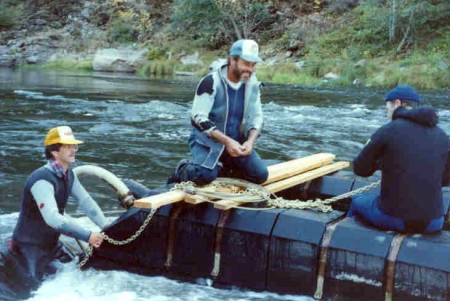
At the end of last season, one of our local commercial dredgers was trying to winch his dredge up through a particularly difficult section of rapids on our K-17 property along the Klamath River. He was trying to test a potentially-excellent hot spot that no one else had ventured into, yet. The spot looked great; many pounds of gold were recovered just upstream and just downstream. The spot is probably still loaded with gold!

He was moving the dredge alone, using a power winch anchored to the streambank some distance upstream. Just as he was almost around a large rock, the outside edge of his dredge took a dive and the dredge flipped over — just like that. This is the way it usually is in fast water; when something goes wrong, it happens quickly and decisively. Usually, there is little time to do anything effective about it.

connecting sluiceBesides all of the damage to a dredge, the loss of support gear, and the loss of production time, there is also a large amount of embarrassment which goes along with having a dredge floating upside down in the river!
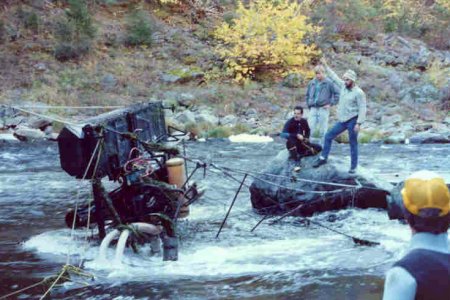
Once we found out about his problem, we put the word out, and experienced New 49’er members from the area converged on the site to help our friend. It is no small task to right an eight-inch dredge in fast water! The images in this article were captured as we made it happen.
First, we had him winch the dredge around the rock and pull it into slower moving water. This did not help the equipment much, because his sluice box was dangling in the current and dragging along the river-bottom. His engine was also dragging the bottom. Not good!

We spanned the bottom of his pontoons with some beams, and then cranked his sluice box back up to his deck before trying to winch the dredge back over.

winchingThen, we had several divers go under the dredge and use chains and a come-along to lift the sluice box up and secure it to the deck. We used a boat to set up an electric winch on the far bank. We secured the two outside corners of the dredge to the bank on the close side of the river. We secured the winch cable to the opposite corners of the dredge and we winched the dredge over. What a mess the dredge was! Since it was late fall anyway, this pretty-much finished the dredger’s season. Miners are a hardy bunch; he returned the following year, better and smarter than ever!



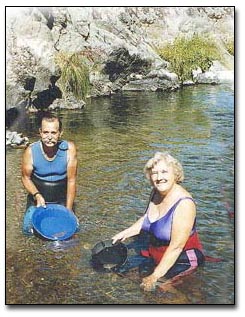
The moral of the story is that a little prevention goes a long way. Another thing: we are dealing with the forces of nature. We use our observation and judgment. We take some chances and we are not always right. Murphy lives! And, when he wins a battle, it doesn’t mean he has to win the war. There is always another day and another opportunity.

Another thing: We are dealing with the forces of nature. We use our observation and judgment. We take some chances and we are not always right. Murphy lives! And, when he wins a battle, it does not mean he has to win the war. There is always another day and another opportunity!

Never quit!


By George Anderson

My adventure started the day I arrived in Happy Camp, California, a small town located on the Klamath River, and headquarters for The New 49’ers Prospecting Organization.

My first order of business was to join The New 49’ers, so I went to the headquarters, and after paying my membership dues and signing a few papers I was asked to go on a tour of the more than 50 miles of claims that I now had access to. It was that simple. The gentleman who took me on the tour was very knowledgeable about claim locations, boundaries, camping areas, club rules and regulations, and those stretches of the river that he felt would be good dredging for my size dredge. On the tour we stopped often as he would point out access points, newly-exposed bedrock from this past winter’s flood, and newly-deposited gravel bars that looked like good prospects.

After the tour I spent the rest of the day looking for what I felt would be the ideal place to dredge. To help me in my search I had been given an indexed list of each claim, which included a detailed description of the location, access, camping, maps, and information about the prospecting and dredging potential. This information proved to be invaluable in my assessment of the many different stretches of river and tributaries I was interested in dredging.

After a few hours of looking at, and reading about, the claims I had access to, I found a stretch of river that looked to me like an ideal place for placer gold to deposit. It was a submerged gravel bar located on the inside of a bend, just downriver from a high pressure area. There were large boulders half-buried, sticking out from the bank. I knew these boulders would make low pressure eddies behind them during high water. The high water during this last winter’s floods laid the trees at the river’s edge right down. 20 feet up the bank in this particular area I could picture that raging water running over these boulders, and hopefully carrying gold to be deposited in the low pressure areas behind them. This looked like a textbook location to find a good placer gold deposit.

So on the following day, after setting up camp I pulled my dredge to the river’s edge, put it together, put the rest of my gear on the pontoons, and suited up. Then I floated it across the river to a point just behind a large boulder that stuck out from the bank about 3 feet. This boulder was also dug into the bank about 3 feet and had saplings growing around it, which told me it had been there a few years.

I started dredging about 6 feet downstream of the boulder, moving forward and down as I dredged. When I got to the boulder I was beneath it. As I dredged the last foot of material from behind it I saw a beautiful nugget wedged between the boulder and another rock. I pulled the nozzle away, plucked the nugget from between the rocks and held it in front of my mask. It was the prettiest nugget I’ve ever seen, and later weighed in at 2.2 pennyweight. Underwater it looked like it weighed a half-ounce, which really added to my excitement!

After I regained my senses I placed the nugget on top of the boulder and kept dredging. After just a few more passes with the nozzle, and about a foot from the outer edge of the boulder I saw about 8 pieces of shale standing on end, spaced about 1 inch apart. I made another pass, and there in front of my eyes were four more nice nuggets! Now, by this time I was really getting excited, and thinking I’d hit the Mother Lode. I lay there staring at them until my breathing returned to normal. It was a sight I’ll never forget. So, after relishing in the moment, I plucked them from their hiding place and sat them

on top of the boulder, also. The largest of these weighed 1.6 pennyweight. That evening while panning out the material from the sluice box I recovered 5 matchhead-sized nuggets and a bunch of nice pickers. My first day of dredging had proved to be very rewarding–I’d recovered more than 6 pennyweight of gold from this one test hole! I was really looking forward to what tomorrow might bring.

The next morning I decided to drop back to see where the end of this paystreak started, so I moved the dredge downriver and punched another test hole. After a few hours I found just a few pickers, so I moved forward to just downstream of my first test hole and dredged into it. I made it longer and wider. I dredged behind, under and around the boulder and found one more nugget and quite a few pickers. Before I felt it was unsafe it undermine it much more, I decided to move upriver to the next boulder.

I punched a hole to bedrock, which was about 4 feet deep, behind this second boulder. I found a shale-like seam about a foot wide and rough, inset about 2 inches below the surrounding bedrock. I really started getting excited with anticipation, knowing this was another textbook location for gold to deposit. I hastily dredged a 4-foot-square area above the seam down to bedrock, leaving a few inches of material covering the seam, and after waiting a minute for my sluice box to clear I dredged the seam material out. You can imagine my disappointment when I discovered there wasn’t any gold in the seam. It’s my belief that someone beat me to this spot, due to the lack of any hard-packed material over the seam. I also saw an area to the inside of this seam, consisting of a cement-like material (caliche), where it appeared to me that some had used a pry bar to break it apart. I did pull a couple of nuggets and a few pickers from this hole, but not what I was hoping for.

The next day I dropped back to the end of the gravel bar where I had spotted 4 large boulders. By large I mean they were as big as a dresser and twice as wide. These boulders were wedged against each other in a horseshoe configuration and about half-buried. This looked to me like another good place for gold to deposit. As I started dredging I hit a semi-hard packed material just a couple of feet down, and could see small nuggets lying amongst the large rocks. Within an hour I found a beautiful 3/4-pennyweight nugget, just behind the first large boulder I came to. I dredged here for the next few days, going around this horseshoe configuration of boulders, from about 4 feet out to under and in-between them, recovering a lot of gold. I would check my sluice box every couple of hours, gold pan and tweezers in hand, and was always rewarded with five or six pickers for my effort. All in all I recovered 19-7 pennyweight from the six test holes I dredged.

In conclusion I feel this particular gravel bar has good gold throughout, but that the paystreak runs 2-4 feet deep. I didn’t have time to see how far out in the gut the paystreak ran. I’ll have to determine that the next time, but I do know it looks pretty rich along the bank to 10 feet out, as all my test holes had a good showing, except for maybe the fourth one I punched on the seam towards the front of the gravel bar.

I had a great time dredging in the Klamath River country. And, I plan on returning very soon. I want to thank the people at The New 49’ers for this opportunity, and their help. I met some really nice people there, while dredging, especially Jerry H., a true prospector and friend who makes the best hobo coffee in the world. Good luck to you all. Hope to see you real soon!


By Marc Rogers

Chuck and Chris Carfrae have a rich and varied background in gold prospecting and treasure hunting. Their interest began in 1974 when they took a vacation up through the Mother Lode area of California. While there, they decided to try their hand at gold panning.
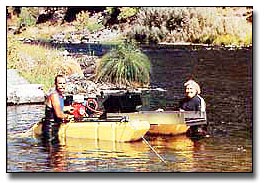
They didn’t have much luck until they saw a sign offering panning lessons for $2. Their teacher was an old miner who “didn’t hesitate to tell you if you weren’t doing it right,’ and after taking the lessons they fared much better. They finished up that vacation with a week spent on the Feather River where they found 1/4 ounce of gold, panning! They decided that if they could do that well panning, they should get some equipment, so Chris bought Chuck a 2 1/2-inch dredge for Christmas.

The following season they found almost an ounce with Chuck’s little dredge, so Chuck bought Chris a 3-inch dredge with air the next Christmas. They bought a motorhome so they could be comfortable while they dredged, and at home they joined a local club, the PCSC (Prospector’s Club of Southern California), and have continued to be active in the club for many years. Through club outings they gained knowledge and interest in metal detecting and drywashing, bought equipment to participate, and by this time were planning all their vacations around dredging. They spent a number of years visiting different areas of the Mother Lode, eventually dredging every major river from the Merced to the Yuba.

One year they wanted to do something different, so they flew back to Georgia on vacation, taking their smallest dredge, and rented a car. They went first to the Dahlonega area where they spent time dredging and finding gold, and visiting local mines and miners. Then they moved on to Franklin, North Carolina, and other nearby areas, where they dug in the gem fields.

They then visited nearby relatives who told them of a Civil War battlefield where they thought they might detect. After receiving permission from the owner, they recovered numerous minie balls, one of which was unusual. They found that it was a special one shot intermittently to clean the gun. They then moved on to Norfolk, Virginia, where they detected some of the old canals, and made several good finds, the best find being a very old ruby ring which Chris found.

The next year they decided to try detecting in Hawaii. They found most people detected in the mornings. Since there were a lot of nighttime shows on the beach, and all the lights from the hotels provided plenty of light, they did their detecting about 11 p.m., after seeing one of the shows. They had very good luck, and came home with a nice bunch of jewelry and coins.

Both Chuck and Chris have a very mischievous twinkle to the eye, and you know that whatever they do, it will be interesting. So when you hear about the unusual finds they’ve made while dredging, it doesn’t surprise you too much. Most people consider themselves lucky if they find one good cache in their lifetime. Chuck and Chris have found two, and they weren’t even looking for them. They found them dredging and panning!

The first was on some property they own in the Mother Lode area, which has a small creek. They were vacationing and panning in and around some rocks, since there was not enough water to dredge. The material was very hardpacked, and Chuck was having a hard time breaking it loose. He finally got a pan full, and was swirling it around as he worked at loosening it all up when he found a hard rectangular object in the pan. After cleaning it up they could see that it was a hard leather case.

Taking a screwdriver, Chuck worked the case open to find it was full of dirt. He was using the screwdriver to scoop the dirt out when a coin popped into view! They hurriedly got another pan and carefully scooped the contents of the case into it, then carefully panned off the dirt. What they were left with was 19 coins and two gold nuggets. The nuggets were 3 dwt. and 2 dwt. in size; the coins consisted of 3 silver dollars, one $5 gold piece, and 14 half dollars. All were from before the turn of the century. They later learned that the case was an 1870 Spencer rifle bullet case.

When they found this cache, Chuck and Chris didn’t even know what the gold coin was. They thought perhaps it was a token of some kind. They took it to a coin shop in a nearby town, and asked if they could identify it. The store owner told Chuck it was “just an old coin,” and he would give him $25 for it. Chuck almost took it, but finally decided to keep the coin. He later found that the gold coin was worth $350.

The second cache was found on the Klamath River, on New 49’er claims. They had just joined The New 49’ers, and came up to spend a vacation dredging club claims on the Klamath River. Chris was dredging in a shallow spot that bordered an area that had already been dredged by someone else. While she was working a large rock fell on her leg. A trip to the local doctor showed nothing broken, but the doctor told her to stay off the leg for a few days.

At the end of that time Chuck thought Chris should dredge first so she wouldn’t build up a fear after being hurt. While she dredged, Chuck sat on a rock nearby, panning concentrates left from the day Chris hurt her leg. Just as he was picking out the nice pieces of gold to put in the bottle, the pan tipped, and all the gold fell back into the water. The bedrock was clean and smooth there, so he had Chris stop dredging and he maneuvered the dredge so he could pick the gold back up with the nozzle.

When he started picking up the gold it didn’t all come. Some of it had fallen into a crevice, and was scattered along the bottom of it. He worked the crevice as far as he could, but it went under a large boulder. He felt around underneath as far as he could, and it felt like smooth bedrock but, thinking that some of it could still be in the crevice underneath, he got the pry bar and worked until he moved the boulder over. When he went back down, he could see there was some hardpacked streambed there. It was packed so hard, in fact, that the nozzle couldn’t even budge it! He used the bar to loosen it up, and then worked the nozzle in a back and forth motion to try to clean the area down to the crevice. All of a sudden he saw something shiny and large. He laid the nozzle down and waited for the water to clear. Chuck says, “All I could see was a pile of shiny coins.”

At this point he stopped dredging and worked with the pry bar until he’d completely moved the large boulder out of the way. Then he began working the material very carefully. At one point he came across a piece of wood, so he carefully removed all the material around it, but as soon as he touched it, it disintegrated in his hand, turning the water almost purple.

When he finished cleaning out the spot he had a hole about 3 feet in diameter, and 12 to 18 inches deep. Their cache consisted of 35 silver dollars and 3-five dollar gold coins! They have them in safekeeping with their other finds. They decided they didn’t want to even clean them. The newest of the coins was a 1927 silver dollar. The boulder that covered the cache was about the size of an office desk, so they think the cache was lost possibly in a flood, and the boulder came to rest on it some time later. Last year Chuck and Chris went to Alaska and carried their dredge on the truck for 72 days before they found a place they could dredge. They report that there were a lot of places where you could pan, but not many where you could dredge. As always, however, they enjoyed their trip.
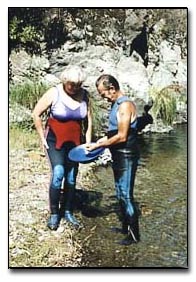
They finished their vacation in Dawson City, Yukon, Canada, at the World Goldpanning Championships, where Chuck and Chris entered the competition. Chris was the only American woman entered, and she won the beginner’s competition!

They spent an entire week there, joining in parties every evening with German, English, French, Swedish, and other competitors, and in making friends from all 17 countries represented. Chris says “We didn’t even have trouble communicating with the people who spoke no English. We enjoyed visiting with all of them! We traded pins and sweatshirts, and had a great time. We were even loaned Klondike pans from the group from Great Britain, to use in the competition.”

Whatever else they do next summer, you can bet that there will be a lot of fun involved. Chuck and Chris are great people to be around. They are eager to pitch in and help anyone with almost anything. One thing for sure, if there are any organized activities going on, and Chuck and Chris are around, they will be in the forefront of the activity. Speaking for both of them, Chuck has said it this way: “The most fun is being directly involved; to be helping the people who are getting things accomplished.”

This article was first published in Gold & Treasure Hunter magazine.

Tags