By Dave McCracken General Manager
“This was one of those few times in life where the accomplishment in itself, along with the shared experiences, were worth as much as the gold.”
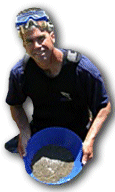
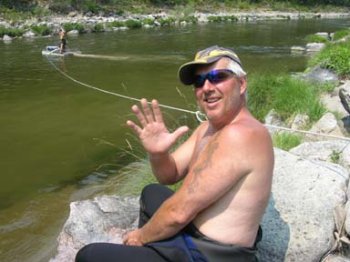
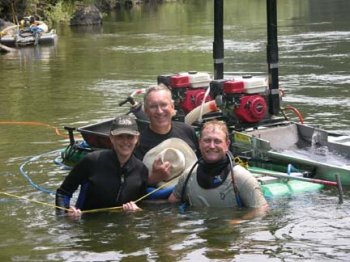
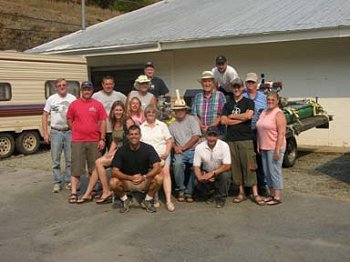
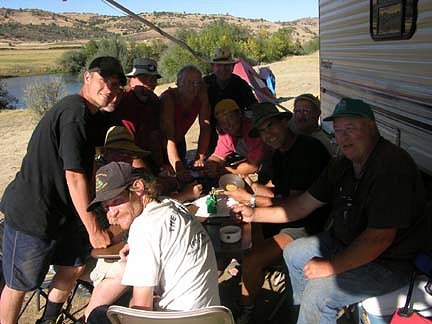
There were 18 participants in this gold dredging Project, including myself. We decided to do it on the Club’s K-13 property. Other New 49’er members had discovered high-grade gold on both sides and in the middle of the river in that area over the years. Since K-13 is such a long mining claim, we figured the earlier mining activity could barely have scratched the surface of the larger gold deposits which pretty-much extend continuously down the full length of the Klamath River.
We have been finding consistently during these Group Mining Projects that if we just launch an aggressive sampling program into an area where other members have already found gold on New 49’er properties, we always seem to be able to discover that some meaningful part of the high-grade gold remains in place – sometimes even the best part of the pay-streak!
People wonder why we always seem to be able to get into high-grade when we do these Group Projects. Really, there is no secret to it. The first thing we do is choose a place along the river where we are nearly certain that high-grade gold deposits exist within reach of the mining equipment that we will use. This is nearly always the result of other New 49’er members having already discovered high-grade in the same area at some time during the past. Then we perform an aggressive, coordinated sampling program into that immediate area.
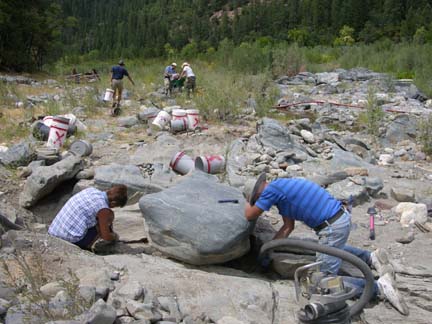
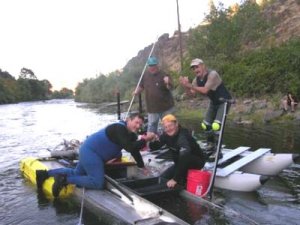
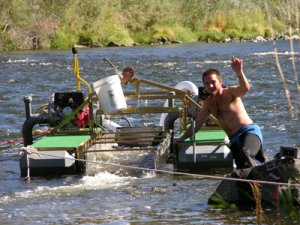
We were using 4 dredges on this project, because we had a pretty large team. Using four dredges provided us with a sampling-advantage, in that we were able to carefully coordinate the sample holes while paying very careful attention to where the gold traces are being found. In a step-by-step process, we are able to walk our way right up into the high-grade gold deposits.
We initially arranged to have 2 chemical toilets delivered to a large gravel bar and river access area (named “Sluice Box”) located towards the upper-end of K-13. There was plenty of room there to organize a group camp. But, early on Saturday morning, our shore boss, Otto Gaither, suggested we set up our camp a little further downriver on K-15A. Several other members had just vacated that area, which left plenty of room for a group camp with more natural shade. So we sent a small crew over on early Saturday morning with a flat bed trailer to move the toilets down to K-15A.
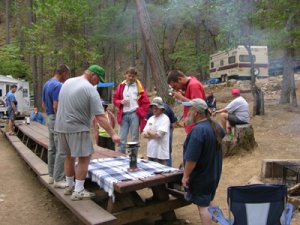
The first day on these Projects (Saturday) is always planned for setting up our group camp in the vicinity of where we will spend the week on the river – and to get all the mining equipment moved to the river and set up. Depending upon the circumstances, sometimes we even have time to get the sampling program started on Saturday afternoon.
This time, though, we used up all of the first day launching gear and positioning it on the river. This was the first time we had ever used an 8-inch dredge on one of these Group Projects. Launching the larger dredge into this particular section of the Klamath River required us to disconnect the flat bed trailer from my truck and use a winch to lower it down a sandy access trail to the river. All of this took some very coordinated teamwork and a lot of effort. But we finally got the big dredge into the river. Otto captured the following video sequence as we wrestled that big dredge into the water:
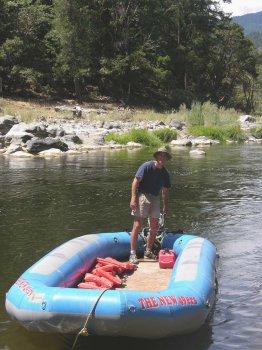
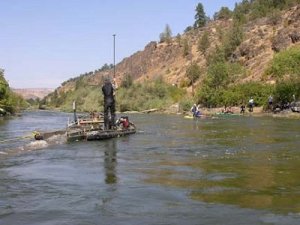
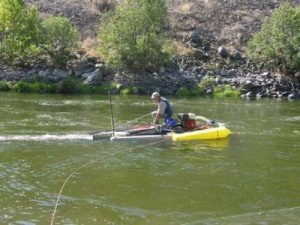
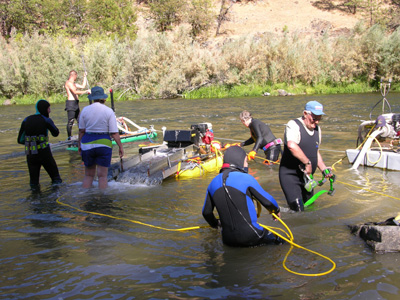
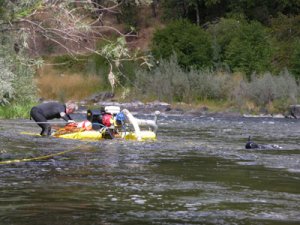
We were also using two 5-inch dredges on this Project, along with a great 6-inch dredge that Richard Dahlke had brought along. Those dredges all went into the water quite easily after what we went through to launch the 8-incher. We were using a small motor boat to help position dredges on both sides of the river, and to move people, gear and supplies up and down the river all week long.
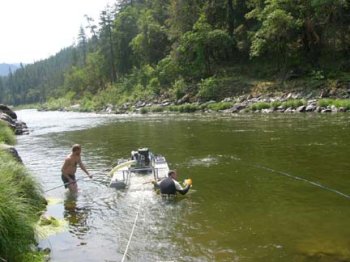
My trusty assistants, Craig Colt, Andrew Inks and Jake Urban were all present on this Project to give a hand. Our shore boss, Otto, was also present to help organize all of our ongoing support needs, capture some video, do the photography, make sure there was a pot of coffee ready every morning, and generally help with everything else that needed doing. We call Otto “Mr. Mom.” In turn, once in a while, if we start crying or complaining too much, he starts calling us names, like “Sally” and “Betty.” Otto keeps everyone reminded that life is too short to not enjoy yourself at least a little bit every day. He adds a friendly, human side to these Projects. We are lucky to have him!
Andrew and Craig agreed to manage the 8-inch dredge. Jake agreed to supervise one of the 5-inch dredges; the one where we would help beginners get through the early stages of underwater mining. Richard Dahlke agreed to supervise a team using his 6-inch dredge as the primary sampling rig on this Project.
Matt Johnson agreed to supervise the second 5-inch dredge. Matt had participated on an earlier dredging Project and had already proven himself to be a dependable and experienced dredger and team-leader. Also, from several days of dredging before the Project started, Matt and his wife, Jennifer, had already located some kind of gold deposit using their 4-inch dredge on K-13. So the immediate mission for Matt’s team was to open up that area using a 5-inch dredge and establish where (what layer in the streambed) the gold was coming from.
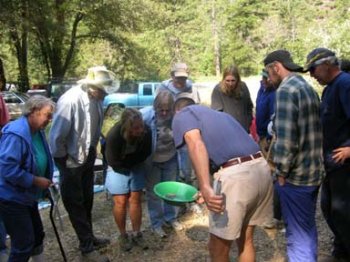
We all split off into separate teams early on Sunday morning, with each of the 4 dredges having their own assigned targets to complete. These individual dredge targets are part of a bigger sampling plan where we attempt to: (1) establish where the strongest path(s) of gold is traveling down the river; (2) establish which layer(s) within the streambed where the richest gold is located, and; (3) then locate the high-grade gold deposits within those zones.
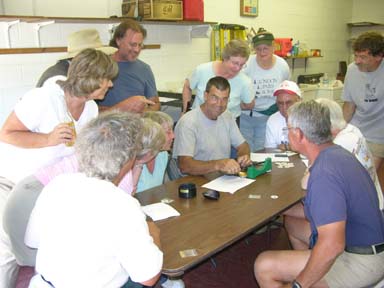
The following video sequence captured a typical morning on one of these Projects. Our entire team meets every morning to review how progress is being made on the larger sampling program, to better-coordinate our efforts and to set new targets for the upcoming day:
Since Craig’s was the most experienced team, using the 8-inch dredge, their mission was to push a sample hole out towards the middle of the river. Not surprisingly, they immediately started turning up lots of fine-sized flake-gold over towards the edge of the river. The reason we were not surprised, was because other members had already long-established a continuous line of fine gold in the hard-packed gravels along the Highway-96-side of the river throughout the entire length of K-13. But others had found higher-grade deposits out in the center of the river in the vicinity of where we were sampling. That’s what I was hoping we would find! But after several days of hard work, we pretty-much discovered that those earlier members dredged out the middle in that area. Too bad! So Craig’s team ultimately decided to devote the remainder of the week to working the fine gold deposit closer to the edge of the river.
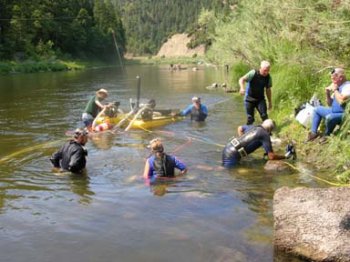
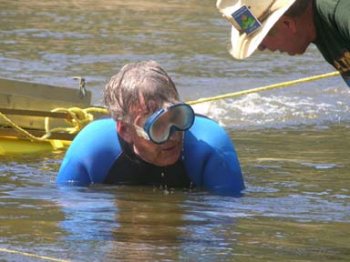
While I do oversee the bigger sampling program during these Projects, early in the week, I am mainly concerned with helping beginners work through the early steps necessary to get them underwater. This is so they can become a meaningful part of the forward momentum that is necessary to recover exciting amounts of gold from the bottom of a river. Gold mining is a volume-sensitive activity. The more work you get accomplished (in the right places), the more gold you end up with. So, early in the week, I am eager to help all participants get off to a good start. The following video sequence captured a typical setting during these Projects when we are helping some beginners to get started:
It is normal for some participants to arrive with a healthy fear of the water. Actually, everyone has a healthy fear of the water. That fear just happens to be energized more-easily in some, than others. People who arrive afraid need some special help during the beginning stages. We always start them in shallow-enough water that there is zero chance of drowning, and nearly zero chance of encountering any traumatic experience. Under very controlled conditions, we assist beginners to overcome the initial fear, simply by starting them doing things which they are comfortable with. This might begin with just floating around along the edge of the river while getting used to looking through a face mask or breathing through a hookah regulator. In a step-by-step process, it seldom takes long to be out there holding beginners just underwater so they can get used to breathing down there. Having helped hundreds of members through these early stages, I have found that most people are able to overcome the initial fear on the first or second day. By the end of the week on these Projects, most beginners have worked their way onto an important part of the underwater-production aspect of the program. Once in a while, it is a beginner that makes the highest-grade discovery of the week!
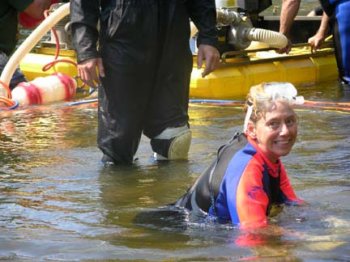 Jake’s 5-inch dredge remained in the same place all week long. This was because the dredge was recovering a handsome showing of fine gold alongside the highway-side of the river. Several beginners graduated up to Matt’s dredge that was working the very same fine-gold deposit further upstream, only in deeper water. The remainder of the beginner-team utilized the rest of the week to develop a production dredging program so they could recover as much gold as possible.
We established on the first day that the gold was being recovered out of a tan-colored hard-packed streambed layer which was resting on top of an older grey-colored layer. The key to production was to dredge up as much of the tan material as possible.
One of the really nice things about these Projects is how much help and support that team members give to each other – especially when getting into and out of the water with dredging gear strapped on. Otto captured this following sequence showing a beginner get into the water, just as he was starting to feel some personal confidence underwater:
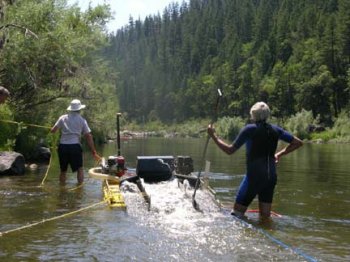 As Matt and Jennifer had already located some kind of pay-streak further upriver the week before, we decided that would be a great place for them to operate the 5-inch dredge during the first day or two of this Project. But when we towed the 5-inch dredge up there using the boat, we discovered that someone else had already moved in on the location. This turned out to be an old grizzly-looking gold miner who materialized there from 150 years ago. When we pulled up in the boat, he gave us a very friendly welcome and showed us all the gold that he was recovering from just digging gravel from the bottom of the river (using a shovel!) in about 5 feet of water. He had a lot of gold to show for his effort!
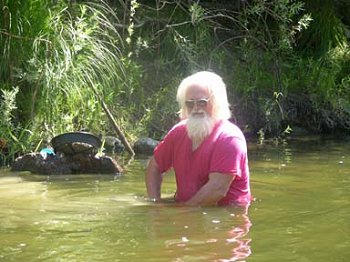 As we had already targeted that same area for some dredge sampling, but the other guy was in there ahead of us, we were initially concerned about not stepping on his right to mine the immediate location. But he told us that he didn’t mind, because he did not have the equipment to get further out into the river where we wanted to go. There was plenty of room for everyone. Otto captured the following video sequence showing us working side-by-side. It’s only one of the few times I have ever watched a prospector recovering an impressive amount of gold from underwater with the use of a normal hand-shovel!
That’s one of the great things about The New 49’ers. You are always meeting such nice and helpful people!
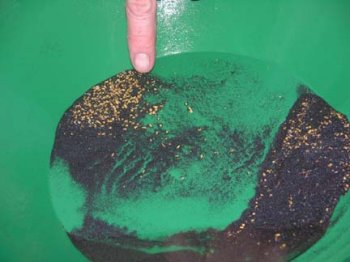 Matt’s team opened up a test hole not far upstream from where the member was shoveling gold off the bottom of the river; and it only took a few hours before Matt was showing us some incredible initial sample results. Here follows a video sequence that was captured just as Matt and Jennifer were showing off the first good sample result from their dredge:
Several participants from the beginner dredge then moved up to help Matt and Jennifer; and I have to say, that was the highest-morale I have seen in a dredge team for as far back as I can remember. They sure were having a great time!
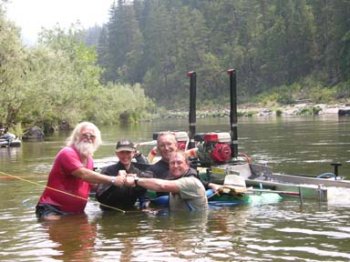
Bob Dahlke (Richard’s Dad) had specially-built a 6-inch dredge for us to use on this Group Project. What a great machine! We had to keep reminding Richard to turn the motor down so the dredge wouldn’t suck someone’s arm off! Those guys really know how to build a dredge!
Once the beginners were all doing well in the water, I spent most of the remainder of the week working close with the Dahlke team in search of high-grade gold. We were looking for nuggets, baby! I knew there was a strong line of beautiful gold nuggets extending down the far side of the river (the side opposite Highway 96), because we had a member devote an entire winter several years ago, dredging up nice nuggets off the far side. I saw the gold. Other members have also occasionally tapped into that same line of beautiful nuggets. As K-13 is such a very long claim, I personally believe that most of the nugget deposits on the far side have yet to be discovered.
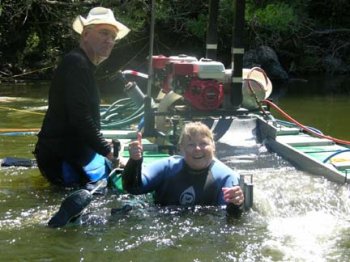 So it was with this in mind that we started Richard’s team early in the week, sampling the far side of the river. The problem was that they were finding a lot of sand over there. The thing about sand is that you never know how deep it’s going to go without at least trying to dredge a hole down through it. So you can eat up days and days just trying to reach down to find bottom!
Richard’s dredge touched down on bedrock several times in the first few days. Each time, he recovered a nice showing of gold; mostly which consisted of bigger pieces than what we were finding on the Highway-96-side of the river. We were encouraged, but mainly overwhelmed by an endless flow of sand sliding into the sample excavations.
When I finally had more time to spend with Richard’s team, we began a sampling process of swimming around with mask and snorkel, free-diving (without hookah) down to survey the bottom of the river. We were looking for places that the boulders and hard-packed streambed were not buried in sand. This is accomplished easier without the added floatation of a wet-suit. Sometimes, in deeper water, we will do bottom surveys similar to this by operating the dredge at idle-speed to provide air for the divers, and just allow them to pull the dredge around by the suction nozzle until they find a location that looks like a good place to do a sample. In this case, a shore team usually has to work the side and rear tie-off lines from the dredge along the riverbank. The following two video sequences captured this important underwater prospecting activity as it all played out:
With some help from me, Richard’s team surveyed the bottom of the far side of the river for the longest way; perhaps a quarter-mile or so. We were looking for places along the river bottom where we could get some samples without having to move a lot of sand out of our way. As we started moving upstream, we found that the sand deposits were no longer present once we got to where the water was moving along in a steady flow.
With only a few days remaining in the Project, I was very motivated to try and tap some of those nuggets! The problem was that once we got upstream of the sand deposits, nearly the entire flow of the Klamath River was directly alongside the bank in about 20 feet of water on the far side. This created near-impossible (fast water) dredging conditions! Still, just to get an idea, Ray Derrick and I went down to give it a try. The water was so fast in that place, we were mostly down there holding onto upcroppings of bedrock, flapping like flags in a strong wind! But we kept at it hard enough to get a pretty good sample; and sure enough, there were a few bigger pieces of gold in the sample result.
The problem, though, was that we could not gain access to the high-grade gold deposit from the far side of the river. The water was just too fast over there. So we found ourselves having an important discussion on the bank of the river; the same discussion I have found myself having countless times before. We knew where the high-grade gold was. How could we get it off the bottom of the river?
Basically, we had two options: One was to drop further down river to where the water slowed enough to allow us to do some work. The other was to swing the dredge across the river and try and gain access to the deposit which we had already located from over there. This second option would require us to put divers in the river on one side of the river. Then, once the dredge was running, the divers would need to walk the suction hose nearly all the way across the river to do the dredging. Operationally, this was much more difficult than the first option. But with only a few days remaining in the Project, I felt more comfortable going after the sure thing in the second option. After all, we had just found some rice-sized pieces of gold in that sample!
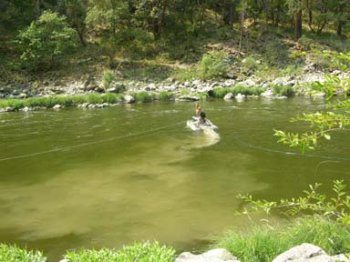
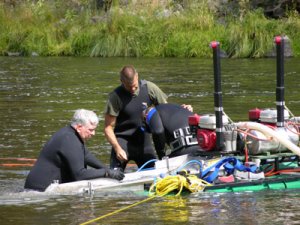
Rigging-up for this exercise meant that we would need to keep a dredge tender on the dredge platform at all times, so he or she could knock plug-ups out for us without our having to pull the dredge all the way back across the river. We rigged the dredge with two ropes; one from upstream to keep the dredge from getting swept downriver by the current; and the other from the rear, to prevent the dredge from motor-boating beyond where we wanted it to position on the river. Otto captured the following video sequence as we completed the first encouraging sample out beyond the middle of the river:
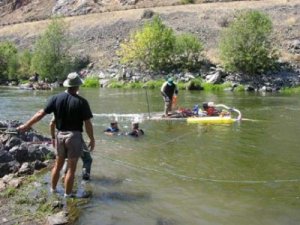
One person was placed on each of the ropes with instructions to allow the dredge to follow us out beyond the middle of the river where we wanted to dredge. This is not hard to do, because you can get a pretty good idea where the divers are by where their bubbles are surfacing. The dredge had a 25-foot suction hose which was clamped tightly to the power jet. So, as long as they allowed a little slack in the lines, they would allow us to drag the dredge out to where we wanted to go. We worked it out after a little trial and error; and soon we were back out within a few yards of where Ray and I had taken a sample off the far side about an hour or so earlier. The following video sequence captured how we were able to dredge high-grade on the far side of the river. Check out the nice nuggets we were finding out there!
But this time, since we were dredging from the slack-water side of the river, we had almost no fast current to contend with. We were making progress!
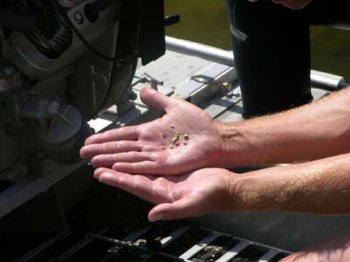 Without the fast current to slow us down, we were able to get a good sample finished in about an hour. Sure enough, when we checked the sluice box, there were some nice pieces of gold there to pay for all the effort! We were getting gold nuggets!
But now we had a new problem: The slack-side of the river we were launching from was actually a great big, slow-moving back eddy; and the silty water from our tailings was washing back around to completely eliminate underwater visibility throughout the entire distance between the bank where we were launching from, and the fast water on the far side of the river. So, getting back to the bank from the place we were dredging meant having to traverse almost all the way across the river in zero visibility. The water was deep and pitch dark (on the bottom) out there!
Traversing back out from the bank to the underwater work area through zero visibility was even harder, because it meant that we had to find the dredge excavation. This was not going to be easy!
After coming up with the first good sample result, the second underwater crew completely failed in their attempt to find the underwater work site. We all watched in amazement as their bubbles showed that they were all over the place down there; just about everywhere but where the work site was. Ultimately, both divers decided that they were not up to the task.
As the work site was actually out in the river’s current, that area was not being clouded-out by the tailings water. It was only the large slack-water area in-between the bank and the current (nearly all the way across the river) where we could not see a thing (near total darkness). It was a long way to go in the dark!
Crawling around along the bottom of a river in the pitch black can draw some serious, primal fear out of you. Do you remember those really nasty nightmares you had when you were just a little kid? That sort of thing! I suspect this has to do with deep, hidden genetic memories, perhaps from times long ago when human beings were not at the top of the food chainâ?¦
I have experienced a lot of deep, dark-water adventures in my time. It always scares the heck out of me! It is definitely not something the average participant in these Dredging Projects signs on to do!
So after our second team failed to get out to the site where we were finding the gold nuggets, we found nearly all of our project crew in a serious discussion about what to do. Several participants felt like they were up to the task. Mario Marroqim volunteered to give it a try, even though up until just a few days before, he had never even breathed from a hookah system before. Ultimately, Mario got out there without any problem.
After seeing the gold from that sample, quitting was not an option that was even considered by the team. It was just a matter of working out who and how we were going to do it. These more difficult conditions required us to pause and catch our breath.
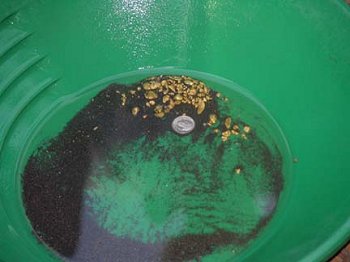
Thursday found us with several teams of divers ready to take shifts on the Dahlke dredge, along with a more-experienced shore crew that had already learned to play out the dredge lines to allow the dredge to follow the divers nearly all the way across the dark river. Since the divers could not see anything underwater in the slack-water area, we worked out a system whereby they would hold onto the suction nozzle together and just crawl out towards the far side as fast and straight as they could go, until they felt the river’s current. As the current was flowing clean water, visibility would return just as soon as they got out there. Then it was just a matter of following the current up or downstream until the excavation was located.
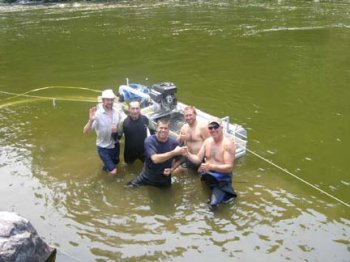 Pretty soon, we were spending more time dredging, than planning – and the gold nuggets started adding up. Here follow 2 video sequences that were captured as we were cleaning up some beautiful gold nuggets from several different dives:
Morale was very high on Thursday afternoon when it was time to dump-off the dredge-sluice from the day’s run. Besides recovering some really nice gold, we all felt a strong sense of team-camaraderie, knowing that we had overcome something difficult together; something that required courage and teamwork. It was a good feeling of accomplishment.
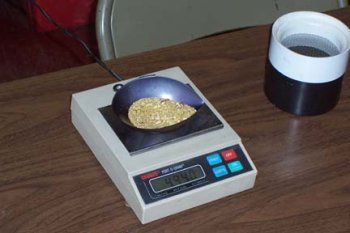
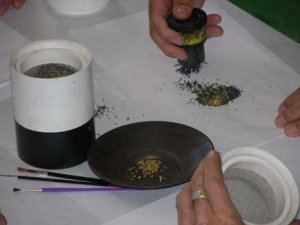
It subtracts too much time to do a final clean-up of gold production every day. So we allow all of our concentrates to accumulate in a bucket, and we deal with all of it on the final day. Friday’s clean-up on this Project was particularly challenging, because most of the week’s gold production was in fine gold.
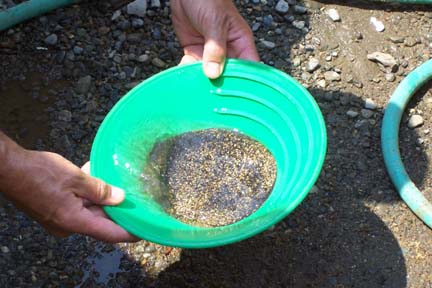
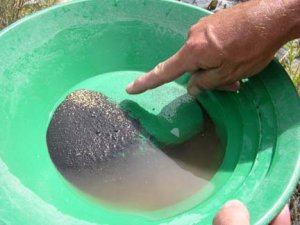
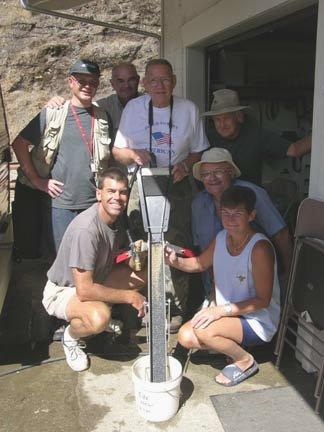
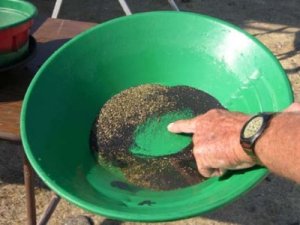
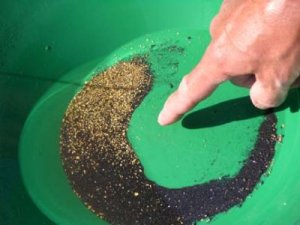
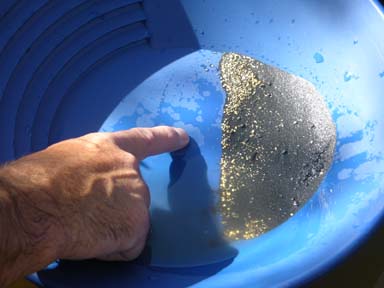
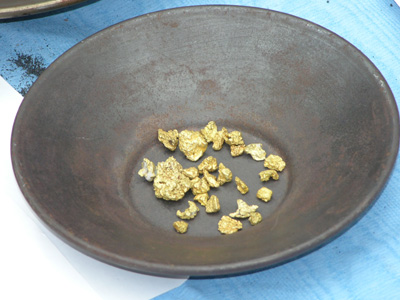
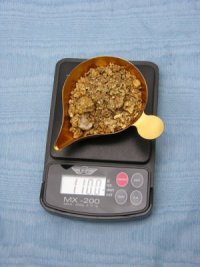
All participants always participate in the final clean-up steps. This is because there is a lot of work involved with separating all of the gold from all of the black (iron) sands. When we had all of the week’s gold concentrated down into a single gold pan, I would have bet anyone that we had accumulated at least a pound. It really looked like a lot!
The following video sequence captured the steps that we usually follow during a final clean-up. Check out how much gold looks to be in that gold pan!
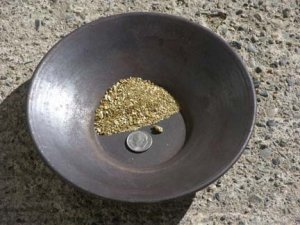
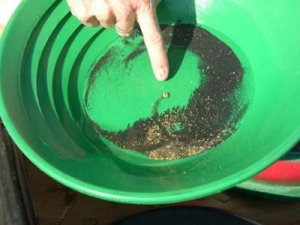
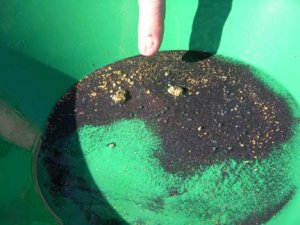
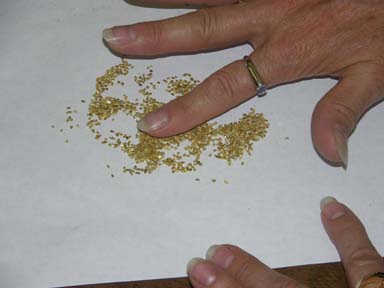
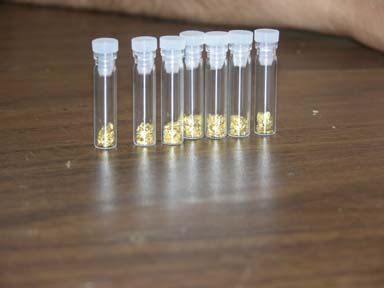
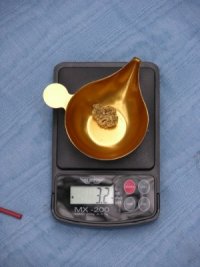
Ultimately, though, by the time we removed all the black sand from the week’s production, we ended up with a total of 4.92 ounces. There were 1.4 ounces of nuggets. The largest nugget weighed 2 pennyweights.
While we have recovered more gold in other Projects, I don’t ever recall another time when the participants needed to overcome more difficult circumstances to win the prize. This was one of those few times in life where the accomplishment in itself, along with the shared experiences, were worth as much as the gold.

 This story is dedicated to Mary Taylor, who is one of the most enthusiastic and dedicated gold prospectors that I have ever met. Mary will always be a welcome participant on any of the group mining projects that we organize!
 The next day, Jake and Lily told me that they had already crossed the river with gold pans to check out the area. They told me that the whole bar on the other side appeared to consist of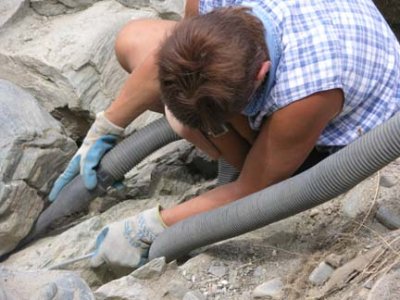
 As is usually the case, my long-time, very experienced assistants, Craig Colt and Dick Bendtzen, were participating on this project. Under normal circumstances, they do a lot of the work in the early stages of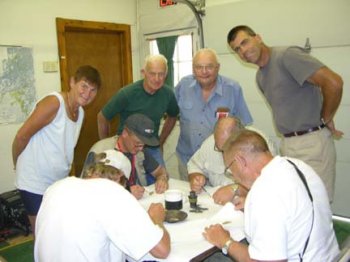
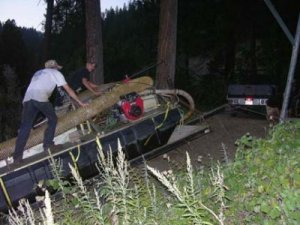 All of this created somewhat of an emergency situation where our dredge supervisors and I found ourselves down on the river after dark on the night before the project, using two winches to pull our 8-inch dredge out of the river, up the side of a rather steep embankment, and onto the road. We needed to do this to keep from losing the first full day of the project!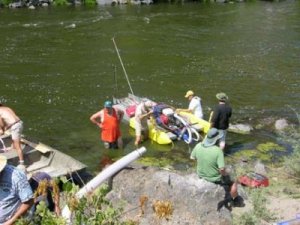
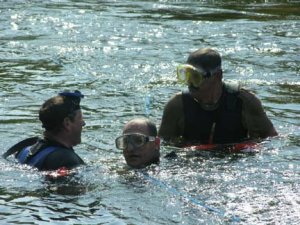
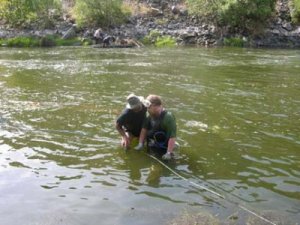 Every human being has a basic fear of the water. Some of us don’t feel that fear until some panic situation arises. For others, intense fear can be energized at just the thought of putting your head underwater. This is actually pretty normal. Through long experience, we have discovered that the key to helping someone through this is by beginning with some activity that the person is comfortable with. This might start with just sitting down along the edge of the river and getting comfortable breathing through the hookah regulator. Then, in a step-by-step process, just allowing the person some personal time to become comfortable with each step along the way, we will soon have the person breathing from the hookah regulator in shallow water. The rest is easy.
 Otto captured the following video sequences as we were using the boat to move our dredges around: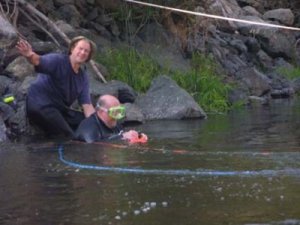
 Like Craig’s crew on the other side of the river, Jason’s team was cheering their results by the end of our first day on the river. Except that Jason’s crew was finding nice gold nuggets! The following video sequence was captured as Jason’s team was just pulling the first nuggets from their sluice box:
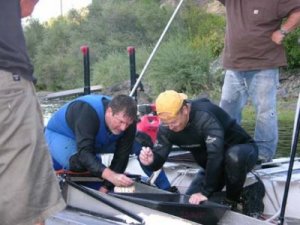 As often happens, the two dredging teams quickly evolved into some friendly competition. While it is nearly impossible for a 6-inch dredge to match the production (nearly double) of an 8-inch dredge, Jason’s team gave Craig’s team a good run for their money all week long. This was because the stronger line of beautiful nuggets was running down Jason’s side of the river. The following video sequence captured how much excitement was going around while we recovered all that beautiful gold:
 Our team was so grooved-in and organized by Thursday, that I found myself with nearly nothing to do. In fact, I was so bored, that I drank my whole thermos of coffee before noon, and had to go back to camp and brew up another pot! I am
 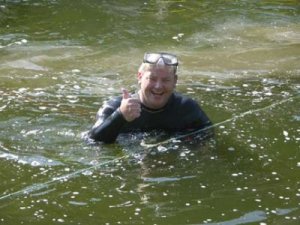 Just to give them all a good run for their money, on Thursday afternoon, I challenged anyone to dive in on a breath of air, swim out to the middle of the river, and walk the 6-inch suction hose to the bank against the strong pull of the river. This is quite a challenging task. Not having done much that day, I was hoping to demonstrate for everybody how it is done. But Andrew succeeded on his first try.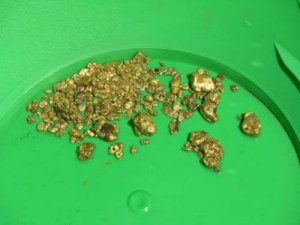
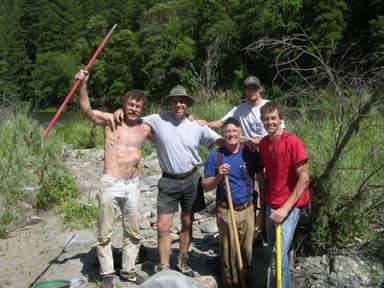
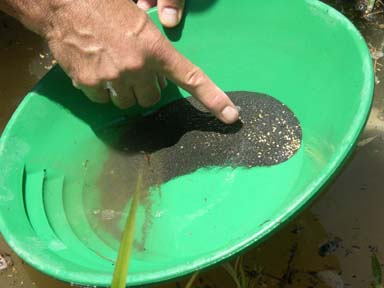
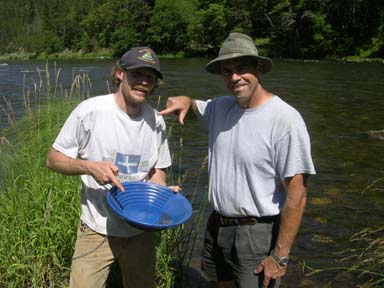

 This particular project found us prospecting on the Highway 96-side of upper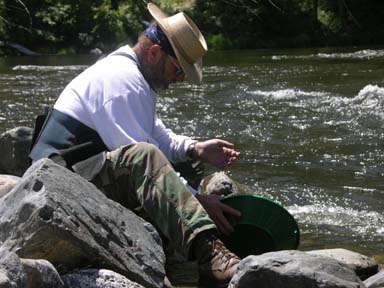
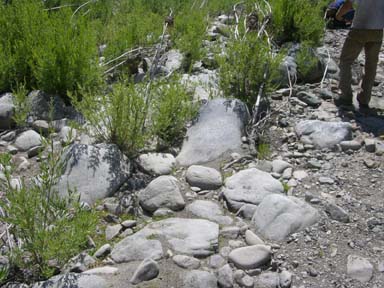
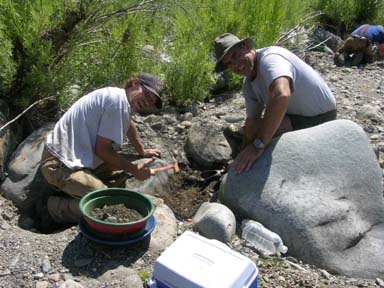 I showed up just in time to watch Craig work his sample down in the gold pan. And sure enough, there was a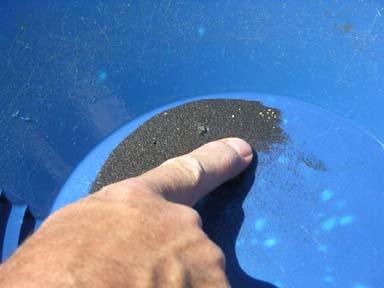

 We do a weekly
  Once I was sure the high-bankers were operating with the
 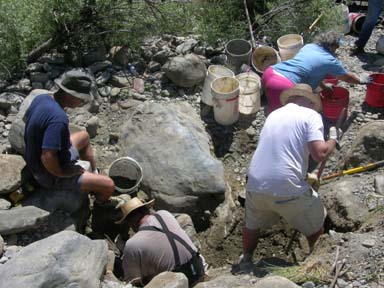 You learn early in gold mining that you can work all day and not recover very much gold if you are shoveling the wrong kind of material! But this particular group had been listening when I talked to them about this, and they were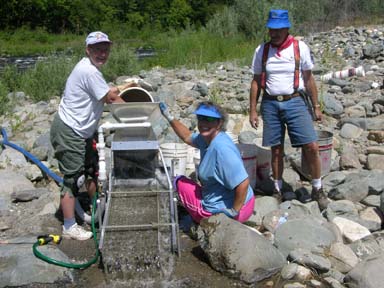
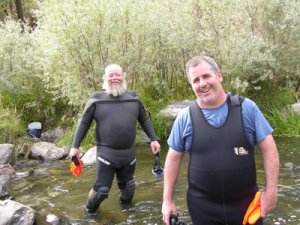 Projects sometimes require more parking than would normally be needed. They require the access to not be too difficult. These are all things we have to think about in advance. Because we don’t know everyone who will be on a Group Project until everyone shows up on Saturday morning, we have to plan for members that might not be up for difficult situations.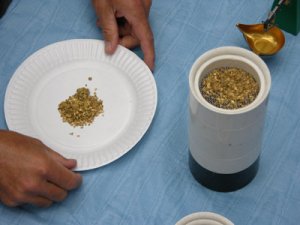
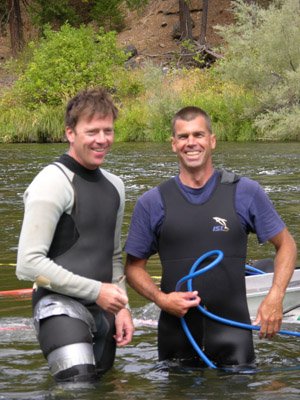
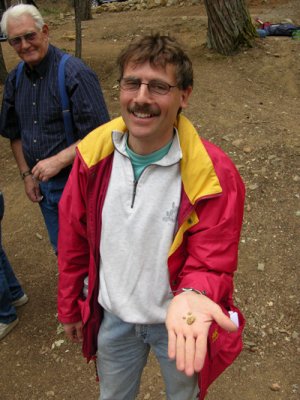
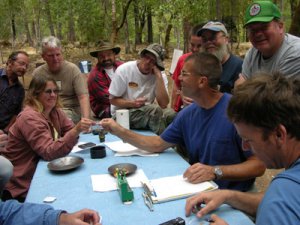


 people—what a life! Before they headed back to headquarters to clean up the concentrates, Ralph, Mike, and Ralph, Jr. (already nicknamed “the New York Boys”),
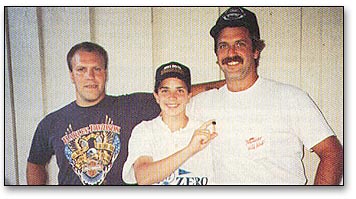 back home. The excitement from the trip stayed with them, and they recounted the events of the week as they traveled across country. Ralph had saved five full buckets of concentrate from their cleanups, and they were hauling it all the way home. He wanted to share the excitement of panning with friends.
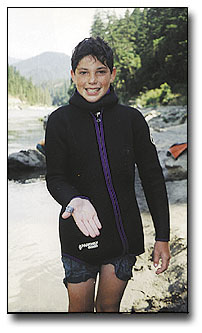 Wherever we settle in for our dredging season, we all work as a team to make our home away from home as comfortable and relaxing as it can be. The children take turns taking care of our trash, making sure we always have a nice, clean camp. Everyone takes turns doing dishes and setting the table for meals…all except for Scott and me! With six children there are plenty of extra hands, eager to be of help.
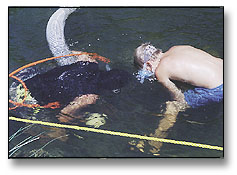 All winter long we watched all of Dave Mack’s videos, so that when we finally got to meet him face-to-face, our kids thought that they already knew him personally. Dave was very surprised, and taken aback, by all the admiration and affection our kids showered on him. If Dave Mack had a free hand, one of my kids had a hold of it. The other ones just waited until another free hand became available so they could latch on. I have to say that Dave took our children’s affection with good cheer and appreciation.
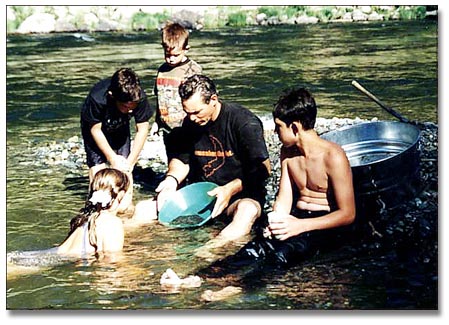 During our first week in Happy Camp the Discovery Channel (Cable TV) paid us a visit at our home on the river. Their crew was producing a show entitled “Easy Does It!” They wanted to film a piece on small-scale gold mining and they spent most all of one day with us. The cameraman filmed Scott dredging and the children panning. They interviewed both
 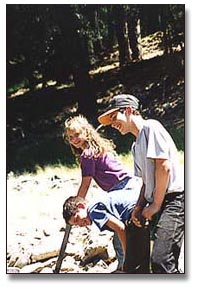 It was deep enough and safe enough for Ben, our youngest, to dive off some of the boulders. At the end of the day we would all get filthy-dirty clawing our way back up to
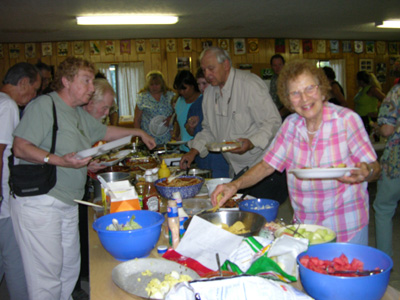
 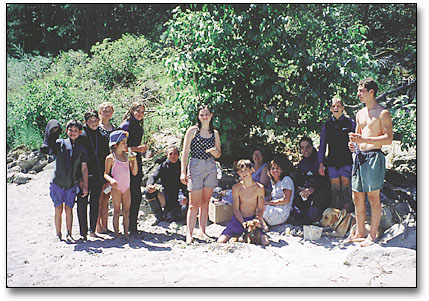 Two sets of parents, eleven children, two dogs, a pan full of gold, and a cool river on a hot day all add up to non-stop adventure and fun! We have all learned a lot from each other in many, many ways! Some of the lessons we learned together even included “bloopers,” such as: Don’t fill your dredge’s gas tank while it is still running; keep plenty of duct-tape on hand; don’t forget to wash your ears out with Domeboro after dredging; peanut butter and jam sandwiches taste best when eaten on a beach; any kind of cookies and chips will be devoured; and be sure to take lots of food to the Saturday night potlucks! Happy Camp is a great place to bring a family. There’s no doubt about it! It’s also a good place to invite your friends to come and visit. The area is really beautiful and the New 49’ers are a great group of people. They are helpful, friendly, hardworking, and adventuresome.
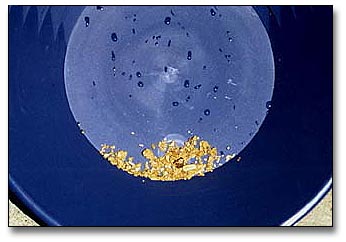 We’ve been coming to Happy Camp for the last four summers. We’ve camped in campgrounds and on a highway turn-out, stayed in a motel, “borrowed” and rented friends’ houses, and this year we’ll probably buy our own property. I will be glad to have a “permanent” place to call home during the summer when that “dredging itch” needs scratching, and we all climb into our car and head back to Happy Camp!