video subscription graphic

By Dave McCracken

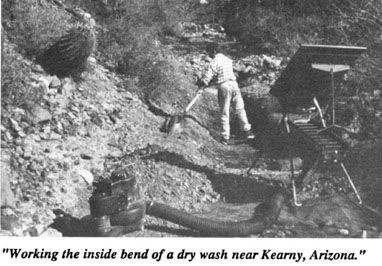
Always set up a dry-washer downwind of where you are working!

Dave Mack


Deserts consist of huge deposits of sedimentary material which have been affected by ancient ocean tides, ancient rivers, glaciers, floods, gully washers and windstorms. They are literally a gold mine of placer deposits.

There is also an enormous amount of gold-bearing mountainous dry placer ground which has remained relatively untouched by large-scale gold mining activity because of the scarcity of water required in those locations to support wet recovery methods.

Generally speaking, dry methods of gold recovery are not as effective or as fast as wet recovery methods. Yet, dry methods do work well enough that they can produce gold well if the ground is rich enough. Recent developments in dry washing equipment have made it possible for a one or two-man operation to work larger volumes of dry placer ground without water, and obtain good results in gold recovery.

Dry processing recovery systems generally use air flows to do the same job that water does in wet recovery systems. Under controlled conditions, air flows and mechanical motion and vibration can be made to effectively get rid of lighter, worthless materials. This causes a concentration of heavier materials similar to what occurs in wet processing.

SETTING UP TO WORK AN AREA

Sometimes a road can be bulldozed to your spot. Sometimes you can drive right in with a 2 or 4-wheel drive truck. In these situations, you might consider screening pay-dirt into the back of a truck and hauling it to a wash plant to be processed elsewhere. Actually, this is just slightly more difficult than shoveling directly into a wash plant. The hardest part is breaking the material away from the streambed and classifying it. It takes a little more time to haul the material to the wash plant, but that depends upon the distance and the condition of the road. It is also more difficult to shovel up into a truck. Some small operations use a portable conveyor belt to lift the material into their truck. Feeding the material from a truck into a wash plant is not as difficult, because it is usually down hill. An average one or two-person team should be able to move the equivalent of a pickup-sized load of screened pay-dirt and process it through a wash plant at another location in the period of a full day’s work-perhaps even two truckloads, depending upon the distances involved. If the material is paying well, they could do well at it, too.

DRY-WASHING PLANTS

If conditions do not allow you to truck the pay-dirt to a nearby water site to be processed by wet methods, you will have to consider processing the rich material by dry-production methods.

While dry-panning and winnowing do work, and have been broadly used as a means of production during the past, they are not normally as effective as some of the modern dry-washing plants which are available on today’s market.

Dry-washing machines use an air blowing fan or bellows-type device to blow a controlled amount of air-flow up through the dry material that is being processed. Air flows help blow off the lighter materials and allow the heaviest particles and gold to collect.

Dry-washing plants are available which can either be operated by hand or by lightweight engine and air-fan assemblies.

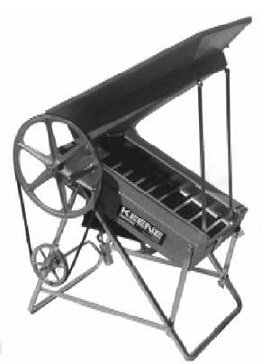
“Non-motorized dry-washing unit”

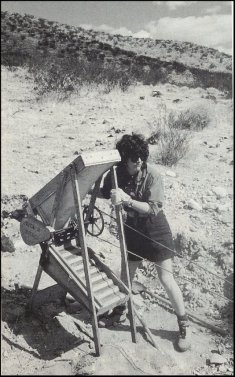
A hand-operated dry washing plant usually includes its own classification screen as part of the unit. Raw material can be shoveled directly onto it. The bellows air-blower is usually operated by turning a hand crank, which is often conveniently located so that one person can both shovel and alternately work the bellows at the same time. Under ideal conditions, two people working together can process up to a half-ton of gravel per hour by taking turns, one person shoveling while the other works the bellows.

Some units also have a 12-volt electric conversion kit to allow you the option to either hand-crank in the field or connect to a 12-volt battery for automatic bellows operation.

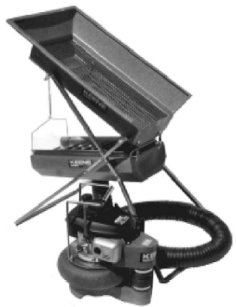
Various gasoline motor-driven dry concentrating units are available on the market which utilize static electricity and high-frequency vibration to help with gold recovery. Most commonly, there is a high-powered air-fan which pumps air through a discharge hose into the concentrator’s recovery system. The air currents which pass through the recovery system are adjustable so that the proper amount of flow of lighter materials through the recovery system can be obtained-similar to a sluice box in wet-processing. The purpose of the steady airflow is to “float off” the lighter materials through the box. Heavier materials like gold will have too much weight to be swept through the recovery system by the flow of air.

The bottom matting in this type of concentrator is usually made up of a specialized material which creates an electrostatic charge as high velocity air is passed through it from the air discharge hose. Fine pieces of gold, while not magnetic, do tend to be attracted to surfaces which have been electrostatically-charged, similar to the way iron particles are attracted to a magnet. So the bottom matting in these concentrators often attract fine particles gold to itself and tends to hold them there.

Some motorized dry concentrators also use a high-frequency vibrating device to keep the entire recovery system in continuous vibration while in operation. The way to get gold particles to settle quickly down through other lighter materials is to put the materials into a state of suspension. The vibrating device on this concentrator helps fine particles of gold work their way down through lighter materials that are being suspended by air-flows.

Here follows an excellent video demonstration which shows exactly how motorized dry concentrators work:

A motorized dry-washing machine is excellent for the production demands of a one or two-person operation. Under ideal conditions, it is able to process up to about a ton of raw material per hour, which is the equivalent of what a medium-sized wet sluicing operation can produce. This is as much or more than one or two people can usually shovel at production speed when working compacted streambed material. Most motorized dry-washers do their own screening of materials and almost everything else automatically. This leaves the operator free to produce at his or her own comfortable speed.

Total weight of the average motorized dry-washer is about 75 pounds, but the units do break down into separate pieces which can usually be carried around by a single person. So the electrostatic concentrator can be carried to a hot spot if it is worth a few trips to do so. They usually get about 3 hours to the gallon of gasoline.

SETTING UP A DRY-WASHER

There is no fixed formula for setting up the proper air flows and downward pitch on the recovery system of a dry-washer. A lot depends upon the nature of the material that you are processing, how heavy it is, whether or not the material is angular or water-worn and the purity (specific gravity) and size of the gold being recovered. Each of these variables is likely to affect how you must set your recovery system in each different place that it is operated.

The main thing to remember is that the machine needs to separate the gold from the lighter, valueless materials. If you only have a small amount of air-flow running through your dry-washer, then you will need more pitch on the recovery system-and you may need to feed the material slower. Too much air flow can also be a problem. Normally, you would compensate by adjusting to a lesser pitch on the riffle board.

Watch how the material flows over the riffle board. You should see the dirt rise up in an orderly fashion and flow over top of each riffle. It looks an awful lot like water. It is best to keep a steady feed of material going through a dry-washer at all times. The riffles should be filled about half to three-quarters, with a steady flow moving from one riffle to the next. The material in the riffles should have a fluid look to them; they should not be packed solid.

This following very important video sequence demonstrates how to set up and operate a motorized dry-washer, and it shows exactly what you should look for while making flow adjustments to obtain optimum gold recovery:

It is a good idea to shovel lower-grade material into your dry-washer while adjusting for the proper air flows and pitch. Once set, you can shovel in the pay-dirt.

One thing about dry-washing is that because it is generally slower than wet methods, the pay-dirt must have more gold. High-grade areas in the deserts certainly do exist! This is all the more reason to make sure your recovery system is set properly before processing pay-dirt. Chances are that you will not see any gold that might be discharged into the tailing pile through a dry-washer recovery system.

Another thing about setting up a dry-washing production program is that you always set up a dry-washer downwind of where you are working!

Once gold falls into the dead air space within the riffles, it will usually stay there. The air-flows are generally not strong enough to push gold out of there. There is a limit to this, however. Just like a water recovery system, a dry-washer will concentrate the heaviest materials which it processes. After some time, the heavier concentrates may require stronger air flows or a steeper pitch to keep them in suspension. At this point, it is probably time to clean up the recovery system and start all over again. If you are keeping a close eye on your recovery system, you can see when it is time to clean up. The fluidity of the material inside the riffles becomes more concentrated and slows down.

DRY-WASHING AND CLAY-LIKE MATERIALS

Material to be processed must be thoroughly dry to get the best results out of any dry-washing plant. Sometimes you will run into moist clays when out in the dry regions-just like you do in the wet streambed areas. It is also possible to find a pay-layer associated with the clay. Clays make dry-washing procedure more difficult, because they must be thoroughly dried out and broken up before being processed effectively by dry methods.

Sometimes this means the material needs to be set out in the sun to dry for a full day or more before anything further can be done with it. Sometimes it is necessary to dig clay a couple of days ahead of the processing stage. You can alternate spending a day digging and laying out material to dry, and then a day processing dried material. Sometimes, the dried clay can harden into clumps, which then must be broken down into dust and sand before you can recover the gold out of it. When necessary, all of these requirements require more time and energy. But if a good pay-streak is involved, you will find yourself doing whatever is necessary to recover the gold out of it.

It may be necessary to use rock-crushing machinery to break up hardened clay-like material and crush it down on any kind of a production -scale.

The clean-up of concentrates from a dry-washing plant is accomplished best by wet-processing methods. Usually, if you have room-enough to haul around a dry-washing plant in your vehicle, you will also have room for enough water to pan down your final concentrates, too. The following video sequence demonstrates how and when to perform a final clean-up during dry-washing:

If water is not available to you out in the field, the clean-up of your dry concentrates can sometimes be accomplished quite effectively by running them through your dry-washing plant several times. Final cleanup procedures can then be done to separate the gold from the last bit of remaining valueless material.

DESERT PLACER GEOLOGY

The chances of finding a hotspot out in the desert, or in some other dry region, are probably just as good or as your chances of finding a hotspot in the watersheds of the gold-bearing mountainous areas. These chances are pretty good, providing that you are willing to spend the time, study and work that is necessary to implement a good sampling plan.

Probably your best bet is to start off with a “Where to Find Gold” book and study the geological reports which apply to the area(s) of your interest. There has been some small-scale mining activity out in the dry regions. Much of it was lode mining, but some placer activity took place, as well. A good portion of prior activity is recorded information today. It can be of great value to you to know where gold has already been found. It is almost a sure thing that the areas which were once worked for gold at a profit were not entirely worked out. They might be worked again with today’s modern equipment at a profit. Any area which has once proven to pay in gold values is a good generalized area to do some sampling activity to see if additional pay-dirt can be found.

The desert areas were pretty-much left alone by the large-scale mining activities of earlier times because of the accessibility problem. Often, during earlier times, there was not enough water to sustain life, much less to process gold-bearing material.

But desert prospector should not limit him or herself to only the once-proven areas. Most of the desert regions have gone pretty-much untouched by past (effective) sampling activity because of accessibility problems, lack of water, and not having adequate equipment to do the job up until recent years. So the desert prospector has access to a lot of ground, and there are not that many competitors to worry about.

A single large rain or wind storm can change the entire face of the desert in just a few hours. There is very little undergrowth in these areas to prevent a good-sized rain storm from causing an incredible amount of erosion. And so you hear all the old-timers’ stories of finding bonanza-sized gold deposits, marking their position, going out after tools and supplies, and then returning to find the desert entirely changed and the bonanza apparently gone. Undoubtedly, some of these treasure stories are true. After all, many of those old-timers had gold to go along with their stories. Many of them spent the rest of their lives looking for their “lost gold mine.”

All of the placer geology concerning wet areas also applies to desert placer deposits (most which were developed during wet storm events). The same remains true of eluvial deposits-which is the gold that has weathered from a lode and been swept some distance away by the forces of nature. Eluvial deposits in the deserts (called “Bajada placers”) tend to spread out much more widely, and in different directions. This is because they are usually not eroding down the side of a steep mountainous slope. Therefore, they are sometimes a little more difficult to trace back to their original lodes. But it can be done. The answer is to do lots of sampling.

History has shown that one of the best locations to look for gold is where the hills meet the desert and fan out. This is where the water slows down during flood storms and drops gold in the gullies and washes. There also are likely to be more gold traps further up the hillside.

When doing generalized sampling in the desert, concentrate much of your activities in the washed-out areas, where natural erosion has cut through the sediments and created a concentration of heavier materials. Dry-washes, dry streambeds and canyons are good for this. Get an eye for the terrain, looking over the high points and the low points to get an idea of where the water flows during large flood storms. Areas where the greatest amount of erosion has taken place are areas where the highest concentration of gold values might be found. Remember that we are looking at many thousands of years of erosive impacts.

Bedrock will be exposed in some low areas, as in canyons and dry washes. These are ideal places for you to get into the lowest stratum of material-where the largest concentrations of gold values are often found. Large and small canyons have been formed by many years of erosion and are likely spots to find paying quantities of gold.

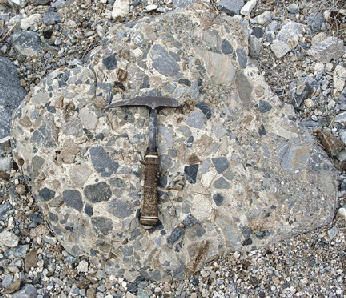
Caliche is cement-like false bedrock which is commonly found in desert placer areas.(photo USGS)

The desert and dry areas also commonly have a “false bedrock” layer specifically called “caliche.” Sometimes (often), this caliche layer is only a foot or two thick. In some areas, gold is concentrated along the caliche, just like on top of bedrock.

After a storm in the desert, in some places you can find small pockets of gold in the gravel traps, under rocks and under boulders which rest on top of the caliche. Sometimes the gold is pounded directly into the caliche and needs to be removed with a pick or crevice tool. Caliche layers which are close to the surface allow small-scale dry-washing operations to be economically feasible, because of the lesser amount of gravel and material which needs to be shoveled off the gold deposits.

Streambed material can be recognized by the smooth water-worn rocks. Anywhere in gold country, where streambed material is present, is a prime area to be doing some preliminary sampling. Such material indicates that it has been exposed to a substantial amount of running water. This means concentrating activity took place with those same materials. It is possible that the material was once washed out of an ancient river.

However, gravel and material does not need to be water-worn to carry gold in the desert areas. Rough and angular gravel, which has not been greatly affected by water, also sometimes carries gold in volume amounts. Testing is the key.

Sometimes it can be worthwhile to do some sampling in the different layers of desert material when they are present and exposed. Gold concentrations in and between flood layers can happen even more in the desert. This is because of the flash floods which can occur there.

Sometimes substantial gold concentrations can be found just beneath boulders which rest upon bedrock, or up in a layer above bedrock.

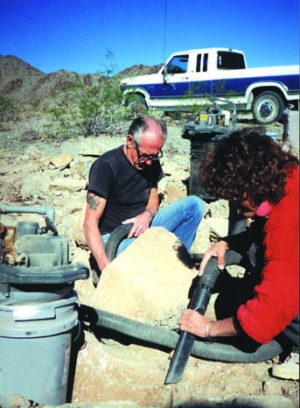
When you find a gold deposit in a dry area, whether on bedrock or the caliche, you will want to thoroughly clean the underlying surface upon which the gold is resting. Seldom will you visually see gold in dry placer material-even when there is a lot of gold present. Use a whisk broom or vack machine to clean all of the loose material. Sometimes, it is also productive to break up the surface of the caliche or bedrock with a pick or other crevicing tool.

Occasionally, in dry washes, you can actually see stringers of black sand along the bedrock or caliche-especially directly after a storm. You can sometimes do exceptionally well by following these stringers and digging out the concentrated gravel traps. Do not forget to test the roots from trees and other vegetation in such areas. Vegetation requires a certain amount of mineralization to grow. Roots can grow in and around high-grade gold deposits. I have heard of single roots which have been dug up and produced as much as three ounces of gold!

Some electronic prospectors use their metal detectors to trace concentrations of black sand. Then they follow up by testing the areas which produce the strongest reads from their detectors.

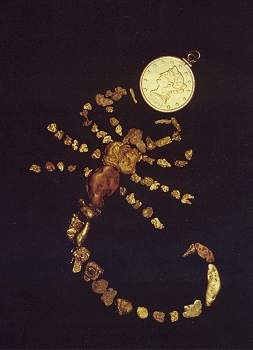
Some desert areas, like Quartzsite, Arizona, also have gold just lying around anywhere-even on top of the ground. Such places are excellent for electronic prospecting and dry-washing. The deserts of Australia are famous for this. I have a number of friends who have been very successful in the Nevada deserts, using metal detectors to recover large numbers of nuggets, some very large, directly off the surface of dry desert ground.

If you find a piece of gold on the surface of a dry placer area, it is likely that there are more pieces of gold in the immediate area. Electronic prospectors call these areas “patches.” Gold generally does not travel alone-unless it was dropped there by mistake.

Sand dunes in the desert are usually not very productive. This is because they mainly consist of lighter-weight sands that were deposited there by the wind. However, sometimes the wind can blow off the lighter-weight sands from a particular location, leaving the heavier materials exposed behind. This is similar to what happens after a big storm at the gold beaches. This is something that should be watched for.

When prospecting around in the dry areas, when you encounter tailing piles from past dry-washing operations, it might be worthwhile to do some raking of the tailings and scan around with a metal detector. Sometimes old tailing piles can be productive enough to run them through a modern dry-washer.


By Jude Colleen Kendrick


Dry washing1I remember, in my beginning days of prospecting, driving through the Upper Mojave Desert in Southern California, looking for mines to explore and tailings to scratch through. Occasionally, off to the sides of the road, I would spot small areas where dust and sand billowed up. At first, I thought that they must be “dust devils,” yet they never seemed to change position. In my imagination, I wondered if someone was sending up smoke signals, because that is what they appeared to resemble. One day, I decided to satisfy my curiosity and follow a dirt road up to the puffs of dust.

As I drove up, I saw an old man shoveling gravel into what I now know was a dry-washer. My own previous experience in gold mining had been with suction dredges, so I was excited at the possibility of another way to find gold! The gentleman was kind enough to show me how his dry-washer worked. He explained that he also dredged during the summer. But during the winter months, he headed for the more moderate desert-climates. The thought came to me that now I could prospect year-round, and that everyone in my life would really be annoyed at that. This was because I didn’t leave much time for anything else but gold prospecting, as it was!

For a more comprehensive explanation about dry-washing, please click here.

The old prospector’s machine was a “Nicks Nugget;” which, as I understand it, was constructed upon the design of an “Old Beck’s” dry-washer. It basically worked from a large bellows which was run by a small gas engine set up around 10-feet away (to separate the motor further from the dust). There was a 10-foot leather belt attached to the pulleys. I noticed that the pulleys were connected in such a way that the entire machine vibrated when the bellows opened and closed. The man told me that he would not have any dry-washer other than a Nicks Nugget I, of course, asked him where I could find one for myself. He told me, “Someone one has to die, because they are not made anymore and that’s the only way you’re ever going to buy one!” That is exactly what happened about a year later. An old prospector in the town of Randsburg passed away. I heard that his equipment was being sold and bought the Nicks Nugget!

Drywashing machineMy machine has great recovery. I have tested my tailings throughout the years; and to my knowledge, I have never lost a single speck of gold!

The desert is peaceful and quiet. At night, you can see the sky and stars in a way that is beyond words…

I should point out that dry-washing is a dirty way to prospect. No matter where you set up the machine so that the dust blows away from you, the wind figures out what you are doing. Then it changes direction so that you get a mouth-full of dust with every shovel-full of gravel! I suppose this is just one of Mother Nature’s many ways of making you pay dearly for her most cherished golden treasures!

Most of the time, I wear a bandanna, which helps a little. But when I go back to camp, I still look like “Pig-pen” from the Peanuts cartoons! Still, it has always been worth it.

Winter in the desert can be hard at times, because the temperature-changes are quite drastic. It will be a comfortable 70 or 75 degrees during the day. Then, the afternoon winds can gust up to 60 miles per hour, and the temperature can drop as low as 20-degrees during the night. I woke up one morning to find that all of my panning water was frozen solid. I could not believe it!

The desert also demands the most out of your creativity and imagination. Very often, we all forget some part of our equipment, no matter how careful we are about packing. Yet with a little thought, anything can be fixed. On one trip, I had forgotten my large panning tub, so I ended up digging a hole, lining it with a large plastic garbage bag, holding the edges down with rocks. Presto; a baby swimming pool! I used it to pan down and perform final clean-up on the concentrates from my dry-washer.

Another time, the worst possible items were forgotten; which were the legs to my dry-washer. Can you imagine? I was frantic! After a few moments of figuring my whole trip was for nothing, I looked over the poles from my picnic awning, and the light went on in my head. Shortly thereafter, I took two of the poles, broke them off at the length I needed, and punched four holes in the poles for the nuts and bolts. Within minutes, I was already cranking up the dry-washer. There is always some solution if you are in the right state of mind; you just have to find it! I’m sure this is all just a part of gold prospecting.

The beauty of the desert makes up for any discomforts which you may experience along the way. Usually, nobody is around for miles. It is peaceful and quiet. At night, you can see the sky and stars in a way that is beyond words. And the gold has always been there for me, from flour to nuggets of various sizes and shapes.

One of my favorite things to do while dry-washing is run my machine all day, collect all of the concentrates; and then at night, by lantern-light, pan everything out! There is something wonderful about working everything down to that glimmering, beautiful gold at the end of my day!

During my years of dry-washing, I have spent Christmas out in the desert a number of times. One year, I grabbed three friends (who have parents and family in other states), and took them to one of my mining claims for a “different” type of Christmas celebration. We decided we would cook our turkey on the BBQ and try to make the side dishes on the Coleman stove. A friend of mine had hooked-up an apparatus so that my rotisserie on the BBQ worked off a 12-volt battery. It was great!

My friends and I thought everything was under control until we realized we had bought too large of a turkey. So we ended up eating our Christmas turkey at 10:30 at night! By then, we had already eaten all of the side dishes as “appetizers.” After a few toasts of champagne, nobody seemed to care much about how or when the turkey was done! It was sometime during that evening that one of my friends decided to make a “snowman” out of three large round lava rocks. Even though there was no snow out there, we found ourselves making the best out of our situation. I’m certain that none of us will ever forget that Christmas experience!

Now-back to the important thing — gold! I have usually dry-wash alone; but when I do have a partner, it certainly makes things a bit easier on both of us. One person can be breaking-up the gravel while the other can shovel. During one of my trips, I ran into my friend Ed “Half-Bucket” Daugherty. So we decided to team up for a while. Later, when we realized that we were onto some good gold, he and I were both feverishly shoveling gravel into my machine so fast, that several times we crossed our shovel handles and sent gravel flying everywhere. To this day, I am convinced that it was those lost shovelfuls which had the big nuggets in them! I’ve often wondered if “Half-Bucket” ever went back out there to get them…

I once watched a young man with a whisk broom and dust pan going from one prospect hole to the next, left behind by other people. He merely swept the shelf completely clean and panned-out what he had collected. He found more gold that way than I did running yards of gravel into my dry-washer! So I started using this method, but took it a step further. I took a gas-powered vacuum, sucked up the layers left on the shelves by others, ran that material through my dry-washer, and then panned-down the concentrates. Trust me; by following this method, I have always recovered a lot of color and sometimes a small nugget or two. I nicknamed this method “dry crevicing.”

While I have not tried it yet, I have run across others in the desert who have made fantastic gold recoveries using modern metal detectors to locate pockets and “patches” of nuggets. I have this plan of trying to combine modern electronic detecting with dry-washing…

At the time of this writing, it remains a little warm to start working my mining claims in the desert. Writing about it, though, has me counting the days until the weather cools.

Until then, I’ll look at my gold from last season and imagine my bottles completely full for the next time.

But even if they aren’t full, the desert and dry-washing are wonderful for the winter months. I can’t wait! Good Luck!!


By Dave McCracken

Every successful gold miner will tell you he or she is absolutely willing to devote whatever time and energy is necessary to locate the next discovery!

Dave Mack

Why is it that some people are able to succeed well at gold mining on a continual basis, while others have difficulty making it work?

There are a multitude of factors which contribute to the success or failure of any operation, but there is one factor which I feel underlies all the rest. It has to do with time.

Upon close inspection, you will find that every person who is doing well in these activities, other than the occasional lucky person, has been willing to devote a great deal of time to his or her mining activities. While luck does contribute to some excellent discoveries, you will find that good luck comes around more often when you spend more time searching for gold.

Unquestionably, there are skills, techniques, and standard procedures to learn in order to succeed well in gold mining. It takes time to get through the learning curve.

People who get involved with the idea of getting rich quick are usually disappointed. People who are willing to devote whatever time is necessary to polish their skills, and who are willing to devote themselves to locating the next discovery, usually do pretty well.

And, it is not necessarily true that you need to spend a lot of time before you start making important discoveries. It is mainly the willingness to devote lots of time. We have seen many beginners, who were approaching the activity with the correct viewpoint, do very well right from the start.

Most good things in life take some time to develop. Get rich quick schemes tend to cheapen the value of an activity. More often than not, it takes time to do things the right way, to make things come out good in the end.

Older people, wise with age, often say that their most worthwhile accomplishments took lots of time and energy. And, for them, the time and energy spent was the best part of it!

There are few activities which are better, more exciting, and more rewarding than gold mining and treasure hunting. While it can be aggravating at times during the testing stages when you are not finding what you are looking for, this just makes the thrill of discovery all that much better.

Every successful gold miner will tell you he or she is absolutely willing to devote whatever time and energy is necessary to locate the next discovery. And this is a lesson we could all learn from.


“Shallow water dredging can be very rewarding”


When it comes to small-scale gold mining, disability does not mean inability. It simply means that we must make accommodations. If you want to say that you can’t do something, then you won’t be able to do it. Your disability, when it comes to mining, is a state of mind. There is a form of small-scale mining that will fit everyone.

Possibly, I have been fortunate in being able to find miners to show me how to mine. Almost everyone I have run into has been more than willing to help, but better than that, they were willing to share their knowledge with hands-on demonstrations. Using this information, I have been able to determine what accommodations I must make for my personal disabilities.

Most of us are unwilling to accept the fact that we may not be able to do something. I think those of us with disabilities may have a greater failing in this. I’m as guilty as anyone.

I started out with a pan and a couple of buckets, and then added a sluice. What I hadn’t properly learned was how to pan. With two bad shoulders and a lack of breathing capacity, the standard panning style just doesn’t work. An old miner with arthritis in his back showed me how he does it, and it works. Confidentially, I still don’t pan well, and that’s why I own a mechanical panner. The next step up was a 2 1/2-inch dredge. It breaks down into manageable loads, and I call it a “four tripper.” Four trips for me to get it in or out of an area.

Keep in mind that miners are a friendly and helpful group. If you are having trouble moving equipment, then ask for help, but I’ll bet you are offered help before you ask. Don’t let anyone kid you, shallow water dredging can be very rewarding. You may not be pulling an ounce a day, but what’s wrong with a couple pennyweight? Also don’t forget that at the end of the day you are going to have to do something with the concentrates you have produced during the day. They weigh twice as much at the end of the day when you are carrying them to your vehicle.

The biggest mistake I made was to let my desire to move more material overtake my common sense. I bought a 4-inch dredge. It became a six-plus tripper. After putting it in the water twice, being exhausted each time, and having friends become very concerned when they watched me move the loads, I have given up on that idea. I’m now back to the 2 1/2-incher. I recently saw in a magazine article a listing of what the author felt was the minimum dredge set-up to start out. He felt that a 4″ dredge was the best, and this included air. I won’t argue too much, but my concern is really with the many miners who begin using air without training. For the person with a heart or lung problem, the compressed air could be a killer.

Another alternative to consider is having a partner. It can be your wife, girlfriend, or just a friend. This way you can share the equipment-moving chores, and you can complement each other when it comes to the mining. If nothing else, someone has to carry the drink cooler and be “straw boss.”

Small-scale gold mining can be good exercise, but know your limits. Have a talk with your doctor to see if there may be a change in your medication due to exercise or altitude. My medications do change when I’m on the river. Your doctor will probably look at you like you are crazy when you say gold mining. Just show the doctor some of the gold you have found. You may end up with the Doc on the river, too!


By Dave McCracken

This system combines two classification screens to more-effectively separate material-feed into three separate size-fractions, each which is directed into a different recovery system.

Dave Mack


Riffles in box Three sections of screen

Classification is the Key to Fine Gold Recovery

It is well-established that if you want to effectively recover finer particles of gold, you must first separate them from the larger-sized materials which are being washed through your recovery system by a higher-velocity flow of water. The small-sized material can then be directed to a milder-flow of water over a shorter set of riffles. The smaller you can classify the size of the material, which can be directed by and even milder flow of water over lower-profile riffles, the finer-sized gold that you can effectively recover.

This is all rather easy to accomplish with surface processing plants where earth-moving equipment can be used to feed a plant some distance above the ground. Feeding a plant well above the ground allows plenty of drop for water and gravity to direct material through multiple sizes of classification screens. Then, gravity can be used to direct the different size-factions of material to separate recovery systems with controlled water-flows and riffle sizes specifically designed to recover gold effectively from each size-fraction.

Conventional Suction Dredges do not allow for Much Classification

I am not sure what the exact formula is, but I know from long experience that every inch you lift the feed of a suction dredge above the surface of the water, you lose a considerable amount of suction-power at the dredge nozzle. Therefore, since we have to accomplish both classification and gold recovery from a feed that can only be effectively lifted about 4-to-6 inches above the surface, our options are pretty limited.

Dredge manufacturers have worked out different ways to direct classified materials into slower-moving recovery systems. Generally these methods fall into three categories:

1) Placing a classification screen over top of a set of riffles. This way, smaller-sized material can fall through the screen into a slower-moving flow of water over riffles that are more-protected from higher-velocity water-flow. You see screened-over riffles in common use today.

2) Placing a classification screen towards the head of the sluice box, and then directing the classified material to one or two completely separate sluices which have a slower-moving flow of water over lower-profile riffles. This was most commonly seen in the form of side-by-side triple sluices during the 80’s and early 90’s. While effective, the problem with the side-by-side sluices is that the side sluice(s) normally have to be placed on top of the dredge’s pontoons. Therefore, in order for gravity to make everything work right, the initial feed to the dredge has to be lifted higher out of the water. This causes a power-loss at the nozzle. So you do not see as many side-by-side recovery systems in production on suction dredges these days.

3) Placing a classification screen somewhere towards the upper-end of the recovery system, and directing the classified material to a slower-moving recovery system which is located directly below the main box. This is commonly referred to as an “over-under recovery system, and remains in popular use today. An over-under system is most commonly accomplished in the same basic sluice box, which is constructed with a removable false bottom. By this, I mean two separate recovery systems, one sitting over top of the other, in the same sluice box.

I cannot go into which of these systems are better or worse; because there are too many variables in play, and experienced prospectors can work it out to get the best recovery possible out of any of these designs, each which would likely be comparable to the other. That’s because all three of these system concepts depend upon a single classification screen to remove some portion of the smaller-sized material from the higher-velocity water-flow which is required in a dredge.

This particular discussion has more to do with the effectiveness and size of material-classification. Remember, with conventional suction dredges, we are using water-flow to move all our material across any classification screen(s) that we are using. The larger the dredge, the faster and more powerful the water-flow must be to wash larger-sized rocks and a larger volume of material through the sluice. The faster the flow, the less time that smaller-sized material has to drop through a classification screen. The smaller the openings in the screen, the less opportunity smaller-sized material has to drop through the screen. The shorter the screen, the less opportunity smaller-sized material has to drop through the screen.

Each of these factors combine into to the effectiveness of the dredge’s classification. For example, the substantial flow of water to move 5-inch sized material over 10 inches of 1/8th inch punch plate does not present much opportunity for minus-1/8th material to drop through the screen. So while a separate slower-moving recovery system might be doing a better job recovering smaller-sized gold, perhaps the classification system is only allowing 5% of the finer-sized gold to be directed into the slower-moving recovery system. In other words, the effectiveness of your recovery system is largely affected by how you are attempting to classify and separate the smaller-sized material.

Therefore, on the subject of fine gold recovery with suction dredges, our first challenge is to try and accomplish effective classification as best we can out of a strong flow of water (strong enough to move the largest rocks you are sucking up through the recovery system).

Years ago, we overcame this whole challenge on commercial dredges by working out a mechanized shaker screen at water level which provided 100% classification of the dredge feed. Minus-sized material from the screen was dropped into a sump where it was redirected by a gravel pump to an elevated feed on a surface-type recovery system either on the shore, or on a separate floating platform.

But it is impractical and too expensive to try and place a mechanized classification screen on smaller-sized dredges — which also must remain more portable for sampling. Therefore, on conventional dredges, until someone comes up with something different (if ever), we must continue to make due with a water-flow to wash material across our classification screen(s). With this in mind, here are a few principles which I believe to be true:

1) The faster the flow, the more difficult it is to drop finer-sized material through the openings of a screen in your sluice box.

2) The smaller the holes in the screen, the less finer-sized material you can expect to drop through the openings out of the high-velocity flow required to move larger material through your sluice box. Example: Using the same flow of water and material, you could expect more fine-size material to drop through a 3/8-mesh screen, than a 1/8-mesh screen. This is because the larger openings provide a bigger doorway for material to drop through.

3) The shorter the length of a classification screen, the less fine-sized material you can expect to drop though. Therefore, we want the classification screens to be as long as we can get away with. Longer screen means more opportunity for finder-sized material to drop through.

4) Effective classification of finer-sized material can be accomplished better in stages. For example, first drop 3/8-minus material out of the fastest flow in the box. Then, using a slower flow of water, direct the minus-3/8 material over a 1/8-inch screen.

5) Since we only have 4 or 5 inches of drop to work with from the feed of a conventional suction dredge, there is only room for two levels of classification screen before we must drop the finest-sized material into a recovery system. Otherwise, we will be underwater where reduced gravity is not going to allow water-flow to work for us, anymore.

What to use for a fine-gold recovery system?
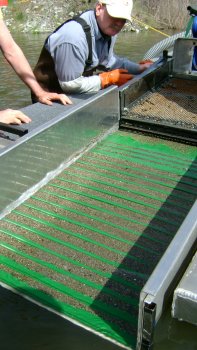
material in rifflesAs I have explained elsewhere, I believe it is necessary to direct finer-sized material over lower-profile riffles that will continue to remain fluid under a mild flow of water, even when they are full of concentrated (heavy) material. If you have not reviewed the theory on this, I strongly suggest you read “The Size of Riffles.”

There are different kinds of low-profile fine gold recovery systems on the market. Just take a look around and make your own choice.

We have been using the green, plastic Le Trap sluices to reduce the volume of our dredge and high-banking concentrates all the way back to the early 90’s. I cannot overstate how effective these Le Trap Sluices are. When set up with the proper water-flow, a Le Trap will recover all the visible gold from a feed of minus-1/8th material with losses that are so minimal as to be meaningless. We know this from panning the tailings hundreds of times over the many years.

So when we needed something to recover overwhelming amounts of fine gold using a dredge on a river in Cambodia, I started giving a lot of thought to how we could more-effectively classify dredged material down to minus-1/8th, and direct the material in a controlled flow over Le Trap-type riffles.

Dredge 1Dredge 2

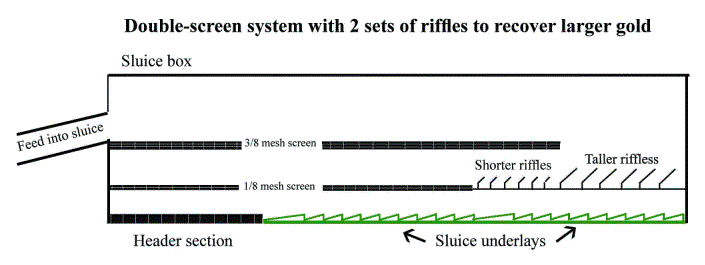
Several very experienced dredge-builders and I created the prototype several years ago from a Precision 6-inch dredge. To accomplish our objective, we assembled two layers of classification screen, each which could be independently raised or lowered, so that we could adjust the water-flow over the riffles, and over each of the screens. The top screen is 3/8-inch mesh. This is to allow the larger-sized material and strong water-flow to wash through the box without affecting the plastic riffles along the bottom. Minus-3/8ths material drops through the top screen onto a 1/8th-inch mesh screen, where the water flow is substantially reduced. Slower water-flow then allows finer-sized material more-extended contact with the 1/8th-inch screen.Double screens over riffles
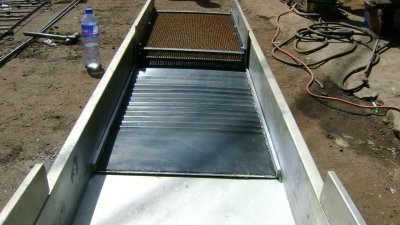
Material that drops through the 1/8-inch screen is then carried over the Le-Trap sluice by a mild flow of water. By adjusting the height of the lower screen over the plastic riffles, and the slope of the sluice box, we are able to control the amount of water-flow over the lower-profile riffles.

Since the sluice box in the 6-inch Precision was much wider than a normal Le Trap sluice, the prototype required quite a lot of work in a cut and paste project (using of 4 or 5 Le Traps) to create the first underlay recovery system for a dredge.
Fine goldWe invested quite a lot of time and energy into the prototype. All you have to do is look at how much (very fine) gold we found on that river in Cambodia to understand why we did it. We were shipping this 6-incher over to resume (sampling) where we had left off on that earlier project.


During trials on the Klamath, I was amazed at how much (very) fine gold we recovered out of just a minute or so of dredging loose material off the surface!

Our trial run on the Klamath River near Happy Camp in March several years ago turned up so much fine gold out of the lose surface gravel, that I hesitated over sending the 6-inch prototype to Cambodia!

I have been told for 30 years that there is so much fine gold in the river that we are losing out of our conventional dredges, if we could just recover it, we could make the river pay just by pumping any gravel! This new system seemed to prove that theory may be true, especially with these higher gold prices. But it was March and the Klamath was cold; so we shipped the original prototype dredge to Cambodia.Cambodia Dredging
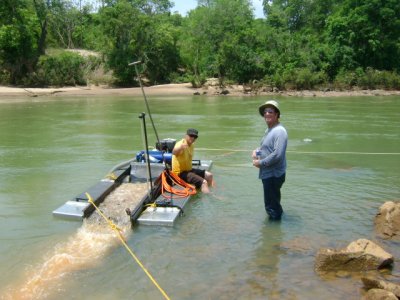
I devoted plenty of time in Cambodia (underwater) observing three separate flows of material coming off the back-end of the recovery system; and it was poetry in motion!

I have a non-disclosure agreement with our clients in Cambodia, so I cannot go into details or images of how well the new system performed over there. But I can say that I devoted a lot of time underwater watching water and material exit the sluice box in three separate flows; and the double-screen system is by far the best thing I have seen on a conventional dredge for effectively classifying material into three separate size-fractions.

Because of that, my experienced buddies and I invested quite a lot of time during the 2009 mining season to adapt the double-screen system to my 8-inch dredge. 8-inch dredge
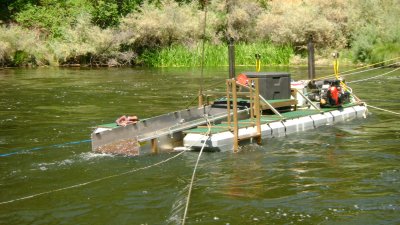
Building double classification screens, so they can be adjusted up and down to allow you to set three separate water-flows through the sluice box, requires quite a lot of labor! But getting this right is the foundation of this whole concept.

Here are some video links which demonstrate the system being used on my 8-incher. These give you a much better look at how we created a double-screen classification system over top of the fine gold recovery: Take a look at the size of the gold we were recovering!


As (bad) luck would have it, the State of California imposed a temporary ban on suction dredging just as we completed the double-screen refit on my 8-inch dredge. This forced us up onto the Rogue River in Southern Oregon, where we are limited to smaller-sized dredges. So my 8-incher had to be set aside.

Picking up on the idea of my double-sluice conversion over a plastic sluice, one industry-fabricator was recently promoting the idea of refitting conventional sluices (using the plastic sluice underlay) which do not include the double-screen classification, and do not allow the screens to be adjusted. I would advise caution on short-cutting these concepts. That is what prompted me to write this article. Since these conversions must be accomplished through custom shop work, I wanted to provide you with some background so you can make your own decisions.

While there is still a lot to learn, for the reasons I outlined above in points 1 through 5, I personally do not believe that you can classify raw material effectively from a 4, 5 or 6-inch (or larger) dredge being washed across an 8-mesh screen by high-velocity water.

I believe effective classification must be accomplished in stages; first to drop the 3/8-minus material out of the higher-velocity flow which is needed to push the larger-sized material through the sluice. Then, drop the 1/8-minus out of the much slower flow necessary to wash 3/8-inch material across the lower screen.

I believe you have to be able to adjust the height of each screen (set the water velocity) in order to get a workable water-flow over the riffles and over the 1/8-mesh screen. The water-flow cannot be so much that you boil-out the riffles, and it cannot be so little that you load the riffles. You also must not pack up the space between the two screens!

Eric Bosch and I first experimented with this double-screen concept in the early 90’s. But we made the mistake of fixing both screens (welded them where we estimated they ought to be). Our estimate of how much water-flow was needed between the screens was incorrect; the space between the screens packed solid with material; and the whole system failed.

Also, if you cannot adjust the water-flow over the riffles, and between the screens, you cannot compensate for different conditions in different areas.
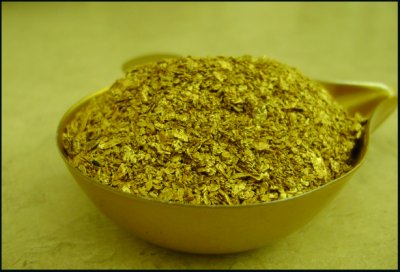
Dave's goldAs an example, there is an overwhelming amount of heavy black sand and small iron rocks (and lead) along the Rogue River in Southern Oregon. We do not encounter this magnitude of heavies on our properties along the Klamath River in northern California. The heavies along the Rogue completely overwhelmed my fixed recovery system (buried the riffles on my 5-inch conventional dredge) at the beginning of last season. This prompted me to place smaller riffles below my (fixed) screen, spaced further apart. That worked better, and I recovered a lot of gold. But I believe I lost most of the (very) fine gold (I could see it in the last riffle) that was fed into my sluice box. This has prompted me to refit the recovery system on one of my 5-inch dredges for the upcoming season.

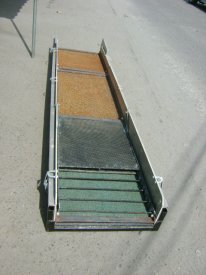
The images at the beginning of this article show an early version of the double-screen system that was designed for deposits we located in Cambodia. We did not find a single particle of gold on that river that was larger than the size of a pinhead. Since larger-sized gold was not present, we did not want to waste the (very) limited amount of room we had to work with by installing riffles for larger gold. Those images are helpful in showing the plastic sluice underlays (there are two of them, one following the other).

The images at the beginning of this article show the Cambodian version of the double-screen refit. Those images are helpful in showing the initial plastic sluice underlays that we were using (there are two of them, one following the other).

Header areaHeader with screen and miners moss

The images in this article also show a header section near the upper-end of the box. My initial theory was that the initial impact of the water and material must bottom-out on something other than plastic sluice underlays. We experimented with a combination of different kinds of heavy screens over top of miners moss or ribbed rubber matting to absorb the initial force of the water and material where it bottoms-out at the head of the sluice box. Fortunately, nearly everything we have tried in the header section seemed to work really well. As you will read below, we have since evolved completely away from using plastic sluice underlays… Header area after running
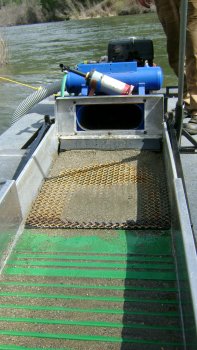
This is what the header area looked like under the screens when we shut the dredge off while dredging at production speed. You can see how classified material kind of mounds up there before flowing onto the slick plate of the riffle system. We are finding that quite a lot of (very) fine gold also gets trapped in the header section!

We have noticed that while in production, material tends to mound on top of the header section under the 8-mesh screen, and then wash off the mound onto the first sluice underlay. This is really good, as long as the mound does not rise up and pack-up the whole space between the screens.

While we were still using them, the plastic sluice underlays followed just behind the header section. This allowed water-flow and material to settle out and slow down before being washed across the lower profile riffles.


Two kinds of rifflesriffle section

Notice that the shorter section of riffles (remains protected by the top screen) are present only to process classified material which washes across the 8-mesh (lower) screen in the box.

Adding larger riffles for bigger gold

We have since evolved the system, adding two sets of different-sized riffles to catch larger-sized gold. We accomplished this by replacing one of the 1/8-mesh (lower) screens with a solid bottom that supports both sets of the added riffles. The false bottom continues to allow an under current to wash minus 1/8th material across a low-profile underlay, just like in the Cambodia version.

The first set of riffles on top of the false bottom is designed to process the material that drops through the 3/8-inch screen, but is too large to drop through the 1/8th-inch screen (1/8th-to-3/8th size-fraction). This would be for small nugget-sized gold. That size-range of gold is very easy to recover.

As I discussed in The Size of Riffles, the height of a riffle necessary to recover a piece of gold normally does not need to be much taller than the size of the gold you are trying to trap. So the first set of riffles for larger gold can be rather short. Notice that the first set of riffles continues to be protected by an extension of the top screen.

Then we added a final set of open riffles (not covered by a classification screen) to catch any gold we might suck up that is larger than 3/8th-inch (larger nuggets). For example, depending upon where you dredge, the Rogue River in Southern Oregon can produce a lot of gold in these larger sizes. But the river is loaded with fine gold, as well.

It is kind of hard to see in the images; but if you look close, you can see the plastic sluice under the false bottom where we placed the riffles for larger gold.

Since you cannot buy these double-screen systems ready-made, you either have to refit your own sluice, or arrange with a capable fabricator to do it for you. With this in mind, I will follow with some basic directions which we have learned from building several of these systems:

Building the System

If you look at a Le Trap, you will see that it has 3 important sections: There is a slick plate at the top. This is vital; because it allows the water-flow to smooth out before material encounters the riffles. Then there are some short riffles. These capture all the gold unless you over-feed the box with too much material at once, or unless you completely fill the short riffles with gold. Then there are some deeper riffles which more-aggressively capture all the rest of the gold when you do over-feed the short riffles up front. “Overfeeding” has more to do with the amount of heavy iron material, than light sand or gravel. I will talk more about this down below.
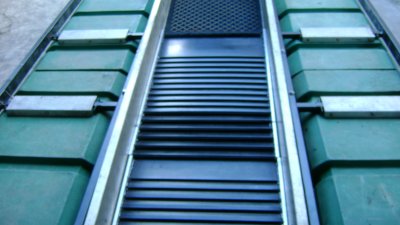
Close-up of rifflesThis image shows two sluice underlays following the header section (with no screens on top)

When we planned these sluice underlay riffle-panels, we included the slick plate up front, and then went about 50/50 the rest of the way using short and deep riffles. We did this because I wanted more of the short-type riffles that work so well in the Le Trap. But I did not want to eliminate the deeper riffles which create such a strong back-flow, especially at times when lots of material is being fed across the box. But through extensive trial and error using the third evolution of this system this past season, we discovered that the higher velocity flows that are necessary to move volume-amounts of classified material across the plastic riffles were also causing some of the trapped fine gold to boil out of the system. Too bad! We then tried Keene’s new ribbed rubber matting (good stuff!) and ended up with the same result (we were losing some gold). So it appears that these plastic and rubber riffle systems are better suited for final concentrating work, rather than being used in the volume production setting inside of a dredge recovery system (more on this below).

Because the double-screen assemblies are heavy, in order to manage them, you have to divide your sluice box into several smaller sections. How many sections depends upon how long your sluice box is. You will notice in the images at the top of this article that we divided my 5-inch dredge into three separate sections. One section is over the header area. The other two sections are over top of two identical sluice underlays. It is wise to divide the sluice underlay sections into exactly the same sizes. This way, the parts can be interchanged when it is time to reassemble your recovery system.

We build the double-screen assemblies so they rest exactly upon the sluice underlays. This allows us to take apart one only portion of the sluice box if that is all we want to look at or clean-up.

The screen assemblies are built so the aluminum side supports slide down inside the sluice box and sit directly on top of the side rails of the sluice underlays. This pins everything down snuggly against the bottom of the sluice box. Then we snap the screen assemblies down tight to make sure everything stays in place when we are running the dredge or moving it around on land or in the river.

Sluice Underlays

Close-up of matting
Close-up of both

Through a very substantial amount of trial and error this past season, we discovered that both the plastic sluice material and also the new Keene rubber matting were losing gold from under the twin screens.
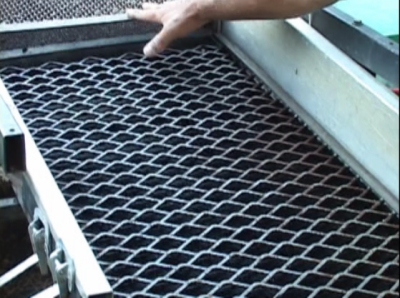
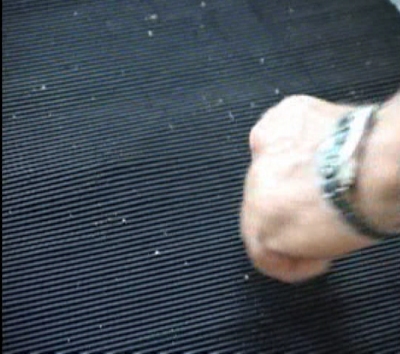
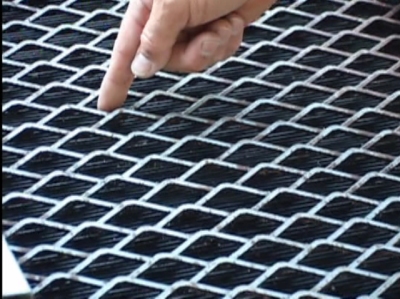
Expanded metalWe finally found the right combination by using a wide, raised expanded metal over top of deep ribbed rubber matting. The aggressive expanded metal was dropping the gold out of the classified feed. Once it was in the ribbed mat, the gold was not getting away. This combination was so effective, we even replaced our header section with the same expanded metal, though we used miners moss underneath, rather than ribbed rubber matting.

We did multiple checks; and we were never able to find a single speck of gold in the final 25% of our recovery system, even though we were mostly dredging in fine gold pay-streaks (loaded with fines in the front section of the recovery system) all season.

This is important: The width of the sluice underlays (and screen assemblies) have to be a bit narrower than the inside of your sluice box. Otherwise, it is too difficult to get them in and out when you want to perform a clean-up or reassemble the recovery system. I always allow a margin of around 1/8th or 3/16ths of an inch, maybe even ¼-inch on a wider sluice.
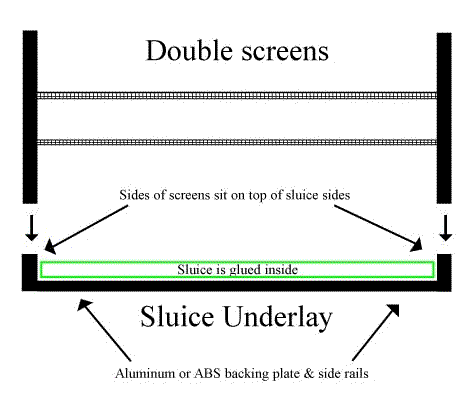
Note: We have since replaced the sluice underlay in the drawing above by welding some 3/4-inch angle iron on both sides of the expanded metal to create side rails that the double-screen assemblies can rest on top of.

The following video sequence should give you a better idea of what we have ended up with as a sluice underlay:

The width of your side rails needs to be greater than the margin you are allowing between the sluice underlay and the side of your sluice box. This is so you will be sure that the sides of the screen assembly are going to slide down and meet the rails of the sluice underlay.

Double-screen Assemblies
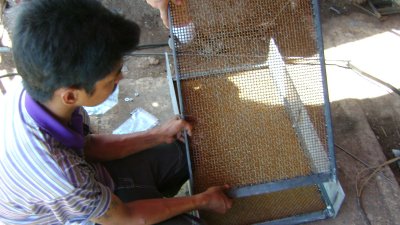
Sliding the second screen into the frameThese add up to some weight; so you have to plan how to divide your sluice box into small-enough sections that you can lift the screen assemblies out of your sluice box without too much trouble. On the other hand, you want to minimize how many sections you have to make, because these are very labor-intensive to build.

The length and width of the screen assembly should match the sluice underlay, so that they will marry-up exactly when you set the screen assembly down on top of the underlay.
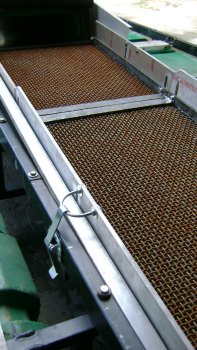
 

Screen LatchYou have to use aluminum plate for the sides to keep the overall weight of the screen assembly from adding up too much. The height of the sides needs to be at least as tall as your sluice box. I build mine high enough that I have room to adapt a latch to snap everything down tight.

Once you have the aluminum sides of your screen assembly cut to size, bring them all to your local machinist, and ask him to mill slots so that you will be able to raise and lower your two screens. If you bring the machinist one of the lag bolts you are going to use, he can mill the slots just wide enough to allow the lags to slide up and down freely, but not so wide that the lag is allowed to turn in the slot when you are tightening or loosening the nuts that hold the screens in place. Just to make sure I will have the full range of adjustment, I have the slots milled nearly the full height of the sides, to within about ¾ inch of the edge, equally at the top and the bottom. Each aluminum side needs three slots; one on each end and another in the exact middle.

You can source thin-headed lag bolts from fastener supply outlets. If you look, I’ll bet you can find them on line. If you cannot find them, then you have to grind the heads down on regular lag bolts, because normal heads are too thick and will take up too much space between the screens and the sluice box.

Helpful hint: The head-thickness of lag bolts on both sides of the screen assembly need to be included when you are deciding how wide your screen assembly and sluice underlay need to be for everything to slide in and out of your sluice box without too much difficulty.

Another helpful hint: If you cut the side plates all the same size, and have the machinist mill the slots exactly the same on all the plates, all the pieces will be interchangeable, and then you can jig-up to drill standardized holes in the side rails to your classification screens.
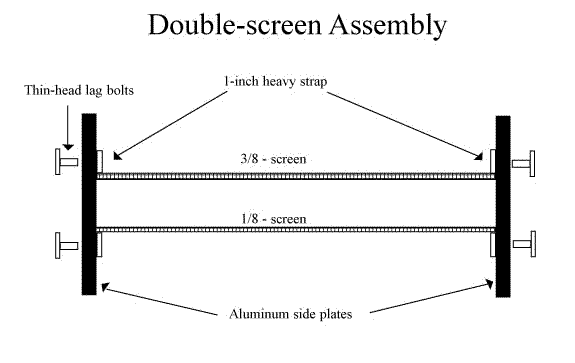
The lag bolts need to be heavy enough to support the weight of your screens (perhaps 5/16ths or 3/8ths). Different boxes have different widths, meaning heavier screens. It is better to go a little heavy on the lag bolts. The bolts need to be long enough to extend through the aluminum side, through the side rail of the screen, and have enough room for a flat washer and self-locking nut.

Screen frameStacking screens

Ideally, you build all your screens exactly the same size, so they can be interchanged. We accomplish this by rigging up a jig to cut all the side rails exactly the same; then to weld the frames all the same; and then to drill all the bolt holes the same. We drill the bolt holes in the side rails a little large to allow some margin for error.

Side rails for the screens need to be heavy enough to support the weight of your screens with you standing on top of them. By heavy, I am discussing rail thickness. Because, if you go too wide, you will limit how close you can adjust the distance between the screens. Thicker 1.25-inch-wide strap has worked well on my refits for the screen side rails.

Unless you want to buy whole new sheets of screen (expensive), I suggest you source used screen at your local metal scrap yard. The one we go to in White City, Oregon nearly always has a large supply in all mesh sizes. I gather that commercial screening plants replace their screens pretty often – most of it still in good enough condition to meet our needs.

The top screen (around 3/8th-inch openings) needs to be heavy enough to span the length and width of your screen assemblies without needing additional support, and without bending or sagging when you stand on top of the finished screen.

The lower screen (around 1/8th-inch openings) needs to be heavy enough to span the length and width of your screen assemblies without needing additional support.

Helpful note: I experimented with a finer-mesh lower screen (about 1/10th-inch openings), and had trouble with small particles of rock plugging up all the holes. We call this “blinding.” It’s when the holes in a screen all become plugged-up (or overwhelmed by too much feed), preventing the screen from doing its job. So it would appear that you do not want to use a mesh on the lower screen much smaller than 1/8th-inch.
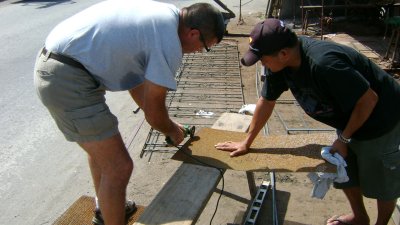
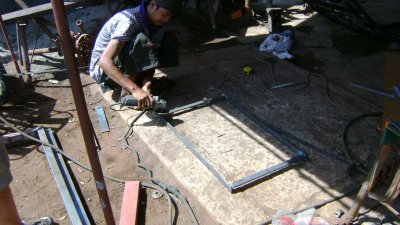
Cutting screenWe have had good luck cutting the screens to size using a cutoff wheel on a hand-held grinder. If your side rails are made of thick material, you should be able to cut the screen to size and weld it down directly on top of the side rail frame. Grind all the edges nice and smooth, so your hands are not getting cut up once you start working with these screens on your dredge.

Helpful note: If you weld the bottom screen on top of the side rails, and the top screen on the bottom of the side rails, you will be able to loosen or tighten the center bolts in the side plate much more easily. I am talking about the lag bolts which attach the screens to the aluminum side plates. If you end up with your center bolts between the screens, it is much more difficult to get at them!

Another helpful note: You might want to drill your holes just off center through the side rails. This way, you can still get a socket on the nuts after the screen is welded on.

These helpful notes are things I have learned the hard way!

When you assemble the screens, a good starting point would be so that the bottom screen rests maybe just a little more than an inch above the plastic sluice.

Helpful hint: If you make the side rails on your sluice underlay too tall, it will limit how far down you can slide your lower screen.

We have had pretty good results lifting the upper screen about 1.25 inches above the lower screen.

This is important: To add more flexibility, if not already present, we modify the sluice box supports on the dredge so that we can raise and lower the slope of the box. This creates a very helpful mechanism for adjusting flow rates.

Once in the field, you can make adjustments to sluice slope and height of each screen to work out the needed velocity in three separate water-flows: First, the water-flow across the sluice; then the water-flow between the screens; and finally, the water flow across the top screen.
I already discussed above how to replace the lower screen with a false flat bottom which you can place riffles on top of to recover the larger classifications of gold. In my view, it is more effective to do this in the lower section of the sluice box (though, I mounted the riffles for larger gold in the upper-end of the sluice on my 8-inch dredge). I know this viewpoint is not popular with some prospectors, because they do not want to chance losing a bigger piece of gold that is allowed to get so close to the end of the recovery system. My answer to this is that gold is really heavy stuff! If there is some anomaly (like the gold is attached to quartz rock which makes the piece lighter) that would keep it from trapping in a set of riffles in the back-end of the box, it probably will not drop out in the front portion of the box, either.

Other than in a very rare occasion, the vast majority of the gold you will recover is small enough to drop through an 8-mesh screen. Some important part of that gold is so fine as to be difficult to recover using the recovery system on a conventional suction dredge. The journey of fine gold through 20 feet of suction hose, and then up through a diffuser (flare jet) places most of this fine gold right on the bottom of the material as it first flows into the sluice – right where you want it; right where it is most likely to drop through the classification screens out of the higher-velocity flows, which otherwise can wash it through your box like sand. Better, I think, to get the minus-1/8th gold into a safe holding area as the first priority.

If you look closely at the diagram just above, you will see another reason to put the larger riffles towards the rear-end of a double-screen system. See how all or most of the fines are directed through an undercurrent below the larger riffles? This means the larger riffles will not be getting flooded and loaded up with fine-sized material. So, while fine material gets more exposure to low-profile riffles (where it belongs), the deeper riffles remain more open so that larger gold has a place to drop out of the flow.

But that is just my view. You guys can do it any way you decide to!Riffles just after shut-down
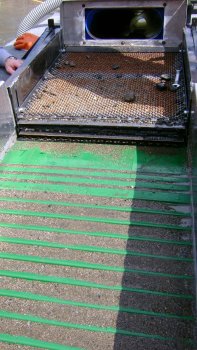
The reason you see rocks on top of the double-screens, is because we turned the dredge off while we were pumping at production speed. See how the riffles are working? They are not loading up, and they are not boiling- out. This means the system was working!

I do my classification and sluice flow adjustments when running the dredge at normal operating speed while I am feeding the nozzle at production speed in hard-packed streambed. I arrange for a second person to kill the motor without notice. Then, when I disassemble the system, I can see how the sluice and screens are performing while I am pumping gold and gravel into them at production speed.

Between these explanations, the drawings above, the images and the video segments, you guys (or the fabricator who will help you) should be able to see how these systems come together, and how they work. They provide you with a whole lot more than I started with!

Here follows a video segment we put together at the end of this last season which demonstrates the most recent evolution of this very effective dredge recovery system:

Other Considerations
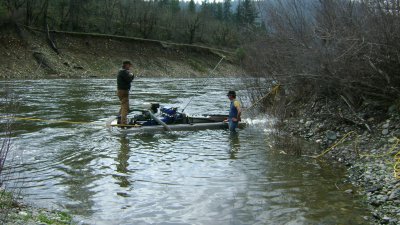
Trial runPossible need for added floatation: As I mentioned above, these double-screen assemblies are heavy. So if you do a refit of your sluice, you may also consider adding some floatation to your dredge. When I refit the original 6-inch Precision dredge for Cambodia (image above), I also had new, larger aluminum pontoons made up to provide enough floatation so that I could also stand on the dredge while it was running. Nice!

Having enough water-flow to make double-screens work: Every dredge is a bit different. Before refitting your dredge with a double-screen system, you might turn the dredge up and watch the water-flow across your existing recovery system and estimate if you will have enough water volume to provide sufficient velocity to meet the needs of three separate flows.

Overfeeding the system: Every recovery system has its volume-limits! Since I find nearly all of my high-grade gold associated with hard-pack, I design my recovery systems to process average material which makes up normal hard-packed streambed that was put in place during the evolution of a major storm event. Normal streambed consists of rocks which are fitted together, with smaller rocks and pebbles in-between, with gravel, sand and silt filling the smaller spaces. When taking apart normal hard-packed streambeds, the smaller-sized material only comprises a small fraction of the overall volume. Therefore, I have yet to overwhelm one of these double-screen systems while production-dredging in hard-packed material.

On the other hand, if you go out on the river and just start pumping sand or loose, classified gravel (like tailings), a much-higher percentage of the material will penetrate the screens and you will almost certainly overload (blind) the sluice with too much material – and perhaps even pack-up the space between the sluice and the bottom screen. Let me be clear: This double-screen system is not designed to process sand or loose gravel deposits or tailings from some earlier mining activity!

This same concern is true for any type of recovery system used on a suction dredge. So it is important for you to be mindful of the material that you are feeding into your suction nozzle. If it is a layer of sand or loose gravel, you should either slow down; or you can speed up and pump it through as fast as you can; and then go up and make sure your system is no longer packed-up before you start feeding pay-dirt into your dredge.

The fine gold needs to be present: The only good place to test the effectiveness of your recovery system is when you are feeding high-grade into your dredge. The more gold you feed into the recovery system, the better you can see how well it is working.

Effectiveness cannot be discounted just because you see a speck or two of gold down towards the end of your box. The thing to look at is where most of the gold is stopping.

So many times, I have watched others decide their recovery system is not working, only because they are not recovering much gold. You cannot recover much gold if it is not present in the streambed that you are dredging! So I suggest you reserve judgment until you test your system in high-grade.



BY PAUL BADALI

Since we’re still in the mainstream of the dredging season, I’ve decided to share a few tricks I’ve picked up in my experiences with dredging over the past few years. Hopefully they will help to make your dredging a little easier.

After several seasons of use, dredge hose becomes cracked and needs to be replaced. I have tried to repair the cracks and holes in my 5-inch yellow hose with silicone R.T.V. glue, that didn’t work; so I knew I would be replacing it. The only 5-inch hose I could find in the dry desert state of Utah was a very light duct hose called Spirolite, which is used to blow insulation into attics. The hose is so light and thin that I decided both the first and second time I went in to purchase some it could not hold up under dredging conditions. But the price was so good (about $3.90/foot for 5-inch) that I finally bought a 10 foot length just to see how it would hold up in the Klamath River. I liked it so well that when Tony Dilmore, who had originally recommended it to me, showed up in Happy Camp with some, I bought another 20 foot length from him.

Spirolite has definite advantages in some dredging applications. First of all, it is extremely flexible. It is ideal for creek dredging where the hose often must be wrapped around boulders. Secondly, it is extremely lightweight weighing only about half what the yellow hose weighs, so it’s easier to pack down the bank or into remote dredging sights. It does not show excessive wear as I had feared it might. When I first looked at this hose, I pinched my thumb nail and finger nail together on the thin clear material between the spiraled ribs and was able to pinch a hole in it. But I can’t see any holes in my 20 foot section of hose after half a season’s use in the Klamath River. So, it seems to hold up well. It does develop small holes where it is clamped to the nozzle and the jet, but these areas are at the end of the hose and can easily be cut off when they get bad. And at $4/foot, you can afford to take this into account and buy five feet more than you need. And as for beating out plug-ups, you don’t have to. This hose is so flexible that it rarely plugs-up. If a rock does turn sideways and plug, you simply deform the hose with your hands, and the plug frees with no hammering on the hose!

There is one application where a heavier, stiffer hose is preferred over the Spirolite, and that is in deep or fast water. Because the hose is so light and flexible, the water can grab it and keep pulling it out of your hole. When I used this hose in the gut of the “Glory Hole” on the Klamath in about 15 feet of water, I had to keep the dredge near the edge of the river, use 30 feet of hose, and anchor it to the bottom at two points on the way out into the gut. The nozzle still washed out each time I went up to knock a plug out. But for calmer more shallow water, it’s the hose I prefer to use.

You should be able to get it at most large hose supply stores in larger cities. If they don’t recognize the brand name Spirolite, ask for the lightweight clear spiral duct hose they use to blow insulation into attics with, and get prices at three or four hose supplies. You may get it even cheaper than I did!

Has your swivel nozzle stopped swiveling after two seasons of use? Mine had. Sand and small rocks work their way down into the joint, and rust accumulates in there over the winter. But if you have access to an arc welder, the repair job is simple. Just cut or grind off the weld beads that hold the swivel joint to the nozzle, and remove the swivel joint. Inside you will find two rubber O-rings or pieces of rubber cord cut to work as O-rings. Pull the whole assembly apart, and use a wire brush to buff rust and sand off of all the metal parts. Clean the rubber cord or O-rings in water.

You want to catch any sand that falls out, and pan it. I found one nice flake of gold inside my nozzle when I cleaned it. You may wish to use some type of non-oil lubricant in the swivel joint before you reassemble it, such as graphite or silicone. I haven’t done this yet, but I suspect graphite is the way to go.

To reassemble, simply match the old ground-off beads back up, and tack it in the same spots with an arc-welder. I would not gas weld these beads, as I suspect it would get the rubber O-rings too hot and damage them. When you are done, your nozzle should swivel as good as new. While you have the welder in hand, touch up any wear you see elsewhere on the nozzle.

This last winter, I got about 26 feet of 36-inch-wide miner’s moss free! You may be able to do the same. I noticed that miner’s moss was used on the floor as mats in every entrance at a local high school. I found the janitor and asked if he would keep me in mind, and give me any old pieces he might be throwing out in the future. He was curious as to why I would want old mats, and we got into an hour’s discussion about dredging for gold. At the end of our chat, he said, “You know, I think we have a few old pieces we’re throwing out in a store room right now.”

We went to look, and he helped me wheel out three six-foot pieces, and one eight-foot piece of miner’s moss. They needed some cleaning up, but hanging the carpets on the kid’s swing set and using the garden hose soon took care of that.

The moral of this story is ASK. If you want something, ask. If you think people will say no, nine times out of 10, then just ask 10 people, and you’ll get what you want. Everyone has seen miner’s moss being used for foot mats. The U.S. Postal Department uses it, supermarkets do, banks do, etc. They all have to throw out the old and replace it with new. So ask for the old mats, and chances are you will get some!

I would also like to give some advice on moving your small-size dredge around on a big river like the Klamath. If you are not a good swimmer, and you are scared to death to swim across; then listen to your intuition, and stay on the side you’re already on. Know your own limits, and don’t get yourself into trouble. But, if you’re an average swimmer, and just a little apprehensive, then here are some tips on getting yourself, the dredge, gas supplies, and concentrates back and forth across the river without a boat.

Number one, buy a good set of fins. Good fins fit over your wet suit booties and are fairly stiff. They are not so stiff that they feel like cedar shingles, nor so soft that you can touch the tip of the fin to the heel, but somewhere in between. With a good set of fins, you have about as much power in your legs as a 2-hp outboard motor, and you can really cruise across that river! Always wear your wet suit without weights when crossing, and take it easy. If you’re not used to pumping fins, you can quickly get a leg cramp from over exertion.

The current will pull you downstream as you swim. Pick a calm stretch of river to swim across, and start way up stream from where you want to end up. Don’t choose a calm spot immediately above bad rapids, because if you don’t make it, you will be going for a very bouncy ride. If you are crazy like I am, this can be lots of fun, but it can also freak out your wife who watches the ride from shore!

To swim across, just float on your back, point yourself towards the other shore, and pump your legs. Don’t try to head up- stream and fight the current! Just start way upstream from where you want to land on the other side, and take a relaxed ride. The fins do all the pushing, just let your arms dangle. With fins and a wet suit on, it’s easy as swimming in a lake.

To take my dredge across, I load everything onto it, and push on the tail-end of the sluice box while kicking with my fins. I do not like a rope tied from the dredge to the shore. I do not swim a rope across first, and let that rope pull the dredge in. I play outboard motor with my fins, and I propel the dredge to the other bank. I lie on my stomach if pushing, or on my back if pulling. I feel much more in control of the dredge this way. I do choose a very calm stretch of river to do this, and I give myself twice the distance upstream that I think it will take to get across. It’s easy this way for one guy to get a dredge across by himself, and it’s a breeze if you have a helper also wearing fins.

Supplies and concentrates are also easy to get across. If you use a large 30-gallon tub to dump your concentrates into, you already own a small boat. You can put your weight belts, winch, tools, towels, etc. into the tub, and pull it with you as you lie on your back and kick across. It will sink if you tip it, and an inflated inner tube around the tub adds safety and more buoyancy. You can pull people in dry clothing across in a small rubber raft as fast or faster than they can paddle. You can also very easily swim a motorized sluice (high-banker) across the river in a small raft or an inner tube. You can fit lots more cargo in a rubber raft if there is no one in the boat! Obviously, when you want to come back across the river, you have to walk upstream; because you will be washed downstream as you swim back across.

There really isn’t much to fear from a big river if you are careful. You float like a cork in a wet suit. Don’t fight the current! The current is stronger than you are, so “go with the flow,” and let it work for you. Get good fins, so you have some push, and have a good time with it. In most cases, there has been less prospecting and mining done on the other side, so you may reap great rewards for your investment in a pair of good fins!

Good luck, and see you out there!


By Dave McCracken

As far as I’m concerned, if you are going to spend a lot of time dredging in cold water, a hot water system is definitely the way to go!

Dave Mack

Cold Water 1
“Photo by Tim Cook”

Can you recall ever standing alongside an unheated swimming pool or just next to the water’s edge on the beach, trying intently to muster the nerve to jump into the cold water? Perhaps you even tried to build up to the big leap by counting, “One, two, three.. .jump!” — only to find yourself still standing at the edge of the water after the countdown and feeling like your body is not quite under your control. This can often be the case when you are dredging in cold water. The key to successful cold water dredging is having the proper equipment — particularly those items needed to keep your body from getting too cold and uncomfortable.

Wetsuits

Wet-suits are designed to allow water to get inside the suit. Your body-heat then warms the water up, insulating you from the colder water that remains outside the suit. In really cold water, the main problem with a wet-suit is that initial frigid shock which shocks your body as the initial cold water rushes into your suit when you first enter the water. This happens again every time you re-enter the water after knocking out a plug-up in the jet tube or every time you take a break. This “cold water shock” has an accumulative affect on the body; and even the toughest people often find ourselves going “one, two, three” on the bank and have trouble making our bodies jump back into the water.

Some wet-suit divers lessen the pain of cold water shock by having a hot tub of water on the bank. They pour the hot water into their suits just before re-entering the water to help bring up their body temperature. Hot water systems that provide a steady flow of warm water into a wet-suit are even better — but we will address that topic below.

There are different types of wet-suits, some which are designed especially for cold water use. Cold water wet-suits are usually made of thicker rubber, have few or no zippers, and almost always have the hood directly attached to the wet-suit top. There is also the “shortie,” which is like a pullover wet-suit sleeveless T-shirt with or without a hood attached. A shortie can be worn underneath or over top of a regular wet-suit to create added warmth. In addition to the added thickness of rubber around your upper torso, a hooded-shortie prevents a lot of the cold water shock from running down your neck and back!

Important note: The more rubber you add for insulation from cold water, the more lead you must add to your weight belt(s) so you can remain firmly anchored to the bottom of the waterway when you are dredging. Also: The more rubber that is added around your upper body, arms and shoulders, the more constrained your arms and shoulders will be. Dredge work underwater is mostly stomach, arms and shoulder-work (movement). Therefore, adding more rubber increases the amount of effort required to get the work done. Effort in dredging is like money in your wallet. You only have so much. So it must be managed as efficiently as possible. Because, once you have used it up, your day is over.

Dry-suits

For cold water dredging or diving, dry-suits are definitely a step above wet-suits (when there is not a hot-water system). A dry-suit is designed to keep all of the cold water out. Basically, there are two different types of dry-suits available on the market: Those that use the rubber or nylon shell as insulation, and those that require additional insulation to be worn inside the suit. Both types work well; it is a matter of individual preference as to which kind is best for you.

Dredging activity is very hard on any type of suit. There are many different models and makes of dry-suits available. Some are designed more for sport diving rather than dredging and hard work. Dry-suits generally are quite a bit more expensive than wet-suits. However, you cannot rightfully put a price on comfort and warmth when you are spending many hours underwater working for a living. If you are cold and uncomfortable, you will not get in as much dredging time; and you will not make as much gold (money). So, my advice is to spend the extra money on getting a quality dry-suit if you are going to buy one.

Dry-suits generally require more maintenance than wet-suits. Mainly, the seals at the extremities and the zipper must be properly maintained. Most dry-suits have zippers which should be coated with bees wax every several uses and sprayed with silicone each time the suit is used. The seals should be sprayed just before each use. This allows them to slip on more easily, and prevents unnecessary stretching. The zipper is the heart of a dry-suit and must be handled with care. You have to be careful not to get sand in it, and not to sit on it or rub it heavily while moving rocks around in the dredge hole. I always glue a rubber flap over my dry-suit zippers to further-protect them from dredging wear and tear. Most manufacturers stress having a second person zip it closed rather than doing it yourself. This is because it is difficult to pull the zipper straight when it is behind you, as many dry-suit zippers are. If you damage the zipper, the suit is no good until you get the zipper replaced.

You will find that even the smallest puncture holes in a dry-suit need to be patched when diving or dredging in extremely cold water. Otherwise, you are constantly uncomfortable with cold water entering the suit from that location.

Hot Water Systems

Cold Water 2As far as I’m concerned, if you are going to dredge long hours in cold water, a hot water system is definitely the way to go! Water is usually heated with a heat-exchanging device mounted to the cooling or exhaust system of the dredge motor. The dredge pump is tapped to provide a water supply, which runs through the heat-exchanger, then through a steam trap/mixing tank, and then down through a hose to pour a constant volume of warm water into the dredger’s wet-suit. Some dredgers are using propane continuous-demand hot water heaters, but most use heat exchangers mounted to their engine exhaust systems.

Hot water heat-exchangers are available on the market. They are also reasonably easy to build. Most homemade exchangers are built with a long length of copper tubing which is either wrapped around the existing exhaust system or is coiled inside a separate housing through which the engine’s exhaust is channeled.

Photo By Tim Cook

The key to a hot water system is to provide an abundance of hot water. If you do not have plenty of hot water for all of the divers working on a system, then you will most likely end up pumping cooler water into each diver’s suit, which can be worse than having a wetsuit with no hot water system.

Hint: You can never have too much hot water — because you do not necessarily have to use it all.

Most ordinary wet-suits are adequate as hot water suits — particularly with the addition of a hooded shortie vest. Dry-suits normally do not make good hot water suits, unless they are modified. This is because the seals prevent the hot water from exiting the suit. After a while, all the excess water inside the suit cools down and makes the diver cold. Removal of the seals on a dry-suit would probably make it a good hot water system (as long as it is a tight-fitting dry-suit) — but this seems a waste of money when a far less expensive wet-suit will accomplish the same purpose.

The main problem dredgers can have with a hot water system is being scalded by extreme hot water or steam. This problem can largely be solved by adding a steam trap to the system. Some prefer to call this a “mixing tank.” A mixing container can be made out of PVC plastic tubing. One of the primary purposes of the mixing container is to be a holding tank for water and steam. So, if extreme hot water or steam is created in the system, it will have a chance to mix with the warm water in the tank before being pumped down to the diver. The mixing container should be mounted vertically on your dredge with the input coming from the top, and the output to the diver being on the bottom of the container. This way, steam is prevented from being pumped directly to the diver(s). Some systems contain a low-pressure relief valve at the top of the container to allow air and steam to release.

mixing containerThe mixing container must be large enough to absorb a shot of extremely hot water, but not so large that it allows the water to cool down before it is pumped to the diver. The mixing container allows the diver to feel the rise in water temperature much more slowly, so that the hot water hose can be removed from the wetsuit before it gets uncomfortably hot. Sometimes, the water can be so hot coming out of a heat exchanger, that a special steam hose must be used. In fact, just for safety, I always use heat hose on the connection from the heat exchanger to the mixing tank.

If the water coming out of the heat exchanger is too hot to pump directly to a diver — which is often the case — a source of cold water can also be tapped from the pump and directed into the mixing tank through a valve. By regulating the amount of cold water, you can adjust the temperature of the water being pumped down to the diver. This also increases the volume of warm water available to all of the divers.

Warm water is usually pumped down to the diver through the same kind of hose being used for air line. The hot water line and air line are usually taped together to prevent tangling and additional underwater confusion. The hot water line can be slipped into your wet-suit down through the neck. I usually poke a hole in my wet-suit near my chest where it is easy to slip the hot water line in and out of my suit.

Or, in extremely cold water, you can devise a splitter system which will direct some of the warm water to your chest, hood, each bootie, and each glove. This is the best way to do it if you are dredging in ice cold water. However, sometimes the splitter system can be avoided simply by having a hot water system which provides so much volume, that the warm water is forced out into these same extremities.

When dredging in ice cold water, if you do not have warm water directed to your hands, it is usually necessary to use three-finger wet-suit mittens. Otherwise, your hands can go numb from the cold. Three finger mittens are bulky; they prevent you from picking up larger cobbles with one hand, and they generally slow you down. With a good source of hot water to the hands, you can often get by with a good set of slightly-insulated rubber work gloves with the openings loosely rubber-banded around your wrists to prevent cold water from entering.

Dredge with snow on the decksAuthor was developing some of the early hot-water heaters on his first dredge in 1981 while working in the frigid waters of the Trinity River in Northern California.

It is necessary to warm up your dredge engine to normal operating speed for at least several minutes to properly set the temperature of the water directed to the divers from the mixing container. Once you get the temperature working right for you, you normally do not need to make any further adjustments on subsequent dives, as long as you are running the motor at the same RPM.

If you stand around for a few minutes with hot water pouring into your suit, there is usually no shock at all when entering the cold water. As a matter of fact, it can be a pleasure to enter the cold water after you run your body temperature up to the uncomfortable stage when you begin sweating.

A hot water system should be removed from the dredge when not being used, like during the warm summer months. Otherwise, the heat and vibration will tend to wear the heat-exchanger out unnecessarily. Also, even when not in use, if a hot water system is attached, water should be allowed to flow through it any time the engine is running. This will prevent unnecessary overheating of the heat-exchanger.cold water 3

Photo by Tim Cook

If you are tapping your dredge pump for a supply of water, be sure the water output is either closed off or underwater when priming your pump. Otherwise, there may be an air leak which can prevent priming.

The nice thing about a hot water system is that it will supply a continuous feed of hot water into your suit. This way, your body’s energy reserves are not being constantly used up to keep warm. As a result, you can be comfortable and get in more dredging time.

Important note: You can also be so warm that your body doesn’t want to work — like being in a hot shower. The solution to this lies in the amount of cold water you valve into the mixing tank, or how far down you zip your wet-suit jacket! Believe me, “too warm” is a much easier problem to solve underwater than “too cold.”

A common question people ask is, “Should I get a hot water system, or a dry-suit?” The answer to this lies in what you intend to do. I suggest having both systems available, depending upon your activity. For production dredging and sampling in extremely cold water, I would use a hot water system. For swimming across the river to stretch a rope, or for swimming down the river with mask and snorkel to look at the bottom in extremely cold water, I would recommend a dry-suit.

Other Things To Know About Cold Weather Dredging

If you are working in freezing temperatures above water, there are certain things that should be done on your dredge each day before knocking off. Your pump should have a drain plug tapped into the bottom. This way, you can drain the water at the end of each day to prevent your pump from freezing solid. It is not a bad idea to bring some hot water with you everyday in a thermos, because sometimes the pump will freeze even with the water drained. Be careful not to crack the pump housing by pouring too much scalding water directly over it when it is freezing cold.

Also, in freezing weather, the concentrates and water must be completely cleaned out of your recovery system at the end of each day. Otherwise, they will freeze solid and prevent the system from working until it thaws out the following day — if it thaws!

If you are not going to process them directly, your concentrates from the day should be stored well underwater to prevent them from freezing on the bank. Your mask, hood and gloves should be brought back to camp each evening and kept warm. Otherwise, you have the misery of putting them on when they are ice cold — unless you have a hot water system on your dredge.

Winter Dredging

Eric Bosch and author displaying nuggets pulled while diving together.

Dave and Eric holding nuggetsEven if you are able to handle most of the cold water problems with the use of good equipment, another factor winter dredgers often have to deal with is higher and faster water. While the higher water will allow you to mine further up on the edges of the river, in many areas it will prevent you from mining out in the faster and deeper water areas-which may provide easy mining during the summer months. If, due to the faster, higher water, you are not able to get out and sample in certain sections of the river, you will not be able to run a full testing program on that section of river; and you will miss pay-streaks. So, it can also be more difficult to locate deposits during the faster and higher water months of the year.

On the other hand, if the river edges are paying, the winter months may be the only time they are available for dredging. The location of deposits are going to vary from one place to the next.

While wet-suits, hot water suits and dry-suits do make for good insulation underwater, they generally provide poor insulation to the cold air above water when you are wet. Therefore, it is good to have a warm winter jacket to wear over your diving suit while taking breaks on the surface.

Tents in the snowAs a side note on this, my commercial dredging buddies and I ate many hurried lunches on deck during the winter months (even while it was snowing) while the dredge continued to run at operating speed (with a rock placed over the suction nozzle to slow the water in our recovery system), pumping warm water into our suits.

If you are mining in extremely cold conditions, it really helps to have a warm and comfortable camp. A person can put up with some pretty cold and miserable conditions if he or she knows there is a warm shower and hot meal coming later that evening. There are few things worse than freezing all day and then going back to stay in a wet and cold camp!

Author’s campsite during his first several years as a gold prospector.

How Tough Are You?

It takes a pretty tough person to dredge in extremely cold conditions. Even with the best equipment, there is still a substantial amount of cold water exposure on your hands and face. You spend quite a bit of time working on the dredge, tying off lines, swimming the river, cleaning up concentrates, making repairs, etc. This all adds up to exposure which can be painful or uncomfortable. Some people are gung-ho enough to dredge in extremely cold water on a short-term basis. Few people are willing to do it long-term.

We all have the potential to be tough enough to dredge in extremely cold water. What it always comes down to is whether or not we desire to be that tough! A lot of people think they are, and then realize they are not willing to do it!

Talk is cheap!

I was mining with several guys in 34-degree water one winter. One of the divers and I were sampling for a new deposit while the other two guys were actively dredging out a rich deposit we had already located. They were recovering several ounces of nugget-gold each day, while we were knocking out sample holes. One day, we helped get the production operation started and then headed out to do our sampling. We soon realized we forgot our lunch, turned around and drove back to where our partners were dredging. We had not been gone fifteen minutes, and they had already gotten out of the water and were in the truck with the heat turned on — drinking hot coffee! These were tough guys; that water was cold!

A partner and I were dredging in Alaska in October when things started to freeze. We’d had a very good season, but I wanted to put more ounces into my bottle before returning home. Ice had already formed on the edges of the river, and my partner had been ready to leave weeks before. I was determined to spend one more week dredging, because the gold was good and I had plans for what I was going to do with it. One day, with a week to go, I could not make my body go underwater again. “One, two, three, go!” — but my body refused. So, it just wasn’t worth it, anymore! I walked over and tugged on my partner’s air line and asked him if he was ready to go — home, that is. We were on the road later that afternoon in a warm truck with the heat blasting. In that area of Alaska, three feet of snow fell that night!

There is a point where the body just takes over and says, “No!” And, this is probably the point where it is smart for you to listen.


BY JUDE COLLEN KENDRICK


This is a picture that you will seldom see – me getting up at 5:30 a.m. full of excitement – to vacuum! Yet, I spent some of last summer and almost all of this past winter, doing just that. It wasn’t “dust bunnies” I was after, however; it was gold!
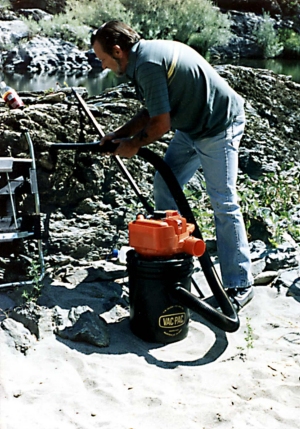
A few Decembers ago, I wrote a Christmas dry-washing article about the Mojave Desert. I said that I had made a portable vack machine to clean off the caliche (cement-like material) shelves that one encounters out in the desert. But it was not until last summer on the Klamath River near Happy Camp in California that I actually used the vack machine for what most people use them for, which is crevicing.

I knew about crevicing, of course, but it just wasn’t my thing. In fact, on several of my surface mining (motorized sluicing) trips there would be lots of prospectors around the creeks crevicing and getting gold. I cannot recall, though, at that time seeing anyone with a vack. They all had store-bought or homemade tools to get the gold out of all the nooks and crannies. On the Klamath, I borrowed a Mack-Vack made by Pro-Mack in Happy Camp, because I did not have the space to bring my motorized sluice along. My little portable vack that I had made was in the “equipment graveyard.” I had brought gad bars and digging tools, so I was set up to crevice. I will admit that I was not very enthusiastic about it at the time. I like to see dirt flying and lots of material running through my equipment. But it did not take long to change that lack of enthusiasm!

The bedrock around the area where I was on the Klamath broke apart fairly easily. I walked around trying to find the right kind of hard-packed gravel between the seams of these massive slabs. I had only used the vack for a while and had only about half of the 5-gallon bucket filled (not much material, I thought). Yet, when I panned it out, there was a beautiful match head-sized nugget. Now, this type of prospecting wasn’t bad at all!

Kay Tabbert and her husband Chuck, both members of The New 49’ers, were in the same area at the time. Chuck was busy dredging while Kay, with only her little hand tools, a whisk broom and dustpan, was crevicing on some bedrock not far downriver from me. All of a sudden I heard Kay calling for Chuck (and anyone else around). So I walked over to see what was going on. I could not believe it. Kay had separated a rock about the size of a melon, and in the crevice, stuck to one side, were 7 beautiful large flakes of gold! Just like that! I could not get back to my area fast enough!

I had dredged for years and I knew just how to spot the places where the water would deposit gold. It was really no different from working in the water – I just did not have to get my hair wet! I was feeling a little impatient, though, as I never did wait to fill up an entire 5-gallon bucket with material using the vack machine. But what I did pan produced great little “clinkers” of Klamath gold.

Unfortunately, I only had about seven days last summer up on the Klamath. But, I had five months this winter to play in the dirt. Lucky for me, I got “hooked” on vacuuming crevices!

I was prospecting Quartzsite, Arizona and the surrounding areas. The desert had a lot of rain this past summer and everyone was hoping that the washes would “pay off!” I decided to sell my beloved “Nick’s Nugget” dry-washer, as I knew I was going to be out prospecting alone a lot. As great as it was, it was too heavy and clumsy for me to manage on my own. I purchased a small dry-washer combo (with the vack option) from my friends Bob and Linda Taylor. This was great. One engine ran both and I could carry everything in one trip.

Hunting for bedrock in the desert is certainly not like on the rivers. It definitely does not expose itself as much. Yet in many places it is not deeply hidden. I was finding many places in washes where people had dug down to bedrock and had not even touched it with a whisk broom. So, guess what I did? They had already done the heavy work. I just sat there and vacked up the gold!

Finding new places to vack was not easy, as I have said. I have known for years, from experience, that the gold in the deserts isn’t always where it is supposed to be. What would look like great bedrock on the rivers often means nothing in the desert, mostly due to the lack of water volume and movement in the deserts. When I arrived at Quartzsite I met up with Al Powell, who is also a New 49’er member that I met briefly while on the Klamath. Al and I were finding “perfect” looking bedrock, in established gold areas, that produced nothing. We were always shocked, because all the “recipes” for gold were there. We could have found more gold in downtown Quartzsite! We were not giving up, however!
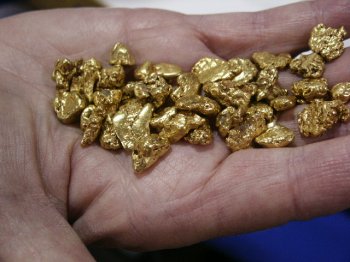
I decided to take five days and go off to find a hot spot for Al and me to work. I found a very small ravine below a heavily mined area that had a large section of bedrock exposed. It took two days of pulling “Buick-sized” rocks to work myself down to where I was getting some nice gold. After the fourth day, I showed Al my gold and took him out to the spot so we could clean it out together. Well, I suppose I did my job too well; as except for some small flecks, Al and I vacked all day and got nothing large. “OOPS! Sorry, Al!”

The weather in the desert turned nasty, with off and on heavy rains that went on for days. Consequently, all of the dry-washers around the desert were silenced. The ground in places was damp as deep as eight inches down, which forced people to grab their gold detectors and head out nugget-shooting until things dried out. Yet, Al and I were not held back; we were still out there, in a new area, with our vacks. We didn’t have any trouble bringing up the damp gravel, although the two of us looked like “mud pies” at the end of the day.

I had, from the beginning, been running my vack materials through my dry-washer so I would not have to pan as much concentrate. Even the damp material did not present much of a problem, as Al and I just ran everything through the dry-washer two or three times. I am sure that the people driving by during those wet days who saw the dry-washer running, said to themselves, “They are crazy!” Well, that is a whole other story, but we did have our pretty desert gold to look at all the way back to our desert “sanitarium!”

I would recommend purchasing a vack to anyone, even as a backup to your usual motorized sluice or dry-washer. And, now, when “housework” day comes each week, I won’t dread using the vacuum; I will just be practicing! Good Luck!


By Richard Doherty

“With the new instruments available today, millions of gold nuggets are within reach of the intelligent, properly equipped, electronic prospector.”


Hand full of beautiful gold nuggetsWhen I first heard about picking gold nuggets from the surface, or close to the surface of the ground, I really didn’t think it was feasible.

I made some halfhearted attempts at locating some of the precious yellow beauties with no success and much frustration. Finally, I buried a gold nugget down in the ground and attempted to locate it with my new detector. To my surprise, it wouldn’t detect the nugget, so I moved it closer to the surface and still couldn’t detect the target. It was almost on the surface by the time I was able to receive a very light audible signal. That did it! I quit!

Still, the idea of locating a gold nugget with an instrument really intrigued me, so I stayed in touch with the advances of metal detectors. In the meantime, I continued my more conventional prospecting activities in Arizona, where I was fortunate enough to associate with other prospectors who knew about gold deposition.

Years later, the metal detector industry began to develop detectors that would deal, at least somewhat, with the highly-mineralized ground associated with gold deposits. So I purchased one of the most advanced detectors on the market and went in hot pursuit of the elusive yellow nuggets. Hour after hour, I combed the ground; I searched everywhere the gold “had to be!” If it was there, I wasn’t finding it, so I pressed on.

Scorpion made from gold nuggetsFinally, after many, many frustrating hours, the first nugget succumbed to my detector, minutes later, another. I really got excited, and I decided to share this new-found activity with my friends. I helped them learn what I had learned, and then we developed new methods and techniques. Detectors were getting better, and I purchased the latest equipment, knowing that I needed every edge that I could possibly acquire.
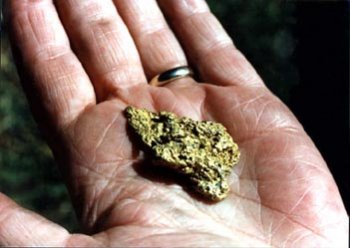
We sorted out which instruments worked best and figured out how to get the most from the ones we decided to work with. Nuggets began to fall on a regular basis, and more friends became interested. We turned them on to the equipment we were using and the techniques we had developed. They began to find gold nuggets almost immediately. This surprised me; because after all the heartache I went through to locate my first nugget, my friends were quick to pick up what we had already learned.

Gold nugget hunting is not like coin hunting at all; it is a specialized field and requires specialized equipment and techniques. Once learned, it is easy. As you do it more and more, nuggets will yield to your detector more consistently.

First, there are three “musts” for any degree of success. Not one of them is any more or any less important than the others, because they are dependent upon each other:

1. The correct instruments must be selected. Selection is based upon the instrument’s performance relative to the size and purity of the gold and type of ground that will be searched.

2. Knowledge regarding the use of your instrument must be thorough.

3. Knowledge about where the gold is located. Most of this information is gathered through research and talking with others who already know.

Your degree of success depends upon how diligently each one of these three “musts” is followed, and it is that simple. If you decide to approach finding gold nuggets in this manner, it is not a matter of, “Will I find a gold nugget?” It is only a matter of when, how big, and how many!

Huge rough nuggetIt has never before been more possible to locate your own gold nuggets with the aid of a metal detector, than it is right now. It is not that there is more gold out there. In fact, each day, there is a little less. However, with the new instruments available today, millions upon millions of beautiful gold nuggets are now within easy reach of the intelligent, properly-equipped electronic prospector. You don’t need tons of equipment to haul around, nor do you need many thousands of dollars to get started. The exercise is mild; the air is fresh; and the pursuit of your own gold nuggets is done at your pace — no one else’s.

I would also like to mention some of the myths surrounding electronic prospecting. It is difficult to place these in any order, so I will just mention them according to the frequency of times I am asked:

“Are there still gold nuggets out there to be found?”

“Will a metal detector really find gold?”

“Didn’t the ‘old-timers’ get all the gold?”

“Why isn’t everybody doing it?”

“Isn’t all the land claimed up?”

“Don’t I need a specialized vehicle or mode of transportation to get to the gold?”

“Isn’t it hard work?”

“How can I find gold nuggets when I know nothing about geology, mining, mineralog, or electronics?”

“Won’t a detector find fool’s gold?”

Please don’t let these questions, objections or myths stop you from gathering your own gold. It’s a whole new exciting, profitable activity, and you can do it!

Public awareness is definitely on the increase, and hundreds are getting into the activity of capturing gold nuggets from the earth. There are pounds of gold being taken daily, and there is no reason why you cannot be taking your share!

Frustration and lack of confidence is the primary cause of failure. The reason most electronic prospectors fail is that they purchase inadequate equipment or don’t learn how to use it properly.

Hunting coins and hunting nuggets with a detector are quite different. Coins are a flat-sided target. Many nuggets are not. Also, many flat nuggets will slip sideways into a crack or crevice in the bedrock, which leaves very little target-area available from the surface. Shape, size, and lack of the “halo” effect can cause a gold nugget to remain a difficult target.

Of course, there are exceptions to this. Not too long ago, I found a 5/8-ounce gold nugget that was about one inch deep, lying flat. It sounded-off like a quarter! I was amazed to retrieve a beautiful nugget which was shaped like an eagle’s head!

Nugget hunters know how important good equipment is. I was speaking with a professional electronic prospector the other day, showing him a new detector. Before I could tell him what the detector cost, he said it didn’t matter anyway; because he was willing to spend any amount of money on the detector if it was significantly better than the one he was using. You see, he knows that good equipment will pay for itself, especially with the price of gold nuggets as they are.

I know coin hunters who dream of finding their first gold coin. Most never do. However, electronic prospectors, who follow the basic guidelines, will find hundreds of gold nuggets.

Where is the gold? This brings us to another reason why now is an excellent time to get started in this fascinating activity. There are clubs and various types of associations which you can join where you will meet other people who prospect. Some of these organizations provide mining properties for their members to prospect. The folks who run clubs are usually quite particular about the mining properties which they own, and they are also knowledgeable about which claims they should stake or purchase. One of the easiest and fastest ways to find gold is to join one of these clubs. Some even provide training programs or organize group mining projects where you can gain immediate, valuable hands-on experience. Talk with other members and the staff to gain information as to where you might begin your prospecting. This is the best way I know of to get started in any type of gold prospecting today.

As you prospect on these claims and talk with others, you will begin to get a “feel” for where the gold is and why it is there. Gold seems to be a lot easier to find if you already know it is there. If you are not sure, it could cause you to search halfheartedly, and that is not conducive for locating nuggets. You must know the gold is there; you must know how to operate your equipment; and you must know that your equipment will get the job done. If you have these three criteria well in hand, you will surely find your own gold. After that, it’s just a matter of spending some time doing it and improving your skills.

In the beginning, it may take you a minute or longer to recover a target you have established; but soon, these targets will be coming out of the ground so quickly that you will surprise yourself. My average recovery time per target is between fifteen and thirty seconds, depending upon digging conditions. I have seen it take as long as 30 minutes to extract a target, but these are more unusual conditions.

In Quartzsite (Arizona) last year, we had occasion to dig in some very old material that was as hard as concrete. This material had been deposited millions of years ago. There was no man-made metal present. But the gold was there! My detector sounded off, and we knew what it was; so we started to excavate. It was hammer and chisel time! You must be very careful not to scar the nugget, so digging has to be carefully-done. Almost 30 minutes later, out came a beauty. It weighed just over ½-ounce. It was detected under 13-inches of highly-mineralized, concreted earth and rock.

As you uncover a valid target, it will usually develop into a clearer signal or stay about the same. If it stays the same, you may also have passed over an area that is highly mineralized. Or perhaps there was some kind of hot fire in that spot during some time in the past. Sometimes, ashes will read very slightly on the detector. But the signal does not develop as you dig down on it.

If the signal disappears altogether, you have either moved the target, or you may have had a piece of rusting ferrous material that fell apart when you moved the soil. A magnet comes in handy to quickly isolate ferrous targets; it can be a real time saver!

Bullets, nails and other foreign metallic targets are some of the items you will learn to deal with. At first, they are nothing but a nuisance. However, let’s take a closer look at this: If you are digging metal of this nature, not only does it hone your recovery skills, but it tells you that the area has not already been searched-out (every smart, responsible detectorist has a container along to remove small metal trash-targets from the playing field).

If there are no previous dig-holes, you may be the first person to detect that area. But if there are dig-holes, and you are still finding metal, it tells you someone else did not do a thorough job. If they left trashy metal in the area because they were using an electronic discrimination mode, they certainly will have left nuggets behind, too! You will pick up the nuggets your predecessor left, because electronic discrimination seldom can be used effectively while nugget hunting. Only under certain conditions would you use discrimination, and that would be after many hours of experience. Even then, you could make costly mistakes. My advice is to not use electronic discrimination while hunting gold nuggets.

Meters, gauges, bells and whistles do not make a good nugget-hunting detector. I personally feel about the only function they serve to the nugget hunter is to add weight to the instrument — which is the last thing you need. Although I will admit that there are other good prospectors around who disagree with my opinion.

The following is a list of recommended reading material which may call for reading and re-reading. This is not a complete list, but the material suggested here is a must:

Willie Merrill wrote a book called, THOSE ELUSIVE NUGGETS; and he not only knows what he is talking about, he shares his knowledge in a very free manner. I have read the book no less than five times. Each time, I learn something new. Our minds are not always ready to accept all information the first or second time through.

Another book of importance is ELECTRONIC PROSPECTING by Roy Lagal and Charles Garrett, which will also require more than one reading. This book goes into the many avenues of electronic prospecting.

Any magazine articles written by successful electronic prospectors are definitely worth reading. Hundreds of articles could be written on the subject of electronic prospecting, and each one of them will have some hot tips for you. .

 
video subscription graphic
This story first appeared in Gold & Treasure Hunter Magazine May/Jun, 1993 on Page 45. This issue is still available! Click here.

By Dave McCracken

Classification is necessary to increase the amount of smaller particles of gold that you will trap in your recovery system.

Dave Mack


It takes more water velocity to move larger-sized material than it does to move the smaller-sized material through a sluice box. Yet, to the degree that the water velocity over a sluice box is increased, there may be a loss of fine gold recovery. Or, to the degree the water velocity over a sluice box is slowed down, there is likely to be an increase in fine gold recovery–as long as there is still enough flow over the box to keep the riffles concentrating.

When larger rocks are pushed through a sluice box by water force, they also create greater turbulence behind the riffles as they pass over, which may cause an additional loss of fine gold.

To improve gold recovery, it is common practice to run material through a screen to classify out the larger rocks before running the material through the recovery-portion of a sluice box. In this way, less water velocity is needed through the box, which allows for a more orderly flow, and an increase in fine gold recovery. The action of screening materials is called “classification.” Materials which have been passed through a classification screen are called “classified materials.” The following video segment demonstrates this very important point:

The size and depth of riffles within a sluice box play an important part of this. A slower water flow might not keep a deeper riffle concentrating. A greater water flow can sometimes “boil-out” a lower-profile riffle. So as water flow is slowed down to catch finer-sized gold, it is generally necessary to use shorter riffles.

Half-inch mesh screen is commonly used for primary classification in small and medium-sized sluicing operations, because the screen is large enough to allow classification to take place quickly, yet no materials greater than half-inch in size will get into the sluice. Therefore a slower-velocity of water can be directed through the box, and fine gold recovery will be improved.

Classification for a sluicing operation can be done in any number of ways. One is to place a piece of strong half-inch mesh screen over a bucket, and shovel or pour through the screen into the bucket while sweeping the larger material off to the side. Once the bucket is filled with classified material, it can be poured into the sluice box at a uniform rate. It is better to not dump the whole bucket into the sluice all at once! This is because too much material is likely to overload the riffles and cause a loss of gold recovery.

In a situation where it is necessary to haul material a short distance to the sluice box, sometimes it is easiest to classify the material directly into a wheelbarrow and transfer only the classified material to the sluice.

Perhaps one of the best screening methods is to build a classification device that you can shovel into, and which will stand directly over the top of, and drop the classified materials into, the head of your sluice box.

The device should be built with the screen set at an angle. This way, larger material is helped to roll off of the screen as the pay-dirt is shoveled onto it. Smaller materials should fall through the screen and be directed into the head of your sluice box. This is actually a miniature model of the big classifiers used by large-scale heavy equipment bench-mining operations. A classification device such as this is rather easy and economical to build and will speed up a production-sluicing operation while screening is being done to improve gold recovery.

Any recovery system will only recover gold effectively down to a certain size-range. Most gold particles smaller in size than that will be lost with the tailings. Classification is one effective way of increasing the amount of gold that will be recovered out of the material that will be processed. As demonstrated in this following video segment, this is especially true of suction dredges; because dredges are able to increase the volume of production over other types of hand-mining activity.

Here is a substantial explanation of the system which we have developed to effectively recover more fine gold on our conventional suction dredges. It combines two classification screens to more-effectively separate material-feed into three size-fractions, each which is directed into a different recovery system. The smallest gold particles (which are most difficult to recover) are directed into low-profile riffles along the bottom of the sluice box which have long been proven to be very effective at trapping fine gold.


Tags