By Dave McCracken
“When lots of gold starts coming into play, everyone gets excited and in a hurry!”
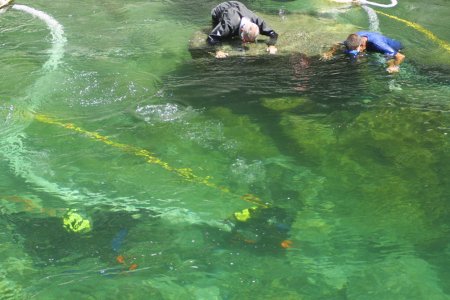
At the beginning of a recent season, my partners and I were sampling a promising section of our properties along the Klamath River for new pay-streaks. We had dredged several holes and were onto a deposit. Since we did not know if it was high-grade enough for us to work, we were dredging more holes up and down the deposit to get a better idea. On the fourth or fifth test hole, we uncovered a section of bedrock which had gold lying all over it; it was truly rich!
Something always happens in the dredge hole when dredgers start uncovering lots of gold! It does not matter how professional or experienced the operators are. When lots of gold starts coming into play, everyone gets excited and in a hurry. And it was no different on this occasion.
There was a pretty good sized boulder in front of us, slightly up in the streambed material. It was too large for one of us to move. But we thought both of us, working together, could probably roll it to the rear of our hole. Hurriedly, because we were anxious to see more gold on the bedrock, we made room behind us for the boulder by throwing a bunch of smaller rocks and cobbles further behind. Then we climbed upstream of that big rock and gave it a shove. The rock moved more-easily than we thought and slammed into the hole—right on top of my airline!
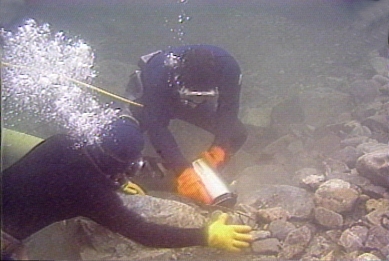 We use extra heavy-duty airline, the kind that does not kink under normal working conditions. I have tossed cobbles onto it hundreds or thousands of times; I have rolled boulders over it; and I have never had an instance where the airline was damaged in any visible way. That is, until this time.
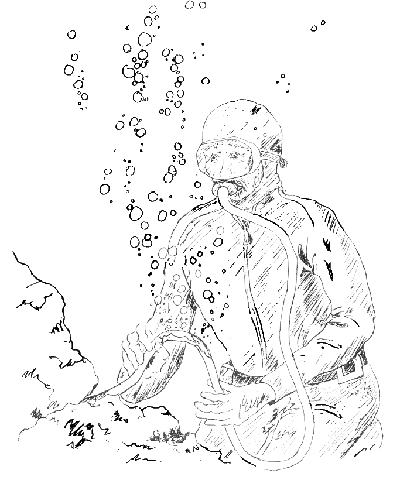
As soon as the boulder stopped moving, I lost all my air supply. That is when I realized the boulder had pinned my airline underneath. I was already winded from the exertion of shoving on the boulder. So quickly, my partner Rob and I put our shoulders against the boulder, propped it up, and I pulled my airline out just far enough to see that it was split almost in half. We set the boulder down to deal with this new problem, but the boulder still had my airline trapped from behind.
These kinds of emergencies unfold very quickly when they happen underwater. One moment everything is fine. And the next moment, your life is hanging in the balance of what you do! I had a similar event once where I got pinned to the bottom by a slab of bedrock that fell on top of me from the side of the river.
First I thought I might be able to get air by holding the airline together and compressing it in my hand. This did not work and I was really starting to hurt for air; the second stage of panic was just starting in. What is the second stage of panic? It’s when you are on the verge of a psychotic break!
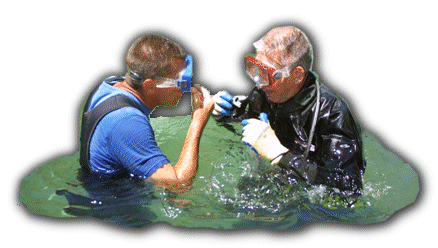
I looked to Rob and signaled him to cut my weight belts loose. We were working in fast water and I was using a second 25-pound belt to keep me in the hole. Instead, Rob handed me his regulator. Good idea, I had not even thought of that! So I took five long, deep breaths from Rob’s regulator. I would have taken more, but he had that “growing worried” look in his eye. The air was a big help, but far from satisfying; my body was demanding more.
However, the air did reduce my emotional state down to first stage panic—which is non-careful, frantic action. I signaled for Rob to release my belts again. The reason I was asking Rob to remove them is that a face mask prevents a diver from being able to see his or her own belt, so it is much easier for a second diver to release them.
I had one heavy belt which carried about 60-pounds of lead. And my second belt, with about 25-pounds, was connected to my airline. Rob released my heavy belt, not seeing that the airline was still connected to me.
This was all happening very fast. Rob was having panic problems of his own, because he was desperate for air while I was breathing off his regulator. When I handed him his regulator back, he was having trouble removing the water from it. So Rob cut his own weights loose and was gone with his own airline. With my heavy belt gone, I floated up into the current and reached the end of my airline (which was still stuck under the boulder), stuck about six feet from the surface. I immediately reached second stage panic; I was dying for air!
We use a boom on the front of our production dredges to help support the suction hose. A cable extends from the boom down to the suction hose. Looking up from my suspended position, I realized I was in reach of the boom cable. I had already frantically tried to find the quick-release buckle on my weight belt. But the belt had shifted around somehow; and with my heavy rubber gloves on, and in my panicked state of hurriedness, I could not find the buckle. I snapped into third stage panic, grabbed onto the cable and started pulling myself to the surface with everything I had. It was an inch at a time.
Finally, when my face was about one foot from the surface, the airline would no longer give. So close, but so far! In a last ditch adrenaline pull, I managed to get my mouth just above the water’s surface; I got a breath of air and water. I did it a few more times. Then I pulled my glove off the right hand, stuck it under my left armpit (no use in throwing away a good right-handed glove), and reached around to release the weight belt. It fell away and I was quickly on top of the dredge. Rob was up there hoping I was going to make it.
That one was close!
While I was catching my breath on the surface, without any delay, I asked Rob to go down and recover our belts and my air line. We repaired the line with some parts in our tool box, fueled up the dredge, and went right back down to finish the sample hole. I immediately went back down to finish the dive because I believe it is important to get back on the horse that throws you without delay, especially when you are feeling emotional trauma from a harrowing experience.
The pay-streak turned out to be a good, rich one!
I learned a few valuable safety lessons that day—the primary one being to not roll heavy rocks across my airline. This means knowing exactly where my airline is, along with everyone else’s in the hole, at the time when boulders are being moved.
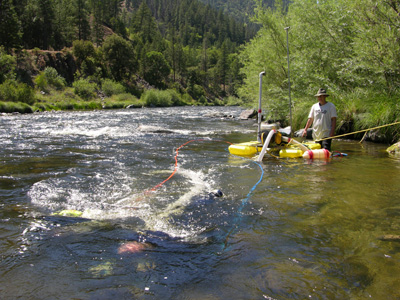 Here are a few other pointers we have learned about airlines from our experience: Stay aware of where your airline is. Do not allow it to get wrapped and tangled around objects, the suction hose, tangled with other divers’ airlines. Immediately untangle your airline if it does get caught up in any way that might prevent you from getting quickly to the surface or the stream bank in an emergency.
I am a true believer in extra heavy-duty, non-kinking airline. Not only is it non-kinking, but it is also a safety line. We run several wraps around the frame of our dredge before plugging our airlines into the air system. This way, if we need to pull ourselves up the airline in an emergency, we are not pulling directly against brass fittings.
Airlines generally float when being used under normal circumstances. This means you have to watch out that yours does not get tangled around the underside of your dredge. Airlines usually sink to the bottom when they are being used in conjunction with a hot water system, which pumps hot water down to the dredger through a second line that is fastened to the airline. In this case, you have to watch what the airline might get tangled around on the bottom of the river. And, spoken from hard-won experience, you have to be careful not to roll boulders on top of it. You also have to watch that you do not bury your air line with cobbles being thrown behind your dredge hole.
Avoid using longer airlines than are necessary. Ten or twenty feet longer than the suction hose is just fine. Longer airlines tend to get caught on more objects and set up more drag in the current.
When we are working in fast current, and the heavy drag on the airline is a problem, we pull our airlines up onto the back-side of the dredge hole and put a cobble on top to hold it there against the fast water. The cobble must be large enough to hold the airline down, but not so large that you cannot jerk it free in an emergency rush for the surface or stream bank.
We always untangle and unwrap our airlines on our way to the surface at the end of every dive. This gives us a free airline to coil up on deck at the end of the day, or to use again at the beginning of the next dive.
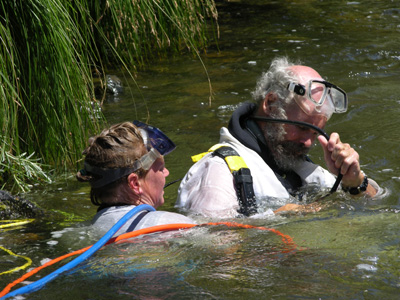 And we always replace or repair a damaged or defective airline without delay. Murphy (as in Murphy’s Law) lurks behind every corner! There are so many details to get right in a dredging operation of any size. There are many things which can possibly go wrong. We try to do everything right to avoid problems. But one thing we should never get lazy about is maintenance action on our air systems. If it even looks like it could be a problem, fix it now! And use quality repairs! Clamping copper tubing between two pieces of airline is not the way to do it!
All in all, I believe safety is a personal matter. This is all about having the right approach in the first place. Different people have different levels of ability doing different things. While one person may have trouble walking across the street without encountering grave personal danger, another person can stay out of personal danger while pursuing hang-gliding or sky-diving activities.
Still, it is true that the more adventuresome the activity, the less margin there is for error. And in adventuresome activities, when things do go wrong, it often turns into a life-threatening emergency. So it is very important to cross all your “T’s” and dot all your “I’s” when it comes to your air system.
- Here is where you can buy a sample of natural gold.
- Here is where you can buy Gold Prospecting Equipment & Supplies.
- Schedule of Events
- More About Suction Dredging
- More Gold Mining Adventures
- Books & Videos by this Author
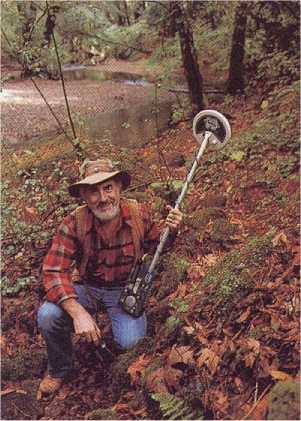 Some have said that the pen is mightier than the sword, and I am sure that on occasions this has truly been the case. Throughout the ages, man has used words to explain, convince and cajole his fellows about one thing or another. Advertising executives are no exception to the rule; and in their deft hands, a word can become downright dangerous or at least costly to some of us. I am, of course, speaking about the use of the language without explaining the meaning of the terms used.
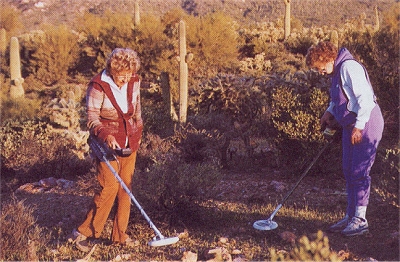 But with the advent of meter identification on many detectors, the user was no-longer locked into searching in a discriminate mode with limited depth. He or she could finally search in an all-metal mode if desired and check the meter for probability of target identification. This is where the definition of terms is becoming important and what I have been leading up to. I have recently heard it said that this or that detector is better for prospecting because it doesn’t discriminate, and many a treasure hunter has set aside his or her perfectly good multipurpose unit and bought another unit just for prospecting. I am not suggesting that these new units are not worthy of the task; but in many instances, it was costly and unnecessary to buy two units. First of all, the original unit should be able to cancel the ground effectively; and secondly, the owner must learn the skills necessary to operate it in a prospecting environment. Every company makes such units, and all are capable of finding the elusive gold nugget. The meter should work independently of the all-metal audio signal. That is, you should be able to operate the detector in the all-metal mode and hear every target that the loop passes over. The meter should respond to these targets in some sort of predictable fashion.


 Time, like the river in front of our camp, takes some interesting twists. Some years back, I sat on a boulder by a small creek with a fishing rod in one hand and a gold pan in the other. I can still remember wondering whether I looked as foolish as I felt. Was I actually going to put some dirt into the pan and try my hand at gold mining? — Or was I just going to go fishing?
 For me, building the equipment, and showing others how and where to use it, widened the pleasures found in our gold mining adventures. Since then, some part of every prospecting trip has been devoted to showing at least one beginner how it all works.
 Over the years, I have gravitated to this type of mining. There is nothing quite like the
  Over the next few days, Howie watched me don my wetsuit and head up the river. In the evening, he would watch me
  We found lots of
  That was last year. This year, Howie is an accomplished sniper. A few hours spent together in the water proved that. Somehow, between this year and last, Howie got thorough. At an evening get-together, Howie turned to me and quietly said “I really have gotten better at sniping.” I already knew that. The gold in his bottle said a lot.
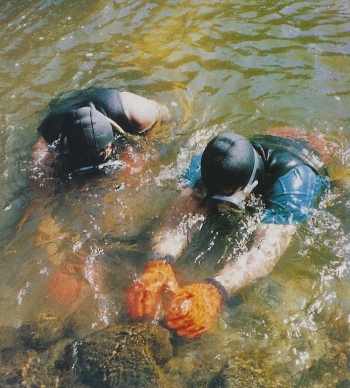

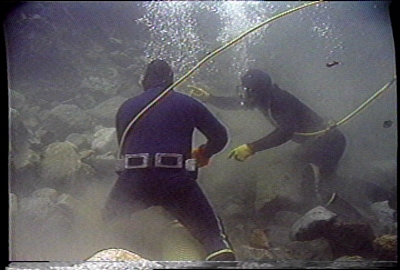
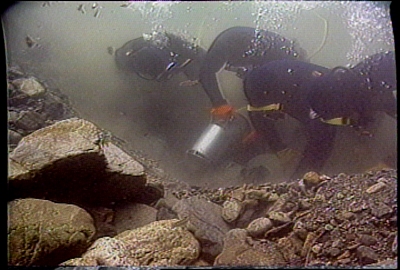 A trapped diver needs time. As long as he has air and has not sustained a fatal injury from the accident, he can wait it out underwater until he starves to death. Here follow some good ideas when you find yourself dredging around big rocks. Some of these ideas will buy you time. Some will help you avoid serious problems in the first place. Some will help get you out of trouble if you are having a bad day:
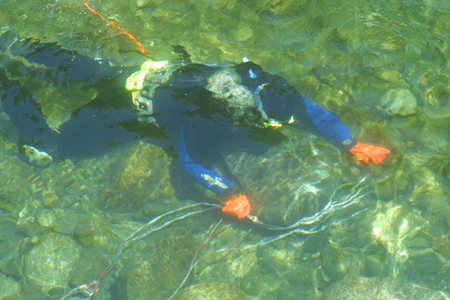 8) When
 No matter what the size or nature of our mining operations, we all have one common procedure to deal with—the
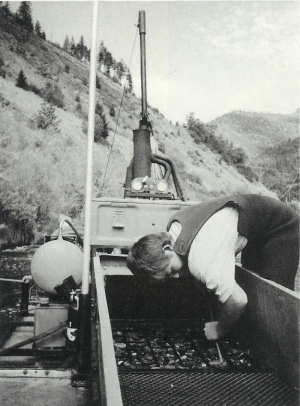
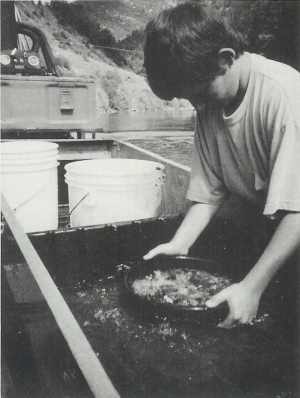
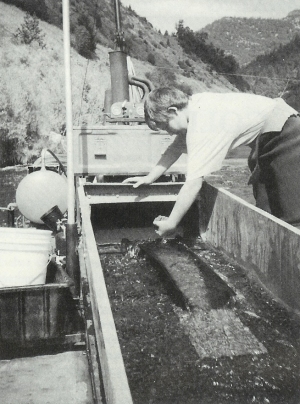
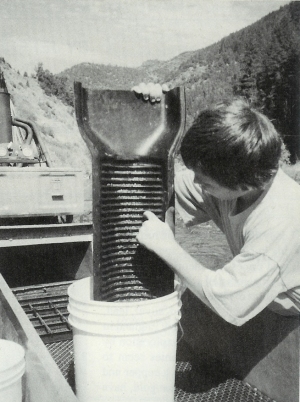
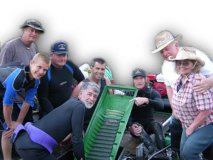
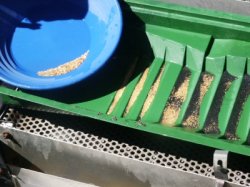 at the top of our lungs, patting each other on the back, and uncovering the gold as slowly as possible to prolong the incredible excitement of uncovering a real treasure.
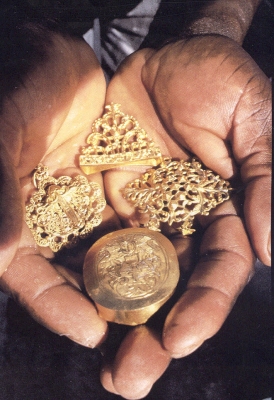
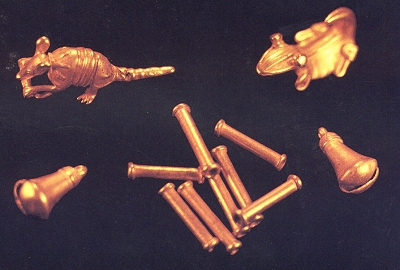 I saw gold and jade artifacts which had been created five, maybe six, centuries ago by people who had not even discovered the wheel! Artifacts so rich in detail, beauty and antiquity that they made my heart pound so hard that I could actually hear it. My body-heat came up enough to run sweat down my back. And my emotions energized to the maximum limit just at the thought of owning such things. No gold deposit ever affected me in this way!
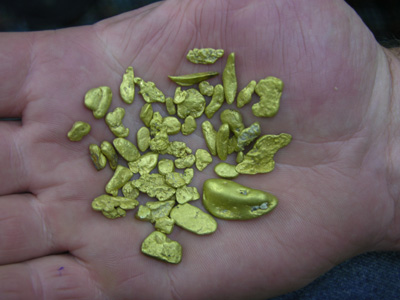 Several years ago, I decided to devote my time entirely to nugget hunting in
 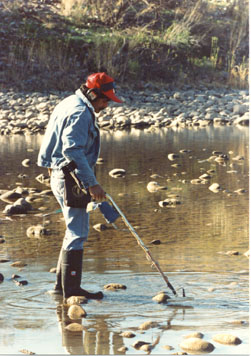 1) Seek out friends or other qualified individuals who can answer questions and show you how to use metal detectors designed for gold nugget hunting. Nugget detecting is a specialized field in itself.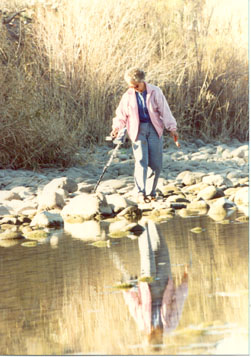
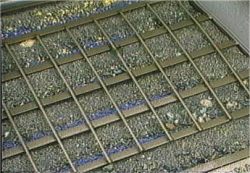 In gold mining, when we talk about gravity-recovery systems (as opposed to chemical-recovery systems), we are basically talking about the creation of a suspended medium. A suspended medium is a condition of fluidity where materials are allowed to separate because of their relative weights.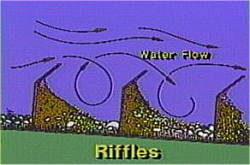
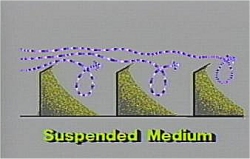
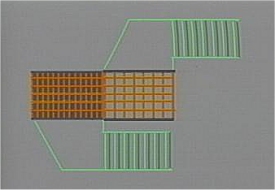 But the one mistake I often see is that the pre-sized materials are usually being directed into slower-moving recovery systems that are using deep riffles. As these riffles do not have enough water-flow directed over them to create the required suspended medium, they pack up and don’t work very well. What I mean by this is that most of the space behind a larger riffle can pack up. Sometimes it is only the surface area behind a big riffle that is working, while the rest of the area behind the riffle is packed solid.